Kirjojen hintavertailu – 12 859 819 kirjaa ja 27 kauppaa

Kirjailija

George Z. Voyiadjis

Kirjat ja teokset yhdessä paikassa: 13 kirjaa, julkaisuja vuosilta 2005–2025, suosituimpiin kuuluu Mechanics of Composite Materials with MATLAB. Vertaile teosten hintoja ja tarkista saatavuus suomalaisista kirjakaupoista.

Nimi esiintyy myös muodoissa: George Z Voyiadjis

13 kirjaa

Kirjojen julkaisuvuodet: 2005–2025.

Damage and Healing Mechanics of Materials

Damage and Healing Mechanics of Materials

George Z. Voyiadjis; Peter I. Kattan

Elsevier - Health Sciences Division
2025
sidottu
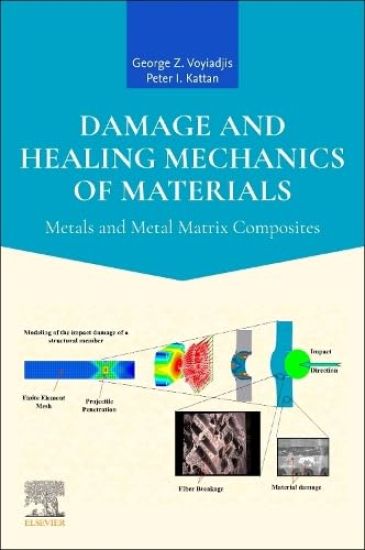
Damage and Healing Mechanics of Materials: Metals and Metal Matrix Composites covers the fundamentals of damage mechanics, with various damage models presented coupled with elastic and elasto-plastic behavior. Experimental investigations and the related data for damage in composite materials are included, as are computational modeling and simulation methods for investigating damage and healing in various materials and structures. Healing mechanics using both scalars and more general theory based on tensor notations are discussed, as are applications of damage mechanics. Undamageable materials, the generalized method of cells, phase field modeling, cyclic plasticity concepts, and more are all also covered.
Scalar Damage and Healing Mechanics

Scalar Damage and Healing Mechanics

George Z. Voyiadjis; Peter I. Kattan

ELSEVIER SCIENCE PUBLISHING CO INC
2022
nidottu
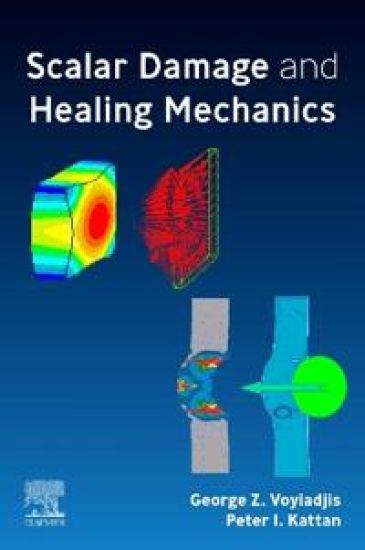
Scalar Damage and Healing Mechanics outlines the latest cutting-edge research in the field of scalar damage and healing mechanics, providing step-by-step insight on how to use scalar damage variables in various modeling scenarios. Additionally, the book discusses the latest advances in healing mechanics, covering the evolution of healing and damage, small damage and small healing, healing processes in series and in parallel, super healing, and the thermodynamics of damage and healing. Coupled systems, in which damage triggers self-healing as well as a decoupled system where healing occurs after damage is identified by external detection, are also discussed. Readers are additionally introduced to fundamental concepts such as effective stress, damage evolution, plane stress damage decomposition, and other damage processes that form the basis for a better understanding of the more advanced chapters.
Gradient-Enhanced Continuum Plasticity

Gradient-Enhanced Continuum Plasticity

George Z. Voyiadjis; Yooseob Song

Elsevier Science Publishing Co Inc
2020
nidottu
Gradient-Enhanced Continuum Plasticity provides an expansive review of gradient-enhanced continuum plasticity from the initial stage to current research trends in experimental, theoretical, computational and numerical investigations. Starting with an overview of continuum mechanics and classical plasticity, the book then delves into concise lessons covering basic principles and applications, such as outlining the use of the finite element method to solve problems with size effects, mesh sensitivity and high velocity impact loading. All major theories are explored, providing readers with a guide to understanding the various concepts of and differences between an array of gradient-enhanced continuum plasticity models.
Damage Mechanics

Damage Mechanics

George Z. Voyiadjis; Peter I. Kattan

CRC Press
2019
nidottu
Before a structure or component can be completed, before any analytical model can be constructed, and even before the design can be formulated, you must have a fundamental understanding of damage behavior in order to produce a safe and effective design. Damage Mechanics presents the underlying principles of continuum damage mechanics along with the latest research. The authors consider both isotropic and anisotropic theories as well as elastic and elasto-plastic damage analyses using a self-contained, easily understood approach. Beginning with the requisite mathematics, Damage Mechanics guides you from the very basic concepts to advanced mathematical and mechanical models. The first chapter offers a brief MAPLE® tutorial and supplies all of the MAPLE commands needed to solve the various problems throughout the chapter. The authors then discuss the basics of elasticity theory within the continuum mechanics framework, the simple case of isotropic damage, effective stress, damage evolution, kinematic description of damage, and the general case of anisotropic damage. The remainder of the book includes a review of plasticity theory, formulation of a coupled elasto-plastic damage theory developed by the authors, and the kinematics of damage for finite-strain elasto-plastic solids. From fundamental concepts to the latest advances, this book contains everything that you need to study the damage mechanics of metals and homogeneous materials.
Size Effects in Plasticity

Size Effects in Plasticity

George Z. Voyiadjis; Mohammadreza Yaghoobi

Academic Press Inc
2019
nidottu
Size Effects in Plasticity: From Macro to Nano provides concise explanations of all available methods in this area, from atomistic simulation, to non-local continuum models to capture size effects. It then compares their applicability to a wide range of research scenarios. This essential guide addresses basic principles, numerical issues and computation, applications and provides code which readers can use in their own modeling projects. Researchers in the fields of computational mechanics, materials science and engineering will find this to be an ideal resource when they address the size effects observed in deformation mechanisms and strengths of various materials.
Mechanics of Composite Materials with MATLAB

Mechanics of Composite Materials with MATLAB

George Z Voyiadjis; Peter I. Kattan

Springer-Verlag Berlin and Heidelberg GmbH Co. K
2014
nidottu
This is a book for people who love mechanics of composite materials and ? MATLAB . We will use the popular computer package MATLAB as a matrix calculator for doing the numerical calculations needed in mechanics of c- posite materials. In particular, the steps of the mechanical calculations will be emphasized in this book. The reader will not ?nd ready-made MATLAB programs for use as black boxes. Instead step-by-step solutions of composite material mechanics problems are examined in detail using MATLAB. All the problems in the book assume linear elastic behavior in structural mechanics. The emphasis is not on mass computations or programming, but rather on learning the composite material mechanics computations and understanding of the underlying concepts. The basic aspects of the mechanics of ?ber-reinforced composite materials are covered in this book. This includes lamina analysis in both the local and global coordinate systems, laminate analysis, and failure theories of a lamina.
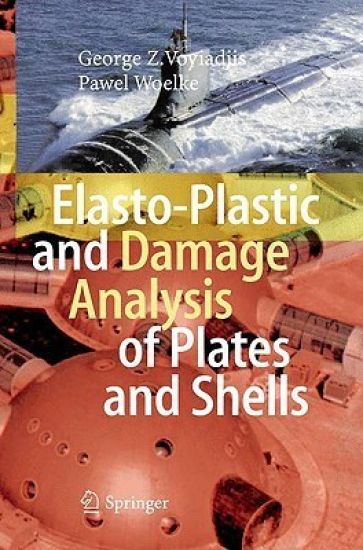
Elasto-Plastic and Damage Analysis of Plates and Shells

Elasto-Plastic and Damage Analysis of Plates and Shells

George Z Voyiadjis; Pawel Woelke

Springer-Verlag Berlin and Heidelberg GmbH Co. K
2010
nidottu
Shells and plates are critical structures in numerous engineering applications. Analysis and design of these structures is of continuing interest to the scienti c and engineering communities. Accurate and conservative assessments of the maximum load carried by a structure, as well as the equilibrium path in both the elastic and inelastic range, are of paramount importance to the engineer. The elastic behavior of shells has been closely investigated, mostly by means of the nite element method. Inelastic analysis however, especially accounting for damage effects, has received much less attention from researchers. In this book, we present a computational model for nite element, elasto-plastic, and damage analysis of thin and thick shells. Formulation of the model proceeds in several stages. First, we develop a theory for thick spherical shells, providing a set of shell constitutive equations. These equations incorporate the effects of transverse shear deformation, initial curvature, and radial stresses. The proposed shell equations are conveniently used in nite element analysis. 0 AsimpleC quadrilateral, doubly curved shell element is developed. By means of a quasi-conforming technique, shear and membrane locking are prevented. The element stiffness matrix is given explicitly, making the formulation computationally ef cient. We represent the elasto-plastic behavior of thick shells and plates by means of the non-layered model, using an Updated Lagrangian method to describe a small-strain geometric non-linearity. For the treatment of material non-linearities, we adopt an Iliushin’s yield function expressed in terms of stress resultants, with isotropic and kinematic hardening rules.
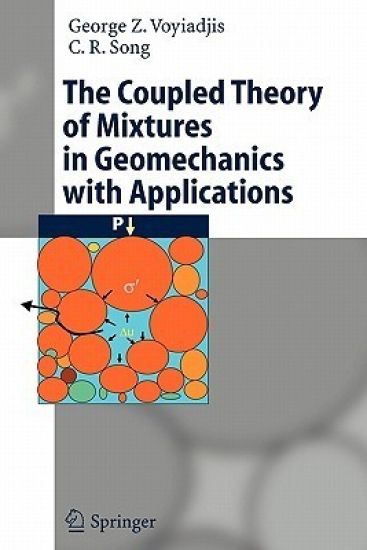
The Coupled Theory of Mixtures in Geomechanics with Applications

The Coupled Theory of Mixtures in Geomechanics with Applications

George Z Voyiadjis; C.R. Song

Springer-Verlag Berlin and Heidelberg GmbH Co. K
2010
nidottu
Geomaterials consist of a mixture of solid particles and void space that may be ?lled with ?uid and gas. The solid particles may be di?erent in sizes, shapes, and behavior; and the pore liquid may have various physical and chemical properties. Hence, physical, chemical or electrical interaction - tween the solid particles and pore ?uid or gas may take place. Therefore, the geomaterials in general must be considered a mixture or a multiphase material whose state is described by physical quantities in each phase. The stresses carried by the solid skeleton are typically termed “e?ective stress” while the stresses carried by the pore liquid are termed “pore pressure. ” The summation of the e?ective stress and pore pressure is termed “total stress” (Terzaghi, 1943). For a free drainage condition or completely undrained c- dition, the pore pressure change is zero or depends only on the initial stress condition; it does not depend on the skeleton response to external forces. Therefore, a single phase description of soil behavior is adequate. For an intermediate condition, however, some ?ow (pore pressure leak) may take place while the force is applied and the skeleton is under deformation. Due to the leak of pore pressure, the pore pressure changes with time, and the e?ective stress changes and the skeleton deforms with time accordingly. The solution of this intermediate condition, therefore, requires a multi-phase c- tinuum formulations that may address the interaction of solid skeleton and pore liquid interaction.
Elasto-Plastic and Damage Analysis of Plates and Shells

Elasto-Plastic and Damage Analysis of Plates and Shells

George Z Voyiadjis; Pawel Woelke

Springer-Verlag Berlin and Heidelberg GmbH Co. K
2008
sidottu
Shells and plates are critical structures in numerous engineering applications. Analysis and design of these structures is of continuing interest to the scienti c and engineering communities. Accurate and conservative assessments of the maximum load carried by a structure, as well as the equilibrium path in both the elastic and inelastic range, are of paramount importance to the engineer. The elastic behavior of shells has been closely investigated, mostly by means of the nite element method. Inelastic analysis however, especially accounting for damage effects, has received much less attention from researchers. In this book, we present a computational model for nite element, elasto-plastic, and damage analysis of thin and thick shells. Formulation of the model proceeds in several stages. First, we develop a theory for thick spherical shells, providing a set of shell constitutive equations. These equations incorporate the effects of transverse shear deformation, initial curvature, and radial stresses. The proposed shell equations are conveniently used in nite element analysis. 0 AsimpleC quadrilateral, doubly curved shell element is developed. By means of a quasi-conforming technique, shear and membrane locking are prevented. The element stiffness matrix is given explicitly, making the formulation computationally ef cient. We represent the elasto-plastic behavior of thick shells and plates by means of the non-layered model, using an Updated Lagrangian method to describe a small-strain geometric non-linearity. For the treatment of material non-linearities, we adopt an Iliushin’s yield function expressed in terms of stress resultants, with isotropic and kinematic hardening rules.
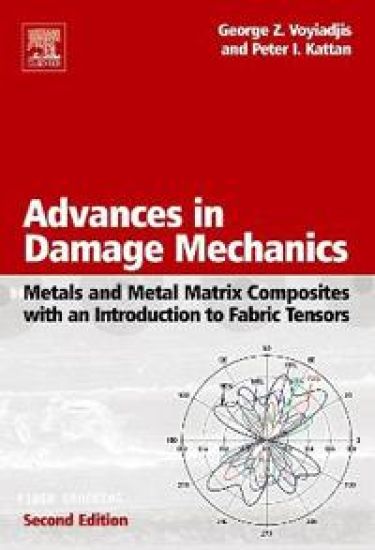
Advances in Damage Mechanics: Metals and Metal Matrix Composites With an Introduction to Fabric Tensors
The book presents the principles of Damage Mechanics along with the latest research findings. Both isotropic and anisotropic damage mechanisms are presented. Various damage models are presented coupled with elastic and elasto-plastic behavior. The book includes two chapters that are solely dedicated to experimental investigations conducted by the authors. In its last chapter, the book presents experimental data for damage in composite materials that appear in the literature for the first time.
The Coupled Theory of Mixtures in Geomechanics with Applications

The Coupled Theory of Mixtures in Geomechanics with Applications

George Z Voyiadjis; C.R. Song

Springer-Verlag Berlin and Heidelberg GmbH Co. K
2006
sidottu
Geomaterials consist of a mixture of solid particles and void space that may be ?lled with ?uid and gas. The solid particles may be di?erent in sizes, shapes, and behavior; and the pore liquid may have various physical and chemical properties. Hence, physical, chemical or electrical interaction - tween the solid particles and pore ?uid or gas may take place. Therefore, the geomaterials in general must be considered a mixture or a multiphase material whose state is described by physical quantities in each phase. The stresses carried by the solid skeleton are typically termed “e?ective stress” while the stresses carried by the pore liquid are termed “pore pressure. ” The summation of the e?ective stress and pore pressure is termed “total stress” (Terzaghi, 1943). For a free drainage condition or completely undrained c- dition, the pore pressure change is zero or depends only on the initial stress condition; it does not depend on the skeleton response to external forces. Therefore, a single phase description of soil behavior is adequate. For an intermediate condition, however, some ?ow (pore pressure leak) may take place while the force is applied and the skeleton is under deformation. Due to the leak of pore pressure, the pore pressure changes with time, and the e?ective stress changes and the skeleton deforms with time accordingly. The solution of this intermediate condition, therefore, requires a multi-phase c- tinuum formulations that may address the interaction of solid skeleton and pore liquid interaction.
Damage Mechanics

Damage Mechanics

George Z. Voyiadjis; Peter I. Kattan

CRC Press Inc
2005
sidottu
Before a structure or component can be completed, before any analytical model can be constructed, and even before the design can be formulated, you must have a fundamental understanding of damage behavior in order to produce a safe and effective design. Damage Mechanics presents the underlying principles of continuum damage mechanics along with the latest research. The authors consider both isotropic and anisotropic theories as well as elastic and elasto-plastic damage analyses using a self-contained, easily understood approach. Beginning with the requisite mathematics, Damage Mechanics guides you from the very basic concepts to advanced mathematical and mechanical models. The first chapter offers a brief MAPLE® tutorial and supplies all of the MAPLE commands needed to solve the various problems throughout the chapter. The authors then discuss the basics of elasticity theory within the continuum mechanics framework, the simple case of isotropic damage, effective stress, damage evolution, kinematic description of damage, and the general case of anisotropic damage. The remainder of the book includes a review of plasticity theory, formulation of a coupled elasto-plastic damage theory developed by the authors, and the kinematics of damage for finite-strain elasto-plastic solids. From fundamental concepts to the latest advances, this book contains everything that you need to study the damage mechanics of metals and homogeneous materials.
Mechanics of Composite Materials with MATLAB

Mechanics of Composite Materials with MATLAB

George Z Voyiadjis; Peter I. Kattan

Springer-Verlag Berlin and Heidelberg GmbH Co. K
2005
sidottu
This is a book for people who love mechanics of composite materials and ? MATLAB . We will use the popular computer package MATLAB as a matrix calculator for doing the numerical calculations needed in mechanics of c- posite materials. In particular, the steps of the mechanical calculations will be emphasized in this book. The reader will not ?nd ready-made MATLAB programs for use as black boxes. Instead step-by-step solutions of composite material mechanics problems are examined in detail using MATLAB. All the problems in the book assume linear elastic behavior in structural mechanics. The emphasis is not on mass computations or programming, but rather on learning the composite material mechanics computations and understanding of the underlying concepts. The basic aspects of the mechanics of ?ber-reinforced composite materials are covered in this book. This includes lamina analysis in both the local and global coordinate systems, laminate analysis, and failure theories of a lamina.