
Kirjailija
Georges Canguilhem
Kirjat ja teokset yhdessä paikassa: 12 kirjaa, julkaisuja vuosilta 1978–2025, suosituimpiin kuuluu Über Maurice Halbwachs. Vertaile teosten hintoja ja tarkista saatavuus suomalaisista kirjakaupoista.
12 kirjaa
Kirjojen julkaisuvuodet: 1978–2025.

Oeuvres Completes Tome VI: Ecrits Philosophiques Complementaires, Conferences Publiques, Lettres Choisies
Georges Canguilhem
Librarie Philosophique J. Vrin
2025
nidottu
Le tome VI et dernier des uvres completes de Georges Canguilhem reunit des ecrits retrouves et complementaires, jusqu'ici peu accessibles, et dont souvent l'existence meme restait ignoree. Y figurent des articles des annees 1920, le memoire de diplome d'etudes superieures sur la theorie de l'ordre et du progres chez Auguste Comte, et pres d'une dizaine de conferences publiques prononcees des annees 1940 aux annees 1970, qui temoignent de l'elaboration chez Canguilhem d'une veritable doctrine sur les normes. Ce tome VI contient egalement quelque trois cents lettres a une trentaine de correspondants de meme qu'un important ecrit, Philosophie, sa premiere synthese philosophique personnelle, au tournant des annees 1930, qui appelle a un reexamen des idees du jeune Canguilhem, notamment sur la psychologie et sur ses rapports avec la philosophie. Tout en reaffirmant des constats dans la pensee de Georges Canguilhem, ce dernier tome permet d'elargir et d'approfondir notre comprehension d'une uvre qui ne connut jamais de purgatoire, mais dont la phase de gestation fut longtemps largement ignoree.

Oeuvres Completes Tome III: Ecrits d'Histoire Des Sciences Et d'Epistemologie
Georges Canguilhem
Librarie Philosophique J. Vrin
2019
nidottu
Ce troisieme tome des OEuvres completes, reunit trois ouvrages. Le premier, Du developpement a l'evolution, est issu d'un seminaire de recherche de la fin des annees 1950: il offre l'exemple alors rare d'un travail d'equipe mene en commun jusqu'a la publication des resultats. Les deux autres ouvrages, les Etudes d'histoire et de philosophie des sciences et Ideologie et rationalite dans l'histoire des sciences de la vie, consacrerent la reputation d'historien des sciences et d'epistemologue de Georges Canguilhem. Cette nouvelle edition offre une mise en contexte de chacun de ces ecrits, en y adjoignant de nombreuses variantes et d'importants ajouts que Canguilhem avait destines a la publication mais qui, par accident, resterent inedits. Tous ces travaux confirment l'originalite de la mise en oeuvre par Canguilhem de l'epistemologie historique, qu'il definit comme la deontologie d'une histoire critique des sciences. Leur lecture corrobore la fecondite de ses contributions conceptuelles propres et le caractere penetrant de ses analyses.

Oeuvres Completes Tome IV: Resistance, Philosophie Biologique Et Histoire Des Sciences 1940-1965
Georges Canguilhem
Librarie Philosophique J. Vrin
2015
nidottu
Personnage majeur, par ses fonctions institutionnelles et son role philosophique, dans l'univers intellectuel de la France de l'apres-guerre, Georges Canguilhem exerca une influence profonde sur plusieurs generations d'universitaires et de professeurs de philosophie, ainsi que sur quelques grands noms des sciences humaines et sociales. Il fut longtemps connu pour ses travaux d'histoire des sciences et ses vues originales sur la technique. Il porta une attention plus particuliere aux sciences de la vie et aux pratiques de la medecine qu'il aborda avec une grande rigueur conceptuelle. Mais depuis une decennie, en meme temps que s'operait une reconnaissance internationale depassant largement le cercle de ceux qui l'ont connu, un interet nouveau pour la personne et l'oeuvre s'est developpe, qui deborde la seule specialite philosophique. Ce quatrieme tome des OEuvres completes reunit une centaine des ecrits de Georges Canguilhem rediges de 1940 a 1965. Plus d'une quarantaine en etaient jusqu'ici peu connus, voire pour bon nombre tout a fait inconnus. Ces ecrits de sa maturite, de 36 a 61 ans, permettent de jauger la profondeur et l'ampleur de son engagement dans la Resistance, de cerner les assises de son projet initial d'une philosophie biologique, et aussi de mieux saisir dans quelles conditions il en vint, assez tardivement, au milieu des annees 1950, a affirmer son identite d'historien des sciences et d'epistemologue. Le lecteur constatera que ce Canguilhem de la maturite n'aurait pas demerite aux yeux du jeune philosophe fougueux qu'avait revele le premier tome de ces OEuvres completes plusieurs de ses ecrits, des annees noires de l'Occupation jusqu'a celles de la guerre d'Algerie et des tumultueux debuts de la Ve Republique, s'averent aujourd'hui des modeles de prises de parole responsables, d'authentiques interventions philosophiques.
At the time of his death in 1995, Georges Canguilhem was a highly respected historian of science and medicine, whose engagement with questions of normality, the ideologization of scientific thought, and the conceptual history of biology had marked the thought of philosophers such as Michel Foucault, Louis Althusser, Pierre Bourdieu, and Gilles Deleuze. This collection of short, incisive, and highly accessible essays on the major concepts of modern medicine shows Canguilhem at the peak of his use of historical practice for philosophical engagement. In order to elaborate a philosophy of medicine, Canguilhem examines paramount problems such as the definition and uses of health, the decline of the Hippocratic understanding of nature, the experience of disease, the limits of psychology in medicine, myths and realities of therapeutic practices, the difference between cure and healing, the organism's self-regulation, and medical metaphors linking the organism to society. Writings on Medicine is at once an excellent introduction to Canguilhem's work and a forceful, insightful, and accessible engagement with elemental concepts in medicine. The book is certain to leave its imprint on anthropology, history, philosophy, bioethics, and the social studies of medicine.
At the time of his death in 1995, Georges Canguilhem was a highly respected historian of science and medicine, whose engagement with questions of normality, the ideologization of scientific thought, and the conceptual history of biology had marked the thought of philosophers such as Michel Foucault, Louis Althusser, Pierre Bourdieu, and Gilles Deleuze. This collection of short, incisive, and highly accessible essays on the major concepts of modern medicine shows Canguilhem at the peak of his use of historical practice for philosophical engagement. In order to elaborate a philosophy of medicine, Canguilhem examines paramount problems such as the definition and uses of health, the decline of the Hippocratic understanding of nature, the experience of disease, the limits of psychology in medicine, myths and realities of therapeutic practices, the difference between cure and healing, the organism's self-regulation, and medical metaphors linking the organism to society. Writings on Medicine is at once an excellent introduction to Canguilhem's work and a forceful, insightful, and accessible engagement with elemental concepts in medicine. The book is certain to leave its imprint on anthropology, history, philosophy, bioethics, and the social studies of medicine.
As the work of thinkers such as Michel Foucault, François Jacob, Louis Althusser, and Pierre Bourdieu demonstrates, Georges Canguilhem has exerted tremendous influence on the philosophy of science and French philosophy more generally. In Knowledge of Life, a book that spans twenty years of his essays and lectures, Canguilhem offers a series of epistemological histories that seek to establish and clarify the stakes, ambiguities, and emergence of philosophical and biological concepts that defined the rise of modern biology. How do transformations in biology and modern medicine shape conceptions of life? How do philosophical concepts feed into biological ideas and experimental practices, and how are they themselves transformed? How does knowledge "undo the experience of life so as to help man remake what life has made without him, in him or outside of him?" Knowledge of Life is Canguilhem's effort to explain how the movements of knowledge and life come to rest upon each other. Published at the dawn of the genetic revolution and still pertinent today, the book tackles the history of cell theory, the conceptual moves toward and away from mechanical understandings of the organism, the persistence of vitalism, and the nature of normality in science and its objects.
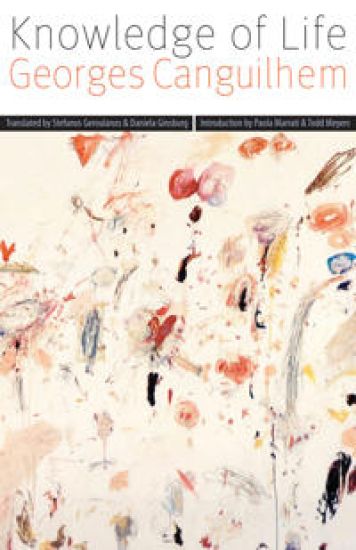
As the work of thinkers such as Michel Foucault, François Jacob, Louis Althusser, and Pierre Bourdieu demonstrates, Georges Canguilhem has exerted tremendous influence on the philosophy of science and French philosophy more generally. In Knowledge of Life, a book that spans twenty years of his essays and lectures, Canguilhem offers a series of epistemological histories that seek to establish and clarify the stakes, ambiguities, and emergence of philosophical and biological concepts that defined the rise of modern biology. How do transformations in biology and modern medicine shape conceptions of life? How do philosophical concepts feed into biological ideas and experimental practices, and how are they themselves transformed? How does knowledge "undo the experience of life so as to help man remake what life has made without him, in him or outside of him?" Knowledge of Life is Canguilhem's effort to explain how the movements of knowledge and life come to rest upon each other. Published at the dawn of the genetic revolution and still pertinent today, the book tackles the history of cell theory, the conceptual moves toward and away from mechanical understandings of the organism, the persistence of vitalism, and the nature of normality in science and its objects.
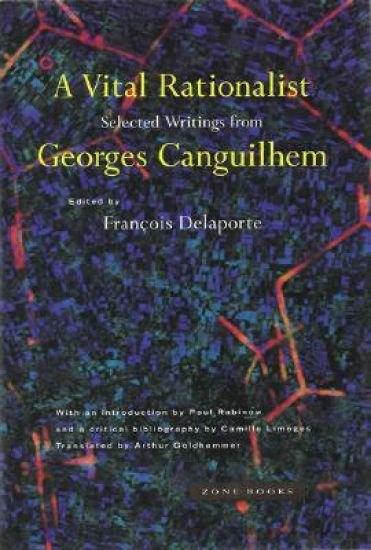
Georges Canguilhem is one of France's foremost historians of science. Trained as a medical doctor as well as a philosopher, he combined these practices to demonstrate to philosophers that there could be no epistemology without concrete study of the actual development of the sciences and to historians that there could be no worthwhile history of science without a philosophical understanding of the conceptual basis of all knowledge. A Vital Rationalist brings together for the first time a selection of Canguilhem's most important writings, including excerpts from previously unpublished manuscripts and a critical bibliography by Camille Limoges. Organized around the major themes and problems that have preoccupied Canguilhem throughout his intellectual career, the collection allows readers, whether familiar or unfamiliar with Canguilhem's work, access to a vast array of conceptual and concrete meditations on epistemology, methodology, science, and history. Canguilhem is a demanding writer, but Delaporte succeeds in marking out the main lines of his thought with unrivaled clarity; readers will come away with a heightened understanding of the complex and crucial place he holds in French intellectual history.

Etudes D'Histoire Et de Philosophie Des Sciences: Concernant Les Vivants Et La Vie
Georges Canguilhem
Librarie Philosophique J. Vrin
1994
nidottu
L'histoire des sciences est pour le moins, un tissu de jugements implicites sur la valeur des pensees et des decouvertes scientifiques... L'histoire des sciences est essentiellement une histoire jugee, jugee dans le detail de sa trame avec un sens qui doit etre sans cesse affine des valeurs de verite. L'histoire des sciences ne saurait etre implicitement une histoire enregistree. L'engagement rationaliste, p. 141.
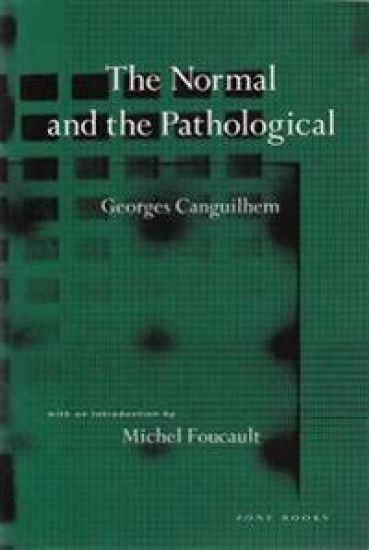
The Normal and the Pathological is one of the crucial contributions to the history of science in the last half century. It takes as its starting point the sudden appearance of biology as a science in the 19th-century and examines the conditions determining its particular makeup. Canguilhem analyzes the radically new way in which health and disease were defined in the early 19th-century, showing that the emerging categories of the normal and the pathological were far from being objective scientific concepts. He demonstrates how the epistemological foundations of modern biology and medicine were intertwined with political, economic, and technological imperatives. Canguilhem was an important influence on the thought of Michel Foucault and Louis Althusser, in particular for the way in which he poses the problem of how new domains of knowledge come into being and how they are part of a discontinuous history of human thought.
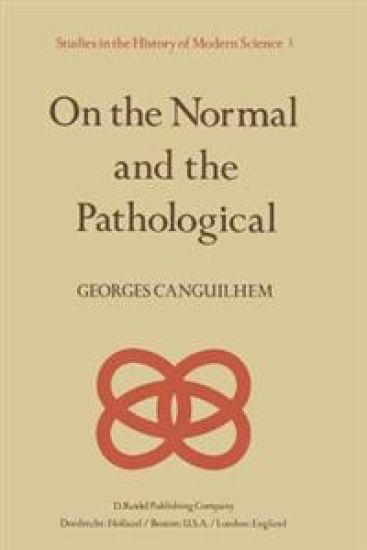
by MICHEL FOUCAULT Everyone knows that in France there are few logicians but many historians of science; and that in the 'philosophical establishment' - whether teaching or research oriented - they have occupied a considerable position. But do we know precisely the importance that, in the course of these past fifteen or twenty years, up to the very frontiers of the establishment, a 'work' like that of Georges Canguilhem can have had for those very people who were separ ated from, or challenged, the establishment? Yes, I know, there have been noisier theatres: psychoanalysis, Marxism, linguistics, ethnology. But let us not forget this fact which depends, as you will, on the sociology of French intellectual environments, the functioning of our university institutions or our system of cultural values: in all the political or scientific discussions of these strange sixty years past, the role of the 'philosophers' - I simply mean those who had received their university training in philosophy department- has been important: perhaps too important for the liking of certain people. And, directly or indirectly, all or almost all these philosophers have had to 'come to terms with' the teaching and books of Georges Canguilhem. From this, a paradox: this man, whose work is austere, intentionally and carefully limited to a particular domain in the history of science, which in any case does not pass for a spectacular discipline, has somehow found him self present in discussions where he himself took care never to figure.