Kirjojen hintavertailu – 12 903 725 kirjaa ja 27 kauppaa

Kirjailija

Georgios E. Stavroulakis

Kirjat ja teokset yhdessä paikassa: 8 kirjaa, julkaisuja vuosilta 1996–2024, suosituimpiin kuuluu Nonconvex Optimization in Mechanics. Vertaile teosten hintoja ja tarkista saatavuus suomalaisista kirjakaupoista.

8 kirjaa

Kirjojen julkaisuvuodet: 1996–2024.

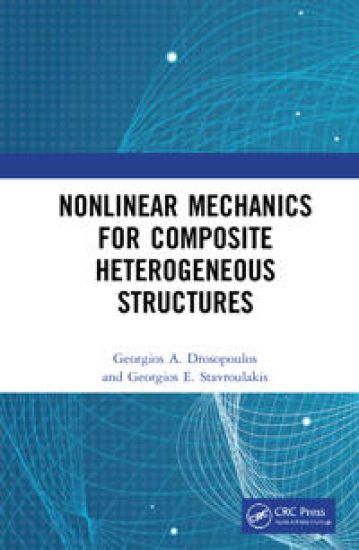
Nonlinear Mechanics for Composite Heterogeneous Structures

Nonlinear Mechanics for Composite Heterogeneous Structures

Georgios A. Drosopoulos; Georgios E. Stavroulakis

TAYLOR FRANCIS LTD
2024
nidottu
Nonlinear Mechanics for Composite Heterogeneous Structures applies both classical and multi-scale finite element analysis to the non-linear, failure response of composite structures. These traditional and modern computational approaches are holistically presented, providing insight into a range of non-linear structural analysis problems. The classical methods include geometric and material non-linearity, plasticity, damage and contact mechanics. The cutting-edge formulations include cohesive zone models, the Extended Finite Element Method (XFEM), multi-scale computational homogenization, localization of damage, neural networks and data-driven techniques. This presentation is simple but efficient, enabling the reader to understand, select and apply appropriate methods through programming code or commercial finite element software. The book is suitable for undergraduate studies as a final year textbook and for MSc and PhD studies in structural, mechanical, aerospace engineering and material science, among others. Professionals in these fields will also be strongly benefited. An accompanying website provides MATLAB codes for two-dimensional finite element problems with contact, multi-scale (FE2) and non-linear XFEM analysis, data-driven and machine learning simulations.
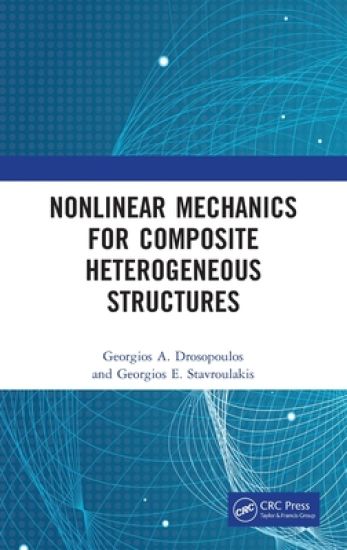
Nonlinear Mechanics for Composite Heterogeneous Structures

Nonlinear Mechanics for Composite Heterogeneous Structures

Georgios A. Drosopoulos; Georgios E. Stavroulakis

TAYLOR FRANCIS LTD
2022
sidottu
Nonlinear Mechanics for Composite Heterogeneous Structures applies both classical and multi-scale finite element analysis to the non-linear, failure response of composite structures. These traditional and modern computational approaches are holistically presented, providing insight into a range of non-linear structural analysis problems. The classical methods include geometric and material non-linearity, plasticity, damage and contact mechanics. The cutting-edge formulations include cohesive zone models, the Extended Finite Element Method (XFEM), multi-scale computational homogenization, localization of damage, neural networks and data-driven techniques. This presentation is simple but efficient, enabling the reader to understand, select and apply appropriate methods through programming code or commercial finite element software. The book is suitable for undergraduate studies as a final year textbook and for MSc and PhD studies in structural, mechanical, aerospace engineering and material science, among others. Professionals in these fields will also be strongly benefited. An accompanying website provides MATLAB codes for two-dimensional finite element problems with contact, multi-scale (FE2) and non-linear XFEM analysis, data-driven and machine learning simulations.
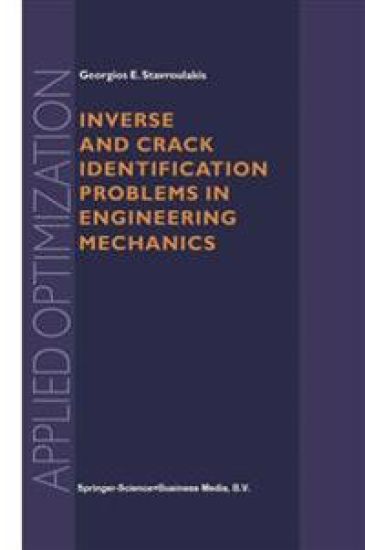
Inverse and Crack Identification Problems in Engineering Mechanics

Inverse and Crack Identification Problems in Engineering Mechanics

Georgios E. Stavroulakis

Springer-Verlag New York Inc.
2013
nidottu
Inverse and crack identification problems are of paramount importance for health monitoring and quality control purposes arising in critical applications in civil, aeronautical, nuclear, and general mechanical engineering. Mathematical modeling and the numerical study of these problems require high competence in computational mechanics and applied optimization. This is the first monograph which provides the reader with all the necessary information. Delicate computational mechanics modeling, including nonsmooth unilateral contact effects, is done using boundary element techniques, which have a certain advantage for the construction of parametrized mechanical models. Both elastostatic and harmonic or transient dynamic problems are considered. The inverse problems are formulated as output error minimization problems and they are theoretically studied as a bilevel optimization problem, also known as a mathematical problem with equilibrium constraints. Beyond classical numerical optimization, soft computing tools (neural networks and genetic algorithms) and filter algorithms are used for the numerical solution. The book provides all the required material for the mathematical and numerical modeling of crack identification testing procedures in statics and dynamics and includes several thoroughly discussed applications, for example, the impact-echo nondestructive evaluation technique. Audience: The book will be of interest to structural and mechanical engineers involved in nondestructive testing and quality control projects as well as to research engineers and applied mathematicians who study and solve related inverse problems. People working on applied optimization and soft computing will find interesting problems to apply to their methods and all necessary material to continue research in this field.
Nonconvex Optimization in Mechanics

Nonconvex Optimization in Mechanics

E.S. Mistakidis; Georgios E. Stavroulakis

Springer-Verlag New York Inc.
2013
nidottu
Nonconvexity and nonsmoothness arise in a large class of engineering applica­ tions. In many cases of practical importance the possibilities offered by opti­ mization with its algorithms and heuristics can substantially improve the per­ formance and the range of applicability of classical computational mechanics algorithms. For a class of problems this approach is the only one that really works. The present book presents in a comprehensive way the application of opti­ mization algorithms and heuristics in smooth and nonsmooth mechanics. The necessity of this approach is presented to the reader through simple, represen­ tative examples. As things become more complex, the necessary material from convex and nonconvex optimization and from mechanics are introduced in a self-contained way. Unilateral contact and friction problems, adhesive contact and delamination problems, nonconvex elastoplasticity, fractal friction laws, frames with semi­ rigid connections, are among the applications which are treated in details here. Working algorithms are given for each application and are demonstrated by means of representative examples. The interested reader will find helpful references to up-to-date scientific and technical literature so that to be able to work on research or engineering topics which are not directly covered here.
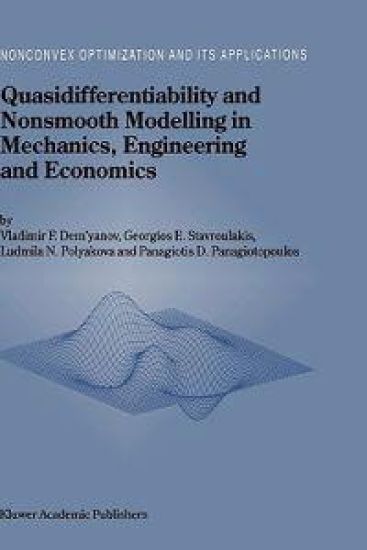
Quasidifferentiability and Nonsmooth Modelling in Mechanics, Engineering and Economics

Quasidifferentiability and Nonsmooth Modelling in Mechanics, Engineering and Economics

Vladimir F. Demyanov; Georgios E. Stavroulakis; L.N. Polyakova; P. D. Panagiotopoulos

Springer-Verlag New York Inc.
2013
nidottu
Nonsmooth energy functions govern phenomena which occur frequently in nature and in all areas of life. They constitute a fascinating subject in mathematics and permit the rational understanding of yet unsolved or partially solved questions in mechanics, engineering and economics. This is the first book to provide a complete and rigorous presentation of the quasidifferentiability approach to nonconvex, possibly nonsmooth, energy functions, of the derivation and study of the corresponding variational expressions in mechanics, engineering and economics, and of their numerical treatment. The new variational formulations derived are illustrated by many interesting numerical problems. The techniques presented will permit the reader to check any solution obtained by other heuristic techniques for nonconvex, nonsmooth energy problems. A civil, mechanical or aeronautical engineer can find in the book the only existing mathematically sound technique for the formulation and study of nonconvex, nonsmooth energy problems. Audience: The book will be of interest to pure and applied mathematicians, physicists, researchers in mechanics, civil, mechanical and aeronautical engineers, structural analysts and software developers. It is also suitable for graduate courses in nonlinear mechanics, nonsmooth analysis, applied optimization, control, calculus of variations and computational mechanics.
Inverse and Crack Identification Problems in Engineering Mechanics
Inverse and crack identification problems are of paramount importance for health monitoring and quality control purposes arising in critical applications in civil, aeronautical, nuclear, and general mechanical engineering. Mathematical modeling and the numerical study of these problems require high competence in computational mechanics and applied optimization. This is the first monograph which provides the reader with all the necessary information. Delicate computational mechanics modeling, including nonsmooth unilateral contact effects, is done using boundary element techniques, which have a certain advantage for the construction of parametrized mechanical models. Both elastostatic and harmonic or transient dynamic problems are considered. The inverse problems are formulated as output error minimization problems and they are theoretically studied as a bilevel optimization problem, also known as a mathematical problem with equilibrium constraints. Beyond classical numerical optimization, soft computing tools (neural networks and genetic algorithms) and filter algorithms are used for the numerical solution. The book provides all the required material for the mathematical and numerical modeling of crack identification testing procedures in statics and dynamics and includes several thoroughly discussed applications, for example, the impact-echo nondestructive evaluation technique. Audience: The book will be of interest to structural and mechanical engineers involved in nondestructive testing and quality control projects as well as to research engineers and applied mathematicians who study and solve related inverse problems. People working on applied optimization and soft computing will find interesting problems to apply to their methods and all necessary material to continue research in this field.
Nonconvex Optimization in Mechanics

Nonconvex Optimization in Mechanics

E.S. Mistakidis; Georgios E. Stavroulakis

Springer
1997
sidottu
Nonconvexity and nonsmoothness arise in a large class of engineering applica­ tions. In many cases of practical importance the possibilities offered by opti­ mization with its algorithms and heuristics can substantially improve the per­ formance and the range of applicability of classical computational mechanics algorithms. For a class of problems this approach is the only one that really works. The present book presents in a comprehensive way the application of opti­ mization algorithms and heuristics in smooth and nonsmooth mechanics. The necessity of this approach is presented to the reader through simple, represen­ tative examples. As things become more complex, the necessary material from convex and nonconvex optimization and from mechanics are introduced in a self-contained way. Unilateral contact and friction problems, adhesive contact and delamination problems, nonconvex elastoplasticity, fractal friction laws, frames with semi­ rigid connections, are among the applications which are treated in details here. Working algorithms are given for each application and are demonstrated by means of representative examples. The interested reader will find helpful references to up-to-date scientific and technical literature so that to be able to work on research or engineering topics which are not directly covered here.
Quasidifferentiability and Nonsmooth Modelling in Mechanics, Engineering and Economics

Quasidifferentiability and Nonsmooth Modelling in Mechanics, Engineering and Economics

Vladimir F. Demyanov; Georgios E. Stavroulakis; L.N. Polyakova; P. D. Panagiotopoulos

Springer
1996
sidottu
Nonsmooth energy functions govern phenomena which occur frequently in nature and in all areas of life. They constitute a fascinating subject in mathematics and permit the rational understanding of yet unsolved or partially solved questions in mechanics, engineering and economics. This is the first book to provide a complete and rigorous presentation of the quasidifferentiability approach to nonconvex, possibly nonsmooth, energy functions, of the derivation and study of the corresponding variational expressions in mechanics, engineering and economics, and of their numerical treatment. The new variational formulations derived are illustrated by many interesting numerical problems. The techniques presented will permit the reader to check any solution obtained by other heuristic techniques for nonconvex, nonsmooth energy problems. A civil, mechanical or aeronautical engineer can find in the book the only existing mathematically sound technique for the formulation and study of nonconvex, nonsmooth energy problems. Audience: The book will be of interest to pure and applied mathematicians, physicists, researchers in mechanics, civil, mechanical and aeronautical engineers, structural analysts and software developers. It is also suitable for graduate courses in nonlinear mechanics, nonsmooth analysis, applied optimization, control, calculus of variations and computational mechanics.