Kirjojen hintavertailu – 12 859 819 kirjaa ja 27 kauppaa

Kirjailija

Gerald Raunig

Kirjat ja teokset yhdessä paikassa: 8 kirjaa, julkaisuja vuosilta 2007–2024, suosituimpiin kuuluu Dividuum. Vertaile teosten hintoja ja tarkista saatavuus suomalaisista kirjakaupoista.

8 kirjaa

Kirjojen julkaisuvuodet: 2007–2024.

Making Multiplicity

Making Multiplicity

Gerald Raunig

JOHN WILEY AND SONS LTD
2024
nidottu
In this poetical-philosophical manifesto, Gerald Raunig develops a materialist philosophy of multiplicity. On the basis of seventeen conceptual innovations – from windy kin to transversal intellect, from dissemblage to technecologies, from minor masculinity to condividual revolution – Raunig reformulates the question of revolutionary multiplicity. Always staying close to contemporary social struggles and movements, the book starts from the contention that we are in need of a storm against identitarian domination, unification, and homogeneity. Raunig argues that the conceptual and political experimentations with multiplicity around and after 1968 did not go far enough: today, anti-identitarian, queer, and multitudinarian positions should not just be defended but pushed further, over unexpected folds and along the flattest surfaces, beyond previous approaches and previous historical experiences. Making Multiplicity is a conceptual manifesto which sets a new tone in poststructural philosophy. The seventeen concepts developed here form an assemblage that invites us to think, read, write, and indeed, make multiplicity.

Making Multiplicity

Making Multiplicity

Gerald Raunig

JOHN WILEY AND SONS LTD
2024
sidottu
In this poetical-philosophical manifesto, Gerald Raunig develops a materialist philosophy of multiplicity. On the basis of seventeen conceptual innovations – from windy kin to transversal intellect, from dissemblage to technecologies, from minor masculinity to condividual revolution – Raunig reformulates the question of revolutionary multiplicity. Always staying close to contemporary social struggles and movements, the book starts from the contention that we are in need of a storm against identitarian domination, unification, and homogeneity. Raunig argues that the conceptual and political experimentations with multiplicity around and after 1968 did not go far enough: today, anti-identitarian, queer, and multitudinarian positions should not just be defended but pushed further, over unexpected folds and along the flattest surfaces, beyond previous approaches and previous historical experiences. Making Multiplicity is a conceptual manifesto which sets a new tone in poststructural philosophy. The seventeen concepts developed here form an assemblage that invites us to think, read, write, and indeed, make multiplicity.

Dividuum

Dividuum

Gerald Raunig

Semiotext (E)
2016
pokkari
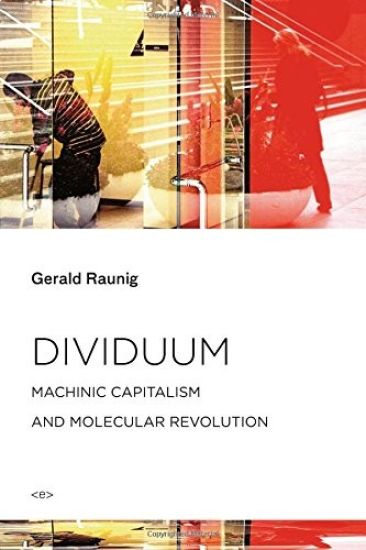
Raunig develops a philosophy of dividuality as a way of addressing contemporary modes of production and forms of life. The animal of the molecular revolution will be neither mole nor snake, but a drone-animal-thing that is solid, liquid, and a gas.-from DividuumAs the philosophical, religious, and historical systems that have produced the "individual" (and its counterparts, society and community) over the years continue to break down, the age of "dividuality" is now upon us. The roots of the concept of the "dividuum" can be traced back to Latin philosophy, when Cicero used the term to translate the "divisible" in the writings of Epicurus and Plato; later, medieval scholars utilized the term in theological discussions on the unity of the trinity. Grounding himself in the writings of the medieval bishop Gilbert de Poitiers and his extensive commentaries on Boethius, Gerald Raunig charts a genealogy of the concept and develops a philosophy of dividuality as a way of addressing contemporary modes of production and forms of life. Through its components of dispersion, subsistence, and similarity, dividuality becomes a hidden principle of obedience and conformity, but it also brings with it the potential to realize disobedience and noncompliant con/dividualities. Raunig's bad news is that dividuality is responsible for much of the intensified exploitation and enslavement taking place under contemporary machinic capitalism. Algorithms, derivatives, big data, and social media technology all contribute to the rampant expansion of divisive management strategies and desires for self-division. The good news, however, is that this same terrain of dividuality presents an opportunity for a new kind of resistance, one that can be realized in the form of con/division.
Factories of Knowledge, Industries of Creativity

Factories of Knowledge, Industries of Creativity

Gerald Raunig; Antonio Negri

Semiotext (E)
2013
pokkari
With the economy deindustrialized and the working class decentralized, a call for alternative horizons for resistance: the university and the art world. What was once the factory is now the university. As deindustrialization spreads and the working class is decentralized, new means of social resistance and political activism need to be sought in what may be the last places where they are possible: the university and the art world. Gerald Raunig's new book analyzes the potential that cognitive and creative labor has in these two arenas to resist the new regimes of domination imposed by cognitive capitalism. Drawing on Gilles Deleuze's concept of "modulation" as the market-driven imperative for the constant transformation and reinvention of subjectivity, in Factories of Knowledge, Industries of Creativity, Raunig charts alternative horizons for resistance. Looking at recent social struggles including the university strikes in Europe, the Spanish ! Democracia real YA! organization, the Arab revolts, and the Occupy movement, Raunig argues for a reassessment of the importance of cultural and knowledge production. The central role of the university, he asserts, is not as a factory of knowledge but as a place of creative disobedience.
A Thousand Machines

A Thousand Machines

Gerald Raunig

Semiotext (E)
2010
pokkari
The machine as a social movement of today's "precariat"—those whose labor and lives are precarious. In this "concise philosophy of the machine," Gerald Raunig provides a historical and critical backdrop to a concept proposed forty years ago by the French philosophers Félix Guattari and Gilles Deleuze: the machine, not as a technical device and apparatus, but as a social composition and concatenation. This conception of the machine as an arrangement of technical, bodily, intellectual, and social components subverts the opposition between man and machine, organism and mechanism, individual and community. Drawing from an unusual range of films, literature, and performance—from the role of bicycles in Flann O'Brien's fiction to Vittorio de Sica's Neorealist film The Bicycle Thieves, and from Karl Marx's "Fragment on Machines" to the deus ex machina of Greek drama—Raunig arrives at an enhanced conception of the machine as a social movement, finding its most apt and concrete manifestation in the Euromayday movement, which since 2001 has become a transnational activist and discursive practice focused upon the precarious nature of labor and lives.
Art and Revolution

Art and Revolution

Gerald Raunig

Semiotext (E)
2007
pokkari
A philosopher and art theorist extends the poststructuralist theory of revolution to the nexus of art and activism. Gerald Raunig has written an alternative art history of the "long twentieth century," from the Paris Commune of 1871 to the turbulent counter-globalization protests in Genoa in 2001. Meticulously moving from the Situationists and Sergei Eisenstein to Viennese Actionism and the PublixTheatreCaravan, Art and Revolution takes on the history of revolutionary transgressions and optimistically charts an emergence from its tales of tragic failure and unequivocal disaster. By eloquently applying Deleuze and Guattari's idea of the "machine," Raunig extends the poststructuralist theory of revolution through to the explosive nexus of art and activism. As hopeful as it is incisive, Art and Revolution encourages a new generation of artists and thinkers to refuse to participate in the tired prescriptions of marketplace and authority and instead create radical new methods of engagement. Raunig develops an indispensable, contemporary conception of political change-a conception that transcends the outmoded formulations of insurrection and resistance. Too much blood and ink has been shed for the art machines and the revolutionary machines to remain separate. Gerald Raunig is a philosopher and art theorist who lives in Vienna, Austria.