Kirjojen hintavertailu – 12 903 725 kirjaa ja 27 kauppaa
Kirjailija
Gerd Faltings
Kirjat ja teokset yhdessä paikassa: 4 kirjaa, julkaisuja vuosilta 1991–2013, suosituimpiin kuuluu Degeneration of Abelian Varieties. Vertaile teosten hintoja ja tarkista saatavuus suomalaisista kirjakaupoista.
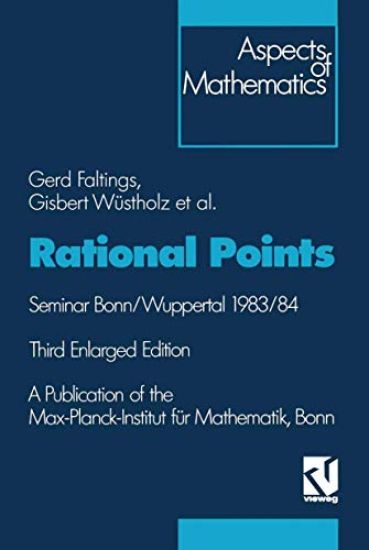
This book consists of the notes from the seminar Bonn/ Wuppertal 1983/ 84 on Arithmetic Geometry. It contains a proof for the Mordell conjecture and may be useful as an introduction to Arakelov's point of view in diophantine geometry. The third edition includes an appendix in which a detailed survey on the spectacular recent developments in arithmetic algebraic geometry is given. These beautiful new results have their roots in the material covered by this book.
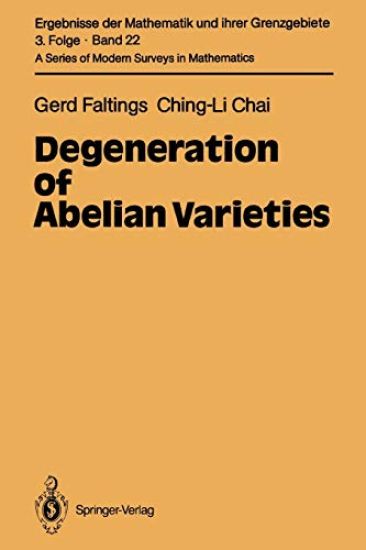
The topic of this book is the theory of degenerations of abelian varieties and its application to the construction of compactifications of moduli spaces of abelian varieties. These compactifications have applications to diophantine problems and, of course, are also interesting in their own right. Degenerations of abelian varieties are given by maps G - S with S an irre ducible scheme and G a group variety whose generic fibre is an abelian variety. One would like to classify such objects, which, however, is a hopeless task in this generality. But for more specialized families we can obtain more: The most important theorem about degenerations is the stable reduction theorem, which gives some evidence that for questions of compactification it suffices to study semi-abelian families; that is, we may assume that G is smooth and flat over S, with fibres which are connected extensions of abelian varieties by tori. A further assumption will be that the base S is normal, which makes such semi-abelian families extremely well behaved. In these circumstances, we give a rather com plete classification in case S is the spectrum of a complete local ring, and for general S we can still say a good deal. For a complete base S = Spec(R) (R a complete and normal local domain) the main result about degenerations says roughly that G is (in some sense) a quotient of a covering G by a group of periods.
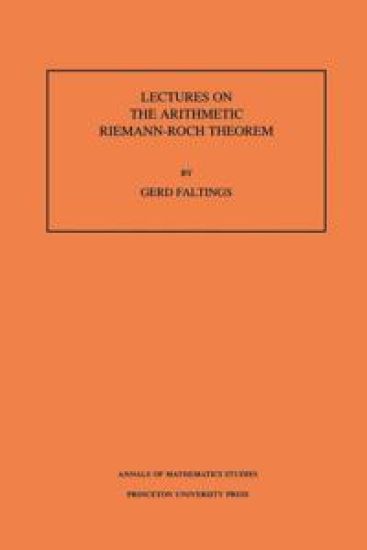
The arithmetic Riemann-Roch Theorem has been shown recently by Bismut-Gillet-Soul. The proof mixes algebra, arithmetic, and analysis. The purpose of this book is to give a concise introduction to the necessary techniques, and to present a simplified and extended version of the proof. It should enable mathematicians with a background in arithmetic algebraic geometry to understand some basic techniques in the rapidly evolving field of Arakelov-theory.
The topic of this book is the theory of degenerations of abelian varieties and its application to the construction of compactifications of moduli spaces of abelian varieties. These compactifications have applications to diophantine problems and, of course, are also interesting in their own right. Degenerations of abelian varieties are given by maps G - S with S an irre ducible scheme and G a group variety whose generic fibre is an abelian variety. One would like to classify such objects, which, however, is a hopeless task in this generality. But for more specialized families we can obtain more: The most important theorem about degenerations is the stable reduction theorem, which gives some evidence that for questions of compactification it suffices to study semi-abelian families; that is, we may assume that G is smooth and flat over S, with fibres which are connected extensions of abelian varieties by tori. A further assumption will be that the base S is normal, which makes such semi-abelian families extremely well behaved. In these circumstances, we give a rather com plete classification in case S is the spectrum of a complete local ring, and for general S we can still say a good deal. For a complete base S = Spec(R) (R a complete and normal local domain) the main result about degenerations says roughly that G is (in some sense) a quotient of a covering G by a group of periods.