Kirjojen hintavertailu – 12 903 725 kirjaa ja 27 kauppaa

Kirjailija

Gerd Gigerenzer

Kirjat ja teokset yhdessä paikassa: 30 kirjaa, julkaisuja vuosilta 1990–2025, suosituimpiin kuuluu Ecological Rationality. Vertaile teosten hintoja ja tarkista saatavuus suomalaisista kirjakaupoista.

30 kirjaa

Kirjojen julkaisuvuodet: 1990–2025.

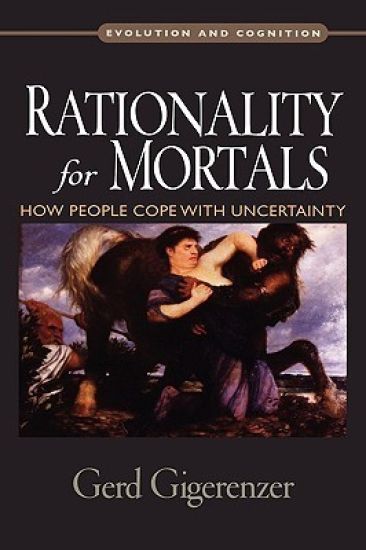
Rationality for Mortals

Rationality for Mortals

Gerd Gigerenzer

Oxford University Press Inc
2010
nidottu

Halvin toimitettuna 39,30 €

Gerd Gigerenzer's influential work examines the rationality of individuals not from the perspective of logic or probability, but from the point of view of adaptation to the real world of human behavior and interaction with the environment. Seen from this perspective, human behavior is more rational than it might otherwise appear. This work is extremely influential and has spawned an entire research program. This volume collects recent articles, looking at how people use "fast and frugal heuristics" to calculate probability and risk and make decisions. It includes the revised articles and newly written introduction that were first published in the hardcover edition. Its appeal is to a mixture of cognitive psychologists, philosophers, economists, and others who study decision making. "Gerd Gigerenzer has created new, pathbreaking ways of thinking about human rationality. His ideas build on one another and are best seen as part of a coherent whole that is when the nature of his arguments emerges most clearly."-- Leda Cosmides, University of California Santa Barbara
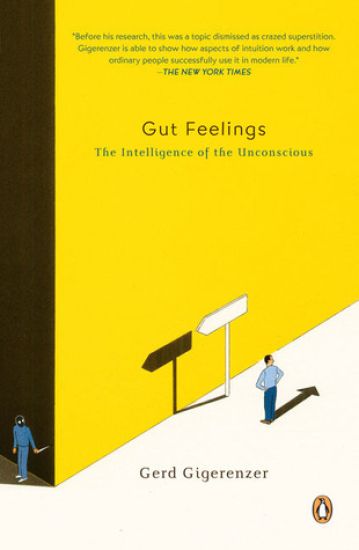
Gut Feelings

Gut Feelings

Gerd Gigerenzer

Penguin Books Ltd
2008
pokkari

Halvin toimitettuna 18,70 €

In Gut Feelings: Short Cuts to Better Decision Making psychologist and behavioural expert Gerd Gigerenzer reveals the secrets of fast and effective decision-making. A sportsman can catch a ball without calculating its speed or distance. A group of amateurs beat the experts at playing the stock market. A man falls for the right woman even though she's 'wrong' on paper. All these people succeeded by trusting their instincts - but how does it work? As Gerd Gigerenzer explains, in an uncertain world, sometimes we have to ignore too much information and rely on our brain's 'short cut', or heuristic. By explaining how intuition works and analyzing the techniques that people use to make good decisions - whether it's in personnel selection or heart surgery - Gigerenzer will show you the hidden intelligence of the unconscious mind. 'Fascinating and provocative ... Gut Feelings may well be the recipe for a simpler, less stressful life' Sunday Times 'Gigerenzer's writing is catchily optimistic and slyly funny ... Devilish' Steven Poole, Guardian 'The science behind the phenomenon cited in the bestseller Blink ... useful and clearly written' Business Week 'Gigerenzer is brilliant' Stephen Pinker Gerd Gigerenzer is Director of the Center for Adaptive Behavior and Cognition at the Max Planck Institute for Human Development in Berlin and former Professor of Psychology at the University of Chicago. He has published two academic books on heuristics, Simple Heuristics That Make Us Smart and Bounded Rationality: The Adaptive Toolbox as well as a popular science book, Reckoning with Risk.
Gut Feelings: The Intelligence of the Unconscious
Why is split second decision-making superior to deliberation? Gut Feelings delivers the science behind Malcolm Gladwell's Blink Reflection and reason are overrated, according to renowned psychologist Gerd Gigerenzer. Much better qualified to help us make decisions is the cognitive, emotional, and social repertoire we call intuition?a suite of gut feelings that have evolved over the millennia specifically for making decisions. ? Gladwell drew heavily on Gigerenzer's research. But Gigerenzer goes a step further by explaining just why our gut instincts are so often right. Intuition, it seems, is not some sort of mystical chemical reaction but a neurologically based behavior that evolved to ensure that we humans respond quickly when faced with a dilemma? (BusinessWeek).
Rationality for Mortals

Rationality for Mortals

Gerd Gigerenzer

Oxford University Press Inc
2008
sidottu
Gerd Gigerenzer's influential work examines the rationality of individuals not from the perspective of logic or probability, but from the point of view of adaptation to the real world of human behavior and interaction with the environment. Seen from this perspective, human behavior is more rational than it might otherwise appear. This work is extremely influential and has spawned an entire research program. This volume (which follows on a previous collection, Adaptive Thinking, also published by OUP) collects his most recent articles, looking at how people use "fast and frugal heuristics" to calculate probability and risk and make decisions. It includes a newly writen, substantial introduction, and the articles have been revised and updated where appropriate. This volume should appeal, like the earlier volumes, to a broad mixture of cognitive psychologists, philosophers, economists, and others who study decision making.
Bauchentscheidungen

Bauchentscheidungen

Gerd Gigerenzer

Bertelsmann Verlag
2007
sidottu
Nach "emotionaler Intelligenz" das große Thema der angewandten Psychologie: die "intuitive Intelligenz" "Das Herz hat seine Gründe, die der Verstand nicht kennt", schrieb Blaise Pascal bereits im 17. Jahrhundert. Die Wissenschaft scheute lange die "Herzensgründe" oder auch Bauchentscheidungen wie der Teufel das Weihwasser. Aber: Gute Entscheidungen basieren oft auf einer unbewussten Intelligenz, die sehr schnell operiert und gerade in komplexen Situationen faszinierend einfach ist, sicher im Erkennen des Wesentlichen und logischen Abwägungen weit überlegen. Das heutige Wissen über das Bauchgefühl revolutioniert unser Bild vom menschlichen Verstand. In einer komplizierten Welt lehren uns Entscheidungen "aus dem Bauch" die Lebenskunst, paradox formuliert, intuitiv zu wissen, was sich nicht zu wissen lohnt. Gerd Gigerenzer ist einer der renommiertesten deutschen Psychologen der Gegenwart. "Bauchentscheidungen ist ein faszinierendes, psychologisch geschickt konzipiertes und ungeheuer kluges Werk - ganz in der Tradition dessen, was vor über dreihundert Jahren der französische Mathematiker Blaise Pascal konstatierte: 'Das Herz hat seine Gründe, die der Verstand nicht kennt.'" KIELER NACHRICHTEN
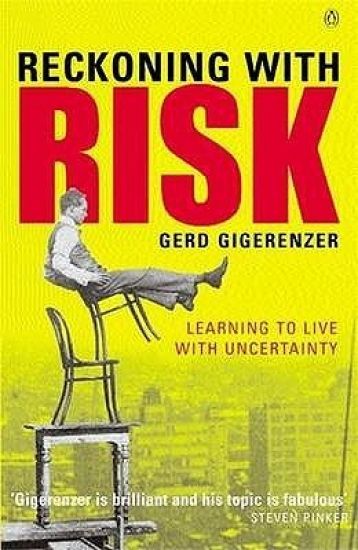
Reckoning with Risk

Reckoning with Risk

Gerd Gigerenzer

Penguin Books Ltd
2003
pokkari

Halvin toimitettuna 17,00 €

Gerd Gigerenzer's Reckoning with Risk: Learning to Live with Uncertainty illustrates how we can learn to make sense of statistics and turn ignorance into insight. However much we want certainty in our lives, it feels as if we live in an uncertain and dangerous world. But are we guilty of wildly exaggerating the chances of some unwanted event happening to us? Are we misled by our ignorance of the reality of risk? Far too many of us, argues Gerd Gigerenzer, are hampered by our own innumeracy, while statistics are often presented to us in highly confusing ways. With real world examples, such as the incidence of errors in tests for breast cancer or HIV, or in DNA fingerprinting, and the manipulation of statistics for evidence in court, he shows that our difficulty in thinking about numbers can easily be overcome. 'Indispensable ... The book will change the attentive reader's way of looking at the world' Sunday Telegraph 'An important book ... the reader is presented with a powerful set of tools for understanding statistics ... anyone who wants to take responsibility for their own medical choices should read it' New Scientist 'Gigerenzer makes clear thinking easier' Evening Standard 'More than ever, citizens need to know how to evaluate risk ... This book should be pressed into the palms of ' Independent Gerd Gigerenzer is Director of the Center for Adaptive Behavior and Cognition at the Max Planck Institute for Human Development in Berlin and former Professor of Psychology at the University of Chicago. He has published two academic books on heuristics, Simple Heuristics That Make Us Smart and Bounded Rationality: The Adaptive Toolbox as well as a popular science book, Gut Feelings: Short Cuts to Better Decision Making.
Adaptive Thinking

Adaptive Thinking

Gerd Gigerenzer

Oxford University Press Inc
2002
nidottu
Where do new ideas come from? What is social intelligence? Why do social scientists perform mindless statistical rituals? This vital book is about rethinking rationality as adaptive thinking: to understand how minds cope with their environments, both ecological and social. Gerd Gigerenzer proposes and illustrates a bold new research program that investigates the psychology of rationality, introducing the concepts of ecological, bounded, and social rationality. His path-breaking collection takes research on thinking, social intelligence, creativity, and decision-making out of an ethereal world where the laws of logic and probability reign, and places it into our real world of human behavior and interaction. Adaptive Thinking is accessibly written for general readers with an interest in psychology, cognitive science, economics, sociology, philosophy, artificial intelligence, and animal behavior. It also teaches a practical audience, such as physicians, AIDS counselors, and experts in criminal law, how to understand and communicate uncertainties and risks.
Simple Heuristics That Make Us Smart

Simple Heuristics That Make Us Smart

Gerd Gigerenzer; Peter M. Todd

Oxford University Press Inc
2000
nidottu
Simple Heuristics That Make Us Smart invites readers to embark on a new journey into a land of rationality that differs from the familiar territory of cognitive science and economics. Traditional views of rationality tend to see decision makers as possessing superhuman powers of reason, limitless knowledge, and all of eternity in which to ponder choices. To understand decisions in the real world, we need a different, more psychologically plausible notion of rationality, and this book provides it. It is about fast and frugal heuristics--simple rules for making decisions when time is pressing and deep thought an unaffordable luxury. These heuristics can enable both living organisms and artificial systems to make smart choices, classifications, and predictions by employing bounded rationality. But when and how can such fast and frugal heuristics work? Can judgments based simply on one good reason be as accurate as those based on many reasons? Could less knowledge even lead to systematically better predictions than more knowledge? Simple Heuristics explores these questions, developing computational models of heuristics and testing them through experiments and analyses. It shows how fast and frugal heuristics can produce adaptive decisions in situations as varied as choosing a mate, dividing resources among offspring, predicting high school drop out rates, and playing the stock market. As an interdisciplinary work that is both useful and engaging, this book will appeal to a wide audience. It is ideal for researchers in cognitive psychology, evolutionary psychology, and cognitive science, as well as in economics and artificial intelligence. It will also inspire anyone interested in simply making good decisions.
The Empire of Chance

The Empire of Chance

Gerd Gigerenzer; Zeno Swijtink; Theodore Porter; Lorraine Daston; John Beatty; Lorenz Kruger

Cambridge University Press
1990
pokkari

Halvin toimitettuna 34,90 €

The Empire of Chance tells how quantitative ideas of chance transformed the natural and social sciences, as well as daily life over the last three centuries. A continuous narrative connects the earliest application of probability and statistics in gambling and insurance to the most recent forays into law, medicine, polling and baseball. Separate chapters explore the theoretical and methodological impact in biology, physics and psychology. Themes recur - determinism, inference, causality, free will, evidence, the shifting meaning of probability - but in dramatically different disciplinary and historical contexts. In contrast to the literature on the mathematical development of probability and statistics, this book centres on how these technical innovations remade our conceptions of nature, mind and society. Written by an interdisciplinary team of historians and philosophers, this readable, lucid account keeps technical material to an absolute minimum. It is aimed not only at specialists in the history and philosophy of science, but also at the general reader and scholars in other disciplines.