Kirjojen hintavertailu – 12 859 818 kirjaa ja 27 kauppaa

Kirjailija

Gerhard Richter

Kirjat ja teokset yhdessä paikassa: 29 kirjaa, julkaisuja vuosilta 2002–2024, suosituimpiin kuuluu December. Vertaile teosten hintoja ja tarkista saatavuus suomalaisista kirjakaupoista.

29 kirjaa

Kirjojen julkaisuvuodet: 2002–2024.

Inheriting Walter Benjamin

Inheriting Walter Benjamin

Gerhard Richter

Bloomsbury Academic
2016
nidottu
Gerhard Richter examines, in the work of Walter Benjamin, one of the central problems of modernity: the question of how to receive an intellectual inheritance. Covering aspects of Benjamin’s complex relationship to the legacies of such writers as Kant, Nietzsche, Kafka, Heidegger, and Derrida, each chapter attends to a key concern in Benjamin’s writing, while reflecting on the challenges that this issue presents for the question of inheritability and transmissibility. Both reading Benjamin and watching himself reading Benjamin, Richter participates in the act of inheriting while also inquiring into the conditions of possibility for inheriting Benjamin’s corpus today.
Gerhard Richter: War Cut (English Edition)

Gerhard Richter: War Cut (English Edition)

Gerhard Richter

Distributed Art Publishers (DAP)
2013
sidottu
In 1988, Gerhard Richter created one of the most controversial and fascinating political painting-cycles of all time, with his Baader-Meinhof series. In 2002, he returned to the theme of media and political truth with his artist's book War Cut. For this project, Richter photographed 216 details of his abstract painting "No. 648-2" (1987), and, working on a long table over a period of several weeks, combined these 4 x 6-inch details with 165 texts on the Iraq war, published in the German Frankfurter Allgemeine Zeitung newspaper on the dates of the war's outbreak (March 20 and 21, 2003). "My method was to attach a number of texts to a number of images without having to think about whether something would be better positioned to the left or the right, above or below," Richter told an interviewer, for a New York Times feature on the publication. "I placed these images so that a connection develops in terms of colors, structures and other characteristics. . . . Some images match the cruelty and the madness described in the texts shockingly well. And others can even serve as illustrations when the texts speak of deserts and other landscapes." Originally published only in German in 2004, this long-awaited English version of this important artist's book presents Richter's powerful attempt to accommodate the extremity of war. For this edition, Richter applied the same process of text selection to The New York Times, using the same dates of the war's outbreak.
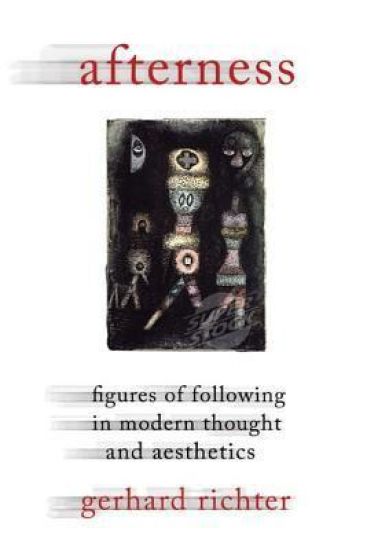
Afterness

Afterness

Gerhard Richter

Columbia University Press
2011
sidottu
Gerhard Richter's groundbreaking study argues that the concept of "afterness" is a key figure in the thought and aesthetics of modernity. It pursues questions such as: What does it mean for something to "follow" something else? Does that which follows mark a clear break with what came before it, or does it in fact tacitly perpetuate its predecessor as a consequence of its inevitable indebtedness to the terms and conditions of that from which it claims to have departed? Indeed, is not the very act of breaking with, and then following upon, a way of retroactively constructing and fortifying that from which the break that set the movement of following into motion had occurred? The book explores the concept and movement of afterness as a privileged yet uncanny category through close readings of writers such as Kant, Kafka, Heidegger, Bloch, Benjamin, Brecht, Adorno, Arendt, Lyotard, and Derrida. It shows how the vexed concepts of afterness, following, and coming after shed new light on a constellation of modern preoccupations, including personal and cultural memory, translation, photography, hope, and the historical and conceptual specificity of what has been termed "after Auschwitz." The study's various analyses--across a heterogeneous collection of modern writers and thinkers, diverse historical moments of articulation, and a range of media--conspire to illuminate Lyotard's apodictic statement that "after philosophy comes philosophy. But it has been altered by the 'after.'" As Richter's intricate study demonstrates, much hinges on our interpretation of the "after." After all, our most fundamental assumptions concerning modern aesthetic representation, conceptual discourse, community, subjectivity, and politics are at stake.

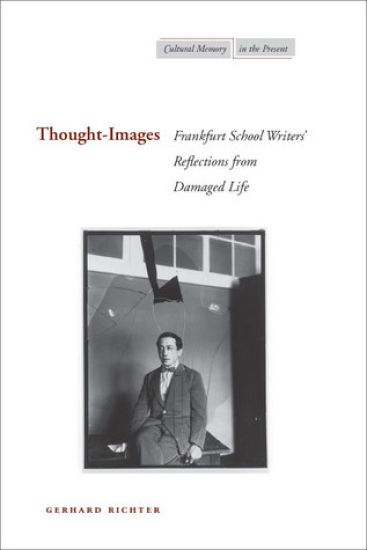
Thought-Images

Thought-Images

Gerhard Richter

Stanford University Press
2007
sidottu
In this book, Gerhard Richter explores the aesthetic and political ramifications of the literary genre of the Denkbild, or thought-image, as it was employed by four major German-Jewish writers and philosophers of the first half of the twentieth century: Theodor W. Adorno, Walter Benjamin, Ernst Bloch, and Siegfried Kracauer. The Denkbild is a poetic mode of writing, a brief snapshot-in-prose that stages the interrelation of literary, philosophical, political, and cultural insights. Richter's careful analysis of the linguistic characteristics of this mode of writing sheds new light on pivotal concerns of modernity, including the fractured cityscape, philosophical problems of modern music, the experience of exiled homelessness, and the disaster of Auschwitz. Thought-Images not only reorients our understanding of the Frankfurt School of Critical Theory in important ways but also establishes significant links between these writers and contemporary French thinkers such as Jacques Derrida.
Thought-Images

Thought-Images

Gerhard Richter

Stanford University Press
2007
pokkari
In this book, Gerhard Richter explores the aesthetic and political ramifications of the literary genre of the Denkbild, or thought-image, as it was employed by four major German-Jewish writers and philosophers of the first half of the twentieth century: Theodor W. Adorno, Walter Benjamin, Ernst Bloch, and Siegfried Kracauer. The Denkbild is a poetic mode of writing, a brief snapshot-in-prose that stages the interrelation of literary, philosophical, political, and cultural insights. Richter's careful analysis of the linguistic characteristics of this mode of writing sheds new light on pivotal concerns of modernity, including the fractured cityscape, philosophical problems of modern music, the experience of exiled homelessness, and the disaster of Auschwitz. Thought-Images not only reorients our understanding of the Frankfurt School of Critical Theory in important ways but also establishes significant links between these writers and contemporary French thinkers such as Jacques Derrida.
Oikonomia

Oikonomia

Gerhard Richter

De Gruyter
2005
sidottu
Der Begriff oikonomia, der griechischen Umgangssprache entnommen, wird in seinen verschiedenen Bedeutungen innerhalb der biblischen und theologischen Literatur umfassend untersucht. Erst durch den Kontext wird er zum theologischen Begriff. Oikonomia bezeichnet im Neuen Testament Gottes Walten, ohne ursprünglich mit einer Heilsvorstellung verbunden zu sein. Auch das innertrinitarische Verhältnis und das Ineinander der zwei Naturen in Christus können mit oikonomia bezeichnet werden. In der Ostkirche gehört oikonomia zu den Kennzeichen kirchlichen Handelns und findet Eingang in die byzantinische Rechtsauffassung. Ebenso hat sie Bedeutung für ökumenische Bemühungen.
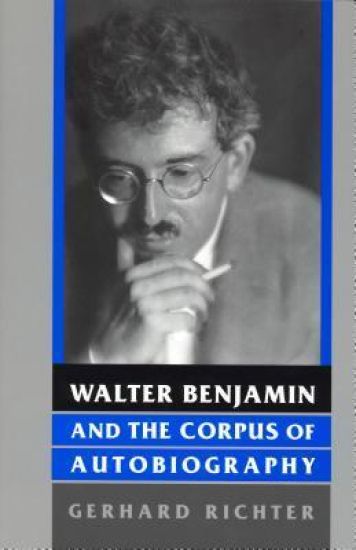
Walter Benjamin and the Corpus of Autobiography

Walter Benjamin and the Corpus of Autobiography

Gerhard Richter

Wayne State University Press
2002
nidottu
Walter Benjamin is considered one of the most significant writers and theorists in 20th-century Western culture. The author of this work shows that Benjamin's engagement with the political cannot be understood in terms of unified concepts, but rather should be understood from his language.