Kirjojen hintavertailu – 12 903 725 kirjaa ja 27 kauppaa

Kirjailija

Gerhard Rosenberger

Kirjat ja teokset yhdessä paikassa: 18 kirjaa, julkaisuja vuosilta 1997–2026, suosituimpiin kuuluu Algebra and Number Theory. Vertaile teosten hintoja ja tarkista saatavuus suomalaisista kirjakaupoista.

18 kirjaa

Kirjojen julkaisuvuodet: 1997–2026.

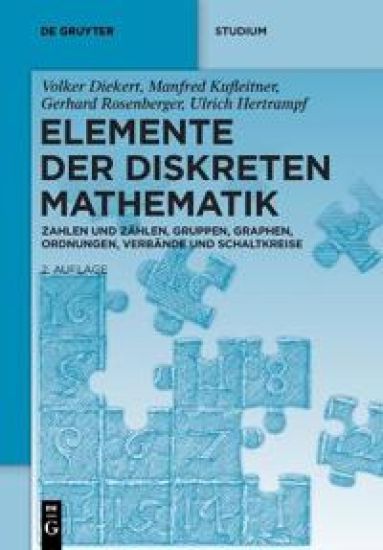
Elemente Der Diskreten Mathematik: Zahlen Und Zählen, Gruppen, Graphen, Ordnungen, Verbände Und Schaltkreise
Das Lehrbuch besch ftigt sich mit den Elementen der Diskreten Mathematik und deren algebraischen Grundlagen, die relevante Anwendungen in der Informatik haben. Notwendige Hilfsmittel werden behandelt, um moderne Entwicklungen im Informationszeitalter der KI kompetent zu beurteilen. Wichtige mathematischen Behauptungen werden vollst ndig bewiesen. bungsaufgaben jeweils mit vollst ndigen L sungen vertiefen das Erlernte.
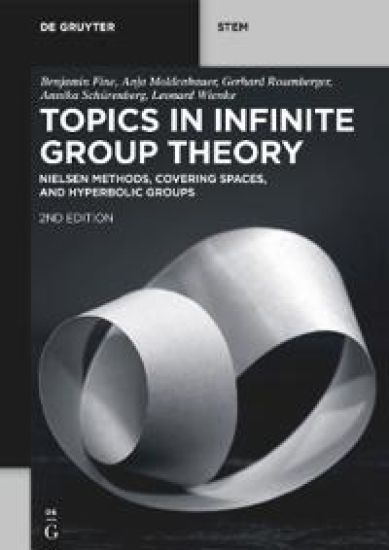
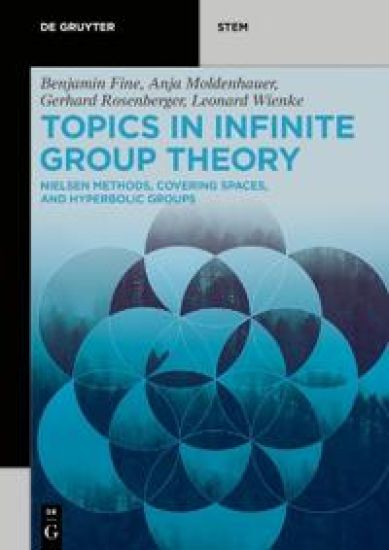
Topics in Infinite Group Theory

Topics in Infinite Group Theory

Benjamin Fine; Anja Moldenhauer; Gerhard Rosenberger; Annika Schürenberg; Leonard Wienke

De Gruyter
2024
isokokoinen pokkari
This book gives an advanced overview of several topics in infinite group theory. It can also be considered as a rigorous introduction to combinatorial and geometric group theory. The philosophy of the book is to describe the interaction between these two important parts of infinite group theory. In this line of thought, several theorems are proved multiple times with different methods either purely combinatorial or purely geometric while others are shown by a combination of arguments from both perspectives. The first part of the book deals with Nielsen methods and introduces the reader to results and examples that are helpful to understand the following parts. The second part focuses on covering spaces and fundamental groups, including covering space proofs of group theoretic results. The third part deals with the theory of hyperbolic groups. The subjects are illustrated and described by prominent examples and an outlook on solved and unsolved problems. New edition now includes the topics on universal free groups, quasiconvex subgroups and hyperbolic groups, and also Stallings foldings and subgroups of free groups. New results on groups of F-types are added.
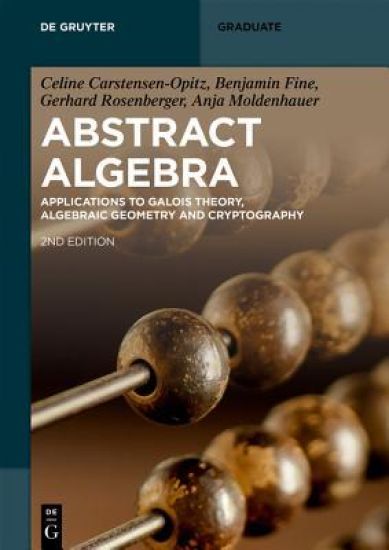
Abstract Algebra

Abstract Algebra

Gerhard Rosenberger; Annika Schürenberg; Leonard Wienke

De Gruyter
2024
isokokoinen pokkari
Abstract algebra is the study of algebraic structures like groups, rings and fields. This book provides an account of the theoretical foundations including applications to Galois Theory, Algebraic Geometry and Representation Theory. It implements the pedagogic approach to conveying algebra from the perspective of rings. The 3rd edition provides a revised and extended versions of the chapters on Algebraic Cryptography and Geometric Group Theory.
Elements of Discrete Mathematics

Elements of Discrete Mathematics

Volker Diekert; Manfred Kufleitner; Gerhard Rosenberger; Ulrich Hertrampf

De Gruyter
2023
isokokoinen pokkari
This book treats the elements of discrete mathematics that have important applications in computer science, thus providing the necessary tools for the reader to come to a competent mathematical judgement of modern developments in the age of information. Almost all assertions are shown with full proofs. Exercises are provided, with solutions presented in full detail.
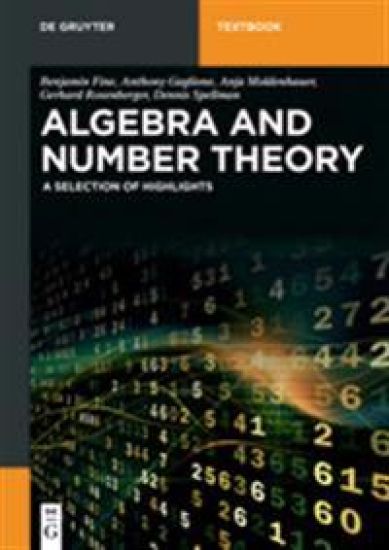
Algebra and Number Theory

Algebra and Number Theory

Benjamin Fine; Anja Moldenhauer; Gerhard Rosenberger; Annika Schürenberg; Leonard Wienke

De Gruyter
2023
isokokoinen pokkari
In the two-volume set ‘A Selection of Highlights’ we present basics of mathematics in an exciting and pedagogically sound way. This volume examines fundamental results in Algebra and Number Theory along with their proofs and their history. In the second edition, we include additional material on perfect and triangular numbers. We also added new sections on elementary Group Theory, p-adic numbers, and Galois Theory. A true collection of mathematical gems in Algebra and Number Theory, including the integers, the reals, and the complex numbers, along with beautiful results from Galois Theory and associated geometric applications. Valuable for lecturers, teachers and students of mathematics as well as for all who are mathematically interested.
Geometry and Discrete Mathematics

Geometry and Discrete Mathematics

Benjamin Fine; Anja Moldenhauer; Gerhard Rosenberger; Annika Schürenberg; Leonard Wienke

De Gruyter
2022
isokokoinen pokkari
In the two-volume set ‘A Selection of Highlights’ we present basics of mathematics in an exciting and pedagogically sound way. This volume examines many fundamental results in Geometry and Discrete Mathematics along with their proofs and their history. In the second edition we include a new chapter on Topological Data Analysis and enhanced the chapter on Graph Theory for solving further classical problems such as the Traveling Salesman Problem.
Topics in Infinite Group Theory

Topics in Infinite Group Theory

Benjamin Fine; Anja Moldenhauer; Gerhard Rosenberger; Leonard Wienke

De Gruyter
2021
isokokoinen pokkari
This book gives an advanced overview of several topics in infinite group theory. It can also be considered as a rigorous introduction to combinatorial and geometric group theory. The philosophy of the book is to describe the interaction between these two important parts of infinite group theory. In this line of thought, several theorems are proved multiple times with different methods either purely combinatorial or purely geometric while others are shown by a combination of arguments from both perspectives. The first part of the book deals with Nielsen methods and introduces the reader to results and examples that are helpful to understand the following parts. The second part focuses on covering spaces and fundamental groups, including covering space proofs of group theoretic results. The third part deals with the theory of hyperbolic groups. The subjects are illustrated and described by prominent examples and an outlook on solved and unsolved problems.
Abstract Algebra

Abstract Algebra

Celine Carstensen-Opitz; Benjamin Fine; Anja Moldenhauer; Gerhard Rosenberger

De Gruyter
2019
isokokoinen pokkari
A new approach to conveying abstract algebra, the area that studies algebraic structures, such as groups, rings, fields, modules, vector spaces, and algebras, that is essential to various scientific disciplines such as particle physics and cryptology. It provides a well written account of the theoretical foundations and it also includes a chapter on cryptography. End of chapter problems help readers with accessing the subjects.
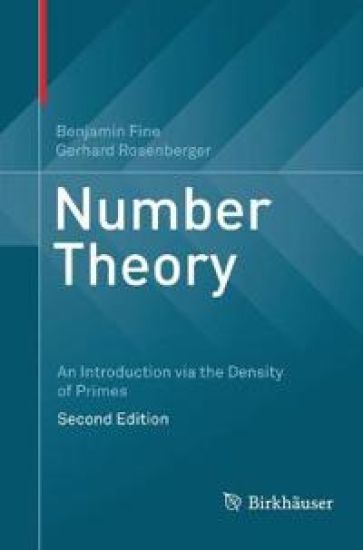
Number Theory

Number Theory

Benjamin Fine; Gerhard Rosenberger

Birkhauser Verlag AG
2018
nidottu
Now in its second edition, this textbook provides an introduction and overview of number theory based on the density and properties of the prime numbers. This unique approach offers both a firm background in the standard material of number theory, as well as an overview of the entire discipline. All of the essential topics are covered, such as the fundamental theorem of arithmetic, theory of congruences, quadratic reciprocity, arithmetic functions, and the distribution of primes. New in this edition are coverage of p-adic numbers, Hensel's lemma, multiple zeta-values, and elliptic curve methods in primality testing. Key topics and features include:A solid introduction to analytic number theory, including full proofs of Dirichlet's Theorem and the Prime Number TheoremConcise treatment of algebraic number theory, including a complete presentation of primes, prime factorizations in algebraic number fields, and unique factorization of idealsDiscussion of the AKS algorithm, which shows that primality testing is one of polynomial time, a topic not usually included in such textsMany interesting ancillary topics, such as primality testing and cryptography, Fermat and Mersenne numbers, and Carmichael numbersThe user-friendly style, historical context, and wide range of exercises that range from simple to quite difficult (with solutions and hints provided for select exercises) make Number Theory: An Introduction via the Density of Primes ideal for both self-study and classroom use. Intended for upper level undergraduates and beginning graduates, the only prerequisites are a basic knowledge of calculus, multivariable calculus, and some linear algebra. All necessary concepts from abstract algebra and complex analysis are introduced where needed.
Algebra and Number Theory

Algebra and Number Theory

Benjamin Fine; Anthony Gaglione; Anja Moldenhauer; Gerhard Rosenberger; Dennis Spellman

De Gruyter
2017
isokokoinen pokkari
This two-volume set collects and presents some fundamentals of mathematics in an entertaining and performing manner. The present volume examines many of the most important basic results in algebra and number theory, along with their proofs, and also their history. Contents The natural, integral and rational numbers Division and factorization in the integers Modular arithmetic Exceptional numbers Pythagorean triples and sums of squares Polynomials and unique factorization Field extensions and splitting fields Permutations and symmetric polynomials Real numbers The complex numbers, the Fundamental Theorem of Algebra and polynomial equations Quadratic number fields and Pell’s equation Transcendental numbers and the numbers e and p Compass and straightedge constructions and the classical problems Euclidean vector spaces
Discrete Algebraic Methods

Discrete Algebraic Methods

Volker Diekert; Manfred Kufleitner; Gerhard Rosenberger; Ulrich Hertrampf

De Gruyter
2016
isokokoinen pokkari
The idea behind this book is to provide the mathematical foundations for assessing modern developments in the Information Age. It deepens and complements the basic concepts, but it also considers instructive and more advanced topics. The treatise starts with a general chapter on algebraic structures; this part provides all the necessary knowledge for the rest of the book. The next chapter gives a concise overview of cryptography. Chapter 3 on number theoretic algorithms is important for developping cryptosystems, Chapter 4 presents the deterministic primality test of Agrawal, Kayal, and Saxena. The account to elliptic curves again focuses on cryptographic applications and algorithms. With combinatorics on words and automata theory, the reader is introduced to two areas of theoretical computer science where semigroups play a fundamental role. The last chapter is devoted to combinatorial group theory and its connections to automata. Contents:Algebraic structuresCryptographyNumber theoretic algorithmsPolynomial time primality testElliptic curvesCombinatorics on wordsAutomataDiscrete infinite groups
A Course in Mathematical Cryptography

A Course in Mathematical Cryptography

Gilbert Baumslag; Benjamin Fine; Martin Kreuzer; Gerhard Rosenberger

De Gruyter
2015
isokokoinen pokkari
Cryptography has become essential as bank transactions, credit card infor-mation, contracts, and sensitive medical information are sent through inse-cure channels. This book is concerned with the mathematical, especially algebraic, aspects of cryptography. It grew out of many courses presented by the authors over the past twenty years at various universities and covers a wide range of topics in mathematical cryptography. It is primarily geared towards graduate students and advanced undergraduates in mathematics and computer science, but may also be of interest to researchers in the area. Besides the classical methods of symmetric and private key encryption, the book treats the mathematics of cryptographic protocols and several unique topics such as Group-Based Cryptography Gröbner Basis Methods in Cryptography Lattice-Based Cryptography
The Elementary Theory of Groups

The Elementary Theory of Groups

Benjamin Fine; Anthony Gaglione; Alexei Myasnikov; Gerhard Rosenberger; Dennis Spellman

De Gruyter
2014
sidottu
After being an open question for sixty years the Tarski conjecture was answered in the affirmative by Olga Kharlampovich and Alexei Myasnikov and independently by Zlil Sela. Both proofs involve long and complicated applications of algebraic geometry over free groups as well as an extension of methods to solve equations in free groups originally developed by Razborov. This book is an examination of the material on the general elementary theory of groups that is necessary to begin to understand the proofs. This material includes a complete exposition of the theory of fully residually free groups or limit groups as well a complete description of the algebraic geometry of free groups. Also included are introductory material on combinatorial and geometric group theory and first-order logic. There is then a short outline of the proof of the Tarski conjectures in the manner of Kharlampovich and Myasnikov.
Introduction to Abstract Algebra

Introduction to Abstract Algebra

Benjamin Fine; Anthony M. Gaglione; Gerhard Rosenberger

Johns Hopkins University Press
2014
sidottu
Introduction to Abstract Algebra presents a breakthrough approach to teaching one of math's most intimidating concepts. Avoiding the pitfalls common in the standard textbooks, Benjamin Fine, Anthony M. Gaglione, and Gerhard Rosenberger set a pace that allows beginner-level students to follow the progression from familiar topics such as rings, numbers, and groups to more difficult concepts. Classroom tested and revised until students achieved consistent, positive results, this textbook is designed to keep students focused as they learn complex topics. Fine, Gaglione, and Rosenberger's clear explanations prevent students from getting lost as they move deeper and deeper into areas such as abelian groups, fields, and Galois theory. This textbook will help bring about the day when abstract algebra no longer creates intense anxiety but instead challenges students to fully grasp the meaning and power of the approach. Topics covered include: rings; integral domains; the fundamental theorem of arithmetic; fields; groups; Lagrange's theorem; isomorphism theorems for groups; fundamental theorem of finite abelian groups; the simplicity of A n for n=5; Sylow theorems; the Jordan-Holder theorem; Ring isomorphism theorems; Euclidean domains; principal ideal domains; the fundamental theorem of algebra; Vector spaces; Algebras; field extensions: algebraic and transcendental; the fundamental theorem of Galois theory; and the insolvability of the quintic.
Diskrete Algebraische Methoden: Arithmetik, Kryptographie, Automaten Und Gruppen

Diskrete Algebraische Methoden: Arithmetik, Kryptographie, Automaten Und Gruppen

Volker Diekert; Manfred Kufleitner; Gerhard Rosenberger

De Gruyter
2013
sidottu
Bei diskreten algebraischen Methoden handelt es sich um ein zukunftsweisendes Gebiet, dessen Grundlagen weiter an Bedeutung gewinnen werden. Die Grundidee des vorliegenden Lehrbuchs ist, wesentliche Elemente der diskreten Mathematik zu vermitteln, um die modernen Entwicklungen im Informationszeitalter kompetent mathematisch beurteilen zu k nnen. Es beginnt mit einem allgemeinen Kapitel ber algebraische Strukturen, welches die Grundlage f r das gesamte Buch bereitstellt. Das folgende Kapitel vermittelt Grundkenntnisse in Kryptographie. Kapitel 3 ber zahlentheoretische Algorithmen ist wichtig f r das Erzeugen von Kryptosystemen, f r die beispielsweise gro e "zuf llige" Primzahlen ben tigt werden. In Kapitel 4 ber Primzahlerkennung in Polynomialzeit stellen die Autoren den deterministischen Polynomialzeittest von Agrawal, Kayal und Saxena vor. Im folgenden Kapitel ber elliptische Kurven stehen wieder die zahlentheoretischen und kryptographischen Anwendungen im Vordergrund. Mit den beiden Kapiteln "Kombinatorik auf W rtern" und "Automatentheorie" begibt sich der Leser in das Teilgebiet der theoretischen Informatik, in dem die Halbgruppentheorie eine zentrale Rolle spielt. Das letzte Kapitel widmet sich diskreten unendlichen Gruppen. Das Buch erg nzt und vertieft Grundlagen und zeigt m gliche Anwendungen auf. Es werden aber auch Themen behandelt, die ber den Standardstoff hinaus gehen. Einen hohen Stellenwert nehmen Aufgaben und L sungen ein. F r alle wichtigen Aussagen geben die Autoren vollst ndige Beweise an. Am Ende eines jeden Kapitels sind kurze Kapitelzusammenfassungen als Lern- und Merkhilfe hinzugef gt. Das Buch wendet sich an Masterstudierende der Mathematik und Informatik mit fortgeschrittenen Kenntnissen in Mathematik. Die behandelten Grundlagen sind keine blo en Aneinanderreihungen von Definitionen und elementaren Zusammenh ngen. Das Buch vermittelt ein tieferes Verst ndnis f r die behandelten mathematischen Zusammenh nge und stellt Wissen, Techniken und Denkweisen vor, welche den Leser in die Lage versetzen, selbstst ndig mathematische Probleme zu l sen.
Elemente Der Diskreten Mathematik: Zahlen Und Zählen, Graphen Und Verbände

Elemente Der Diskreten Mathematik: Zahlen Und Zählen, Graphen Und Verbände

Volker Diekert; Manfred Kufleitner; Gerhard Rosenberger

De Gruyter
2013
sidottu
Die Grundidee des vorliegenden Lehrbuchs ist, wesentliche Elemente der diskreten Mathematik zu vermitteln, um die modernen Entwicklungen im Informationszeitalter kompetent mathematisch beurteilen zu k nnen. Hierzu geh ren das Verst ndnis von Graphen, das Rechnen mit gro en Zahlen und das Rechnen modulo n. Die Autoren beginnen mit einer Darstellung der elementaren Zahlentheorie. Insbesondere wird die Verschl sselung mit dem RSA-Verfahren erl utert. Danach werden Absch tzungen behandelt, die unerl sslich sind, wenn man Objekte z hlen oder Laufzeiten wichtiger Algorithmen verstehen m chte. Diverse in der Praxis vollkommen zuverl ssige Algorithmen nehmen den Zufall zu Hilfe, um berhaupt zu einem Ergebnis zu kommen. Daher darf ein Kapitel zur diskreten Wahrscheinlichkeit nicht fehlen. Danach begibt sich der Leser ins Zentrum der diskreten Mathematik. Es werden Kombinatorik, erzeugende Funktionen und Graphentheorie behandelt. Zum Abschluss widmen sich die Autoren Ordnungsstrukturen und Verb nden sowie booleschen Funktionen und Schaltkreisen. Das Buch erg nzt und vertieft Grundlagen und zeigt m gliche Anwendungen auf. Es werden aber auch Themen behandelt, die ber den Standardstoff hinaus gehen. Einen hohen Stellenwert nehmen Aufgaben und L sungen ein. F r alle wichtigen Aussagen geben die Autoren vollst ndige Beweise an. Am Ende eines jeden Kapitels sind kurze Kapitelzusammenfassungen als Lern- und Merkhilfe hinzugef gt. Das ben tigte Vorwissen ist gering. Die behandelten Grundlagen sind keine blo en Aneinanderreihungen von Definitionen und elementaren Zusammenh ngen. Das Buch vermittelt ein tieferes Verst ndnis f r die behandelten mathematischen Zusammenh nge und stellt Wissen, Techniken und Denkweisen vor, welche den Leser in die Lage versetzen, selbstst ndig mathematische Probleme zu l sen.
The Fundamental Theorem of Algebra

The Fundamental Theorem of Algebra

Benjamin Fine; Gerhard Rosenberger

Springer-Verlag New York Inc.
2012
nidottu
The fundamental theorem of algebra states that any complex polynomial must have a complex root. This book examines three pairs of proofs of the theorem from three different areas of mathematics: abstract algebra, complex analysis and topology. The first proof in each pair is fairly straightforward and depends only on what could be considered elementary mathematics. However, each of these first proofs leads to more general results from which the fundamental theorem can be deduced as a direct consequence. These general results constitute the second proof in each pair. To arrive at each of the proofs, enough of the general theory of each relevant area is developed to understand the proof. In addition to the proofs and techniques themselves, many applications such as the insolvability of the quintic and the transcendence of e and pi are presented. Finally, a series of appendices give six additional proofs including a version of Gauss'original first proof. The book is intended for junior/senior level undergraduate mathematics students or first year graduate students, and would make an ideal "capstone" course in mathematics.
The Fundamental Theorem of Algebra

The Fundamental Theorem of Algebra

Benjamin Fine; Gerhard Rosenberger

Springer-Verlag New York Inc.
1997
sidottu
The fundamental theorem of algebra states that any complex polynomial must have a complex root. This book examines three pairs of proofs of the theorem from three different areas of mathematics: abstract algebra, complex analysis and topology. The first proof in each pair is fairly straightforward and depends only on what could be considered elementary mathematics. However, each of these first proofs leads to more general results from which the fundamental theorem can be deduced as a direct consequence. These general results constitute the second proof in each pair. To arrive at each of the proofs, enough of the general theory of each relevant area is developed to understand the proof. In addition to the proofs and techniques themselves, many applications such as the insolvability of the quintic and the transcendence of e and pi are presented. Finally, a series of appendices give six additional proofs including a version of Gauss'original first proof. The book is intended for junior/senior level undergraduate mathematics students or first year graduate students, and would make an ideal "capstone" course in mathematics.