Kirjojen hintavertailu – 12 903 725 kirjaa ja 27 kauppaa

Kirjailija

Gernot Beer

Kirjat ja teokset yhdessä paikassa: 7 kirjaa, julkaisuja vuosilta 2001–2021, suosituimpiin kuuluu The Boundary Element Method With Programming. Vertaile teosten hintoja ja tarkista saatavuus suomalaisista kirjakaupoista.

7 kirjaa

Kirjojen julkaisuvuodet: 2001–2021.

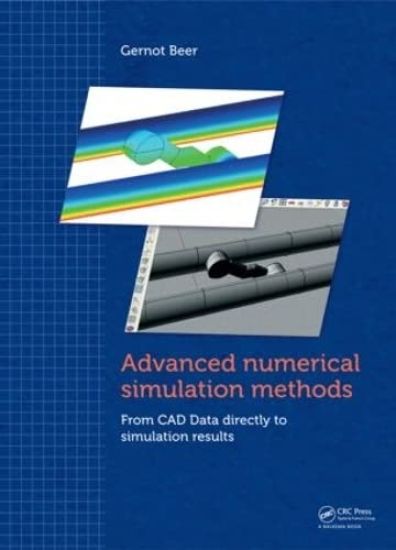
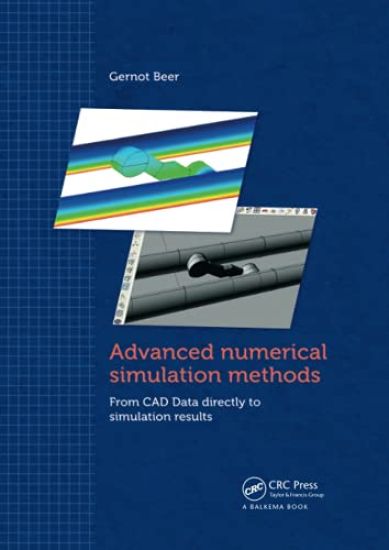
Advanced Numerical Simulation Methods
This book is an entertaining, easy to read introduction to advanced numerical modeling. The aim of the book is to lead the reader on a journey towards the ‘holy grail’ of numerical simulation, namely one without the requirement of mesh generation, that takes data directly from CAD programs. On this journey readers will discover the beauty of Non-uniform Rational B-Splines or NURBS and see how well they are suited for describing geometry, discover how CAD programs work and how their data can be used for simulation. The implementation of NURBS-based simulation is discussed using Finite Element and Boundary Element technology. This is a hands-on book with emphasis on implementation and examples of programming in a higher level language are given. It has been written for users of simulation software, so they can understand the benefits of this new technology and demand progress from a somewhat conservative industry, for software developers, so they can see that this is a technology with a big future and for researchers, in the hope that it will attract more people to work in this exciting new field.
The Isogeometric Boundary Element Method

The Isogeometric Boundary Element Method

Gernot Beer; Benjamin Marussig; Christian Duenser

Springer Nature Switzerland AG
2020
nidottu
This book discusses the introduction of isogeometric technology to the boundary element method (BEM) in order to establish an improved link between simulation and computer aided design (CAD) that does not require mesh generation. In the isogeometric BEM, non-uniform rational B-splines replace the Lagrange polynomials used in conventional BEM. This may seem a trivial exercise, but if implemented rigorously, it has profound implications for the programming, resulting in software that is extremely user friendly and efficient. The BEM is ideally suited for linking with CAD, as both rely on the definition of objects by boundary representation. The book shows how the isogeometric philosophy can be implemented and how its benefits can be maximised with a minimum of user effort. Using several examples, ranging from potential problems to elasticity, it demonstrates that the isogeometric approach results in a drastic reduction in the number of unknowns and an increase in the quality of the results. In some cases even exact solutions without refinement are possible. The book also presents a number of practical applications, demonstrating that the development is not only of academic interest. It then elegantly addresses heterogeneous and non-linear problems using isogeometric concepts, and tests them on several examples, including a severely non-linear problem in viscous flow. The book makes a significant contribution towards a seamless integration of CAD and simulation, which eliminates the need for tedious mesh generation and provides high-quality results with minimum user intervention and computing.
The Isogeometric Boundary Element Method

The Isogeometric Boundary Element Method

Gernot Beer; Benjamin Marussig; Christian Duenser

Springer Nature Switzerland AG
2019
sidottu
This book discusses the introduction of isogeometric technology to the boundary element method (BEM) in order to establish an improved link between simulation and computer aided design (CAD) that does not require mesh generation. In the isogeometric BEM, non-uniform rational B-splines replace the Lagrange polynomials used in conventional BEM. This may seem a trivial exercise, but if implemented rigorously, it has profound implications for the programming, resulting in software that is extremely user friendly and efficient. The BEM is ideally suited for linking with CAD, as both rely on the definition of objects by boundary representation. The book shows how the isogeometric philosophy can be implemented and how its benefits can be maximised with a minimum of user effort. Using several examples, ranging from potential problems to elasticity, it demonstrates that the isogeometric approach results in a drastic reduction in the number of unknowns and an increase in the quality of the results. In some cases even exact solutions without refinement are possible. The book also presents a number of practical applications, demonstrating that the development is not only of academic interest. It then elegantly addresses heterogeneous and non-linear problems using isogeometric concepts, and tests them on several examples, including a severely non-linear problem in viscous flow. The book makes a significant contribution towards a seamless integration of CAD and simulation, which eliminates the need for tedious mesh generation and provides high-quality results with minimum user intervention and computing.
Advanced Numerical Simulation Methods
This book is an entertaining, easy to read introduction to advanced numerical modeling. The aim of the book is to lead the reader on a journey towards the ‘holy grail’ of numerical simulation, namely one without the requirement of mesh generation, that takes data directly from CAD programs. On this journey readers will discover the beauty of Non-uniform Rational B-Splines or NURBS and see how well they are suited for describing geometry, discover how CAD programs work and how their data can be used for simulation. The implementation of NURBS-based simulation is discussed using Finite Element and Boundary Element technology. This is a hands-on book with emphasis on implementation and examples of programming in a higher level language are given. It has been written for users of simulation software, so they can understand the benefits of this new technology and demand progress from a somewhat conservative industry, for software developers, so they can see that this is a technology with a big future and for researchers, in the hope that it will attract more people to work in this exciting new field.
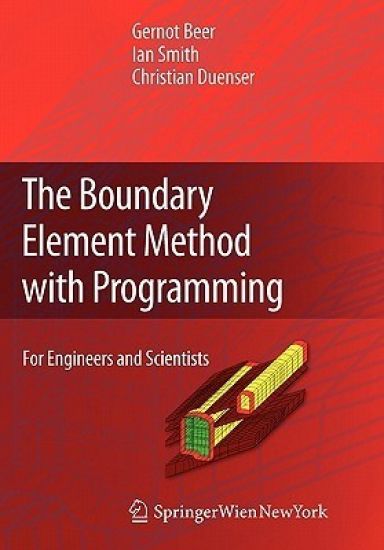
The Boundary Element Method with Programming

The Boundary Element Method with Programming

Gernot Beer; Ian Smith; Christian Duenser

Springer Verlag GmbH
2010
nidottu
This is a sequel to the book “Programming the Boundary Element Method” by G. Beer published by Wiley in 2001. The scope of this book is different however and this is reflected in the title. Whereas the previous book concentrated on explaining the implementation of a limited range of problems into computer code and the emphasis was on programming, in the current book the problems covered are extended, the emphasis is on explaining the theory and computer code is not presented for all topics. The new topics covered range from dynamics to piezo-electricity. However, the main idea, to provide an explanation of the Boundary Element Method (BEM), that is easy for engineers and scientists to follow, is retained. This is achieved by explaining some aspects of the method in an engineering rather than mathematical way. Another new feature of the book is that it deals with the implementation of the method on parallel processing hardware. I. M. Smith, who has been involved in programming the finite element method for decades, illustrates that the BEM is “embarrassingly parallelisable”. It is shown that the conversion of the BEM programs to run efficiently on parallel processing hardware is not too difficult and the results are very impressive, such as solving a 20 000 element problem during a “coffee break”.
The Boundary Element Method With Programming

The Boundary Element Method With Programming

Gernot Beer; Ian Smith; Christian Duenser

Springer Verlag GmbH
2008
sidottu
This thorough yet understandable introduction to the boundary element method presents an attractive alternative to the finite element method. It not only explains the theory but also presents the implementation of the theory into computer code, the code in FORTRAN 95 can be freely downloaded. The book also addresses the issue of efficiently using parallel processing hardware in order to considerably speed up the computations for large systems. The applications range from problems of heat and fluid flow to static and dynamic elasto-plastic problems in continuum mechanics.
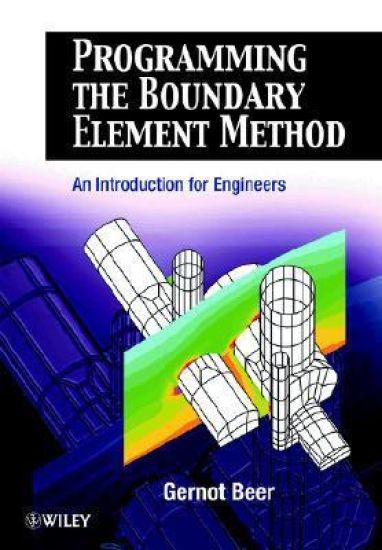
Programming the Boundary Element Method

Programming the Boundary Element Method

Gernot Beer

John Wiley Sons Inc
2001
nidottu
Providing an easy introduction to the boundary element method, this book is ideal for any reader wishing to work in this field or use this method for the solution of engineering problems. From the beginning, the emphasis is on the implementation of the method into computer programs which can be used to solve real problems. The book covers two-andthree-dimensional linear and non-linear analysis in potential flow (heat flow and seepage) and static elasticity. Several computer programs are listed in the book and may be downloaded free of charge via the Internet. They include programs and subroutines for: * 2-D analysis of potential problems using the Trefftz method * 2-D and 3-D linear analysis of potential and static elasticity problems using isoparametric elements (single and multiple regions) * implementation of non-linear problems * coupling to finite elements The programs (written in FORTRAN 90) are well documented, and can be employed by the user to gain experience with the method through the solution of small test examples. Furthermore, readers may use them as a starting point for developing their own boundary element package. In addition, exercises are included in most chapters involving the use of the programs with answers given in an Appendix, and a number of interesting industrial applications in the areas of mechanical, civil and geotechnical engineering are presented.