Kirjojen hintavertailu – 12 903 724 kirjaa ja 27 kauppaa

Kirjailija

Gexiang Zhang

Kirjat ja teokset yhdessä paikassa: 7 kirjaa, julkaisuja vuosilta 2017–2026, suosituimpiin kuuluu Spiking Neural P Systems. Vertaile teosten hintoja ja tarkista saatavuus suomalaisista kirjakaupoista.

7 kirjaa

Kirjojen julkaisuvuodet: 2017–2026.

Smart Safety Management of Energy Storage Batteries

Smart Safety Management of Energy Storage Batteries

Shunli Wang; Yanxin Xie; Guangchen Liu; Qi Huang; Yujie Wang; Gexiang Zhang; Carlos Fernandez

Elsevier - Health Sciences Division
2025
nidottu
Smart Safety Management of Energy Storage Batteries addresses battery management in new power systems which is an important component of the new generation of information technology and power systems. This book covers the application of this new type of power storage as well as power system identification modeling, intelligent energy storage battery status evaluation, and key technologies in intelligent management monitoring. Written for researchers, engineers, and students studying related areas, this book supports research in control science and control, automation, and electrical engineering, and serves as a technical reference for the application of new electric energy storage battery science and technology.
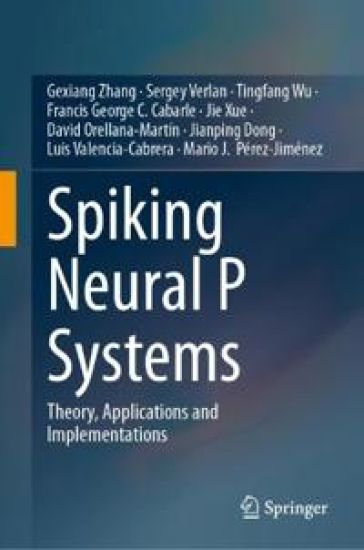
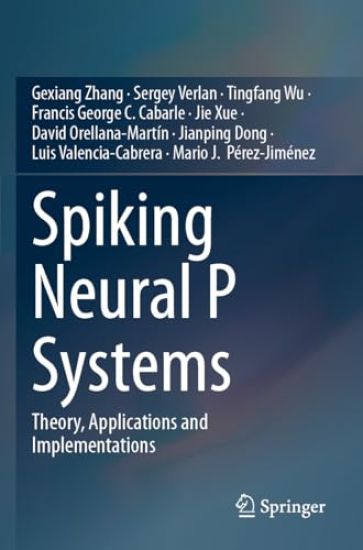
Spiking Neural P Systems

Spiking Neural P Systems

Gexiang Zhang; Sergey Verlan; Tingfang Wu; Francis George C. Cabarle; Jie Xue; David Orellana-Martín; Jianping Dong; Luis Valencia-Cabrera; Mario J. Pérez-Jiménez

SPRINGER VERLAG, SINGAPORE
2024
sidottu
Spiking neural P systems represent a significant advancement in the field of membrane computing, drawing inspiration from the communication patterns observed in neurons. Since their inception in 2006, these distributed and parallel neural-like computing models have gained popularity and emerged as important tools within the membrane computing area. As a key branch of the third generation of artificial neural networks, a fascinating research area of artificial intelligence, spiking neural P systems offer a captivating blend of theoretical elegance and practical utility. Their efficiency, Turing completeness, and real-life application characteristics, including interpretability and suitability for large-scale problems, have positioned them at the forefront of contemporary research in membrane computing and artificial intelligence. This state-of-the-art reference work is organized into three parts comprising twelve chapters. It thoroughly investigates the theoretical foundations, real-life applications, and implementations of spiking neural P systems. From fundamental principles to computational power and complexity, the theoretical aspects are explored, laying the groundwork for understanding their practical applications. Real-life applications span a diverse range of domains, including complex optimization, classification, fault diagnosis, medical image processing, information fusion, cryptography, and robot control. Additionally, the book discusses several software and hardware implementations that provide valuable insights into the practical deployment of spiking neural P systems. As the rapid development of spiking neural P systems continues to unfold, there is an increasing demand for a systematic and comprehensive summary of their capabilities and applications. This work serves as an invaluable resource for researchers, scholars, and practitioners interested in the theoretical underpinnings, algorithms, and practical implementation of artificial intelligence and membrane computing.
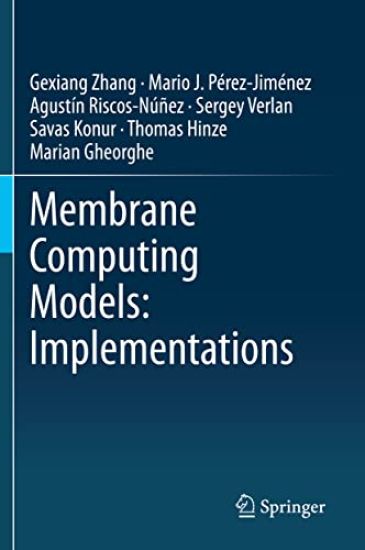
Membrane Computing Models: Implementations

Membrane Computing Models: Implementations

Gexiang Zhang; Mario J. Pérez-Jiménez; Agustín Riscos-Núñez; Sergey Verlan; Savas Konur; Thomas Hinze; Marian Gheorghe

SPRINGER VERLAG, SINGAPORE
2022
nidottu
The theoretical basis of membrane computing was established in the early 2000s with fundamental research into the computational power, complexity aspects and relationships with other (un)conventional computing paradigms. Although this core theoretical research has continued to grow rapidly and vigorously, another area of investigation has since been added, focusing on the applications of this model in many areas, most prominently in systems and synthetic biology, engineering optimization, power system fault diagnosis and mobile robot controller design. The further development of these applications and their broad adoption by other researchers, as well as the expansion of the membrane computing modelling paradigm to other applications, call for a set of robust, efficient, reliable and easy-to-use tools supporting the most significant membrane computing models. This work provides comprehensive descriptions of such tools, making it a valuable resource for anyone interested in membrane computing models.
Membrane Computing Models: Implementations

Membrane Computing Models: Implementations

Gexiang Zhang; Mario J. Pérez-Jiménez; Agustín Riscos-Núñez; Sergey Verlan; Savas Konur; Thomas Hinze; Marian Gheorghe

Springer Verlag, Singapore
2021
sidottu
The theoretical basis of membrane computing was established in the early 2000s with fundamental research into the computational power, complexity aspects and relationships with other (un)conventional computing paradigms. Although this core theoretical research has continued to grow rapidly and vigorously, another area of investigation has since been added, focusing on the applications of this model in many areas, most prominently in systems and synthetic biology, engineering optimization, power system fault diagnosis and mobile robot controller design. The further development of these applications and their broad adoption by other researchers, as well as the expansion of the membrane computing modelling paradigm to other applications, call for a set of robust, efficient, reliable and easy-to-use tools supporting the most significant membrane computing models. This work provides comprehensive descriptions of such tools, making it a valuable resource for anyone interested in membrane computing models.
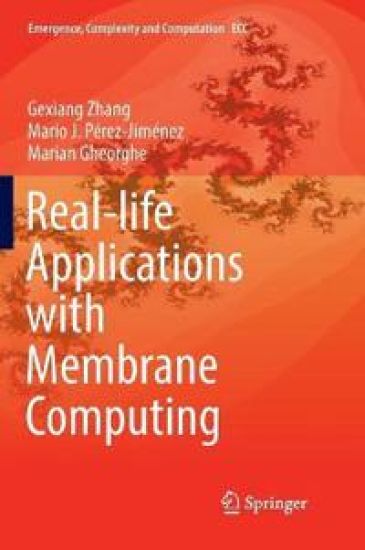
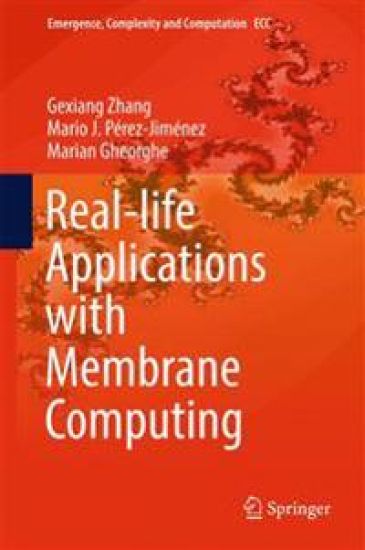
Real-life Applications with Membrane Computing

Real-life Applications with Membrane Computing

Gexiang Zhang; Mario J. Pérez-Jiménez; Marian Gheorghe

Springer International Publishing AG
2018
nidottu
This book thoroughly investigates the underlying theoretical basis of membrane computing models, and reveals their latest applications. In addition, to date there have been no illustrative case studies or complex real-life applications that capitalize on the full potential of the sophisticated membrane systems computational apparatus; gaps that this book remedies. By studying various complex applications – including engineering optimization, power systems fault diagnosis, mobile robot controller design, and complex biological systems involving data modeling and process interactions – the book also extends the capabilities of membrane systems models with features such as formal veri?cation techniques, evolutionary approaches, and fuzzy reasoning methods. As such, the book offers a comprehensive and up-to-date guide for all researchers, PhDs and undergraduate students in the fields of computer science, engineering and the bio-sciences who are interested in the applications of natural computing models.
Real-life Applications with Membrane Computing

Real-life Applications with Membrane Computing

Gexiang Zhang; Mario J. Pérez-Jiménez; Marian Gheorghe

Springer International Publishing AG
2017
sidottu
This book thoroughly investigates the underlying theoretical basis of membrane computing models, and reveals their latest applications. In addition, to date there have been no illustrative case studies or complex real-life applications that capitalize on the full potential of the sophisticated membrane systems computational apparatus; gaps that this book remedies. By studying various complex applications – including engineering optimization, power systems fault diagnosis, mobile robot controller design, and complex biological systems involving data modeling and process interactions – the book also extends the capabilities of membrane systems models with features such as formal veri?cation techniques, evolutionary approaches, and fuzzy reasoning methods. As such, the book offers a comprehensive and up-to-date guide for all researchers, PhDs and undergraduate students in the fields of computer science, engineering and the bio-sciences who are interested in the applications of natural computing models.