Kirjojen hintavertailu – 12 903 725 kirjaa ja 27 kauppaa
Kirjailija
Giambattista Vico
Kirjat ja teokset yhdessä paikassa: 37 kirjaa, julkaisuja vuosilta 1925–2026, suosituimpiin kuuluu La Scienza Nuova. Vertaile teosten hintoja ja tarkista saatavuus suomalaisista kirjakaupoista.
Title: Della antichissima Sapienza degl' Italiani tratta da' Latini parlari. Opera ... dalla Latina nell' Italiana favella recata. Publisher: British Library, Historical Print EditionsThe British Library is the national library of the United Kingdom. It is one of the world's largest research libraries holding over 150 million items in all known languages and formats: books, journals, newspapers, sound recordings, patents, maps, stamps, prints and much more. Its collections include around 14 million books, along with substantial additional collections of manuscripts and historical items dating back as far as 300 BC. The GENERAL HISTORICAL collection includes books from the British Library digitised by Microsoft. This varied collection includes material that gives readers a 19th century view of the world. Topics include health, education, economics, agriculture, environment, technology, culture, politics, labour and industry, mining, penal policy, and social order. ++++The below data was compiled from various identification fields in the bibliographic record of this title. This data is provided as an additional tool in helping to insure edition identification: ++++ British Library Vico, Giambattista; 1816. 8 . 528.g.22.
This volume comprises a new critical edition of Vico’s original Latin text and a faithful translation of this early work on metaphysics. Robert Miner’s introduction offers valuable guidance in understanding this challenging text and assessing its significance.
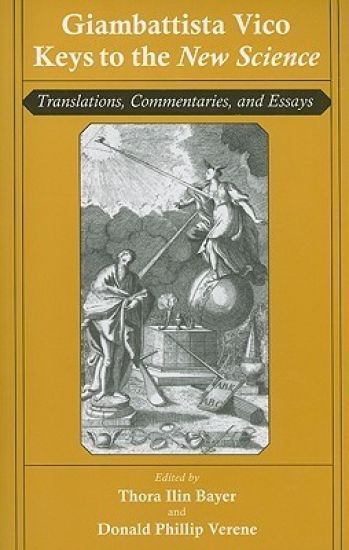
Giambattista Vico: Keys to the "New Science" brings together in one volume translations, commentaries, and essays that illuminate the background of Giambattista Vico's major work. Thora Ilin Bayer and Donald Phillip Verene have collected a series of texts that help us to understand the progress of Vico's thinking, culminating in the definitive version of the New Science, which was published in 1744. Bayer and Verene provide useful introductions both to the collection as a whole and to the individual writings. What emerges is a clear picture of the decades-long process through which Vico elaborated his revolutionary theory of history and culture. Of particular interest are the first sketch of the new science from his earlier work, the Universal Law, and Vico's response to the false book notice regarding the first version of his New Science. The volume also includes additions to the 1744 edition that Vico had written out but that do not appear in the English translations—including his brief chapter on the "Reprehension of the Metaphysics of Descartes, Spinoza, and Locke"—and a bibliography of all of Vico's writings that have appeared in English. Giambattista Vico: Keys to the "New Science" is a unique and vital companion for anyone reading or rereading this landmark of Western intellectual history.
Giambattista Vico (1668-1744) was one of the most original and idiosyncratic philosophers before Kant and Hegel. Although Giorgio Vasari had already diagnosed a cycle of rise, blossoming and decline in the history of art, Vico was the first to base this on a philosophical system. Isolated in Naples from direct contact with the philosophical life of his times, he worked at his grand design of the cycles of rise, blossoming, decline and eternal return which he saw in all areas of culture. His points of reference were ancient mythology and Greek and Roman history. To that extent, he is regarded today as the founder of the philosophy of history and the precursor of a tradition which extends to Hegel and Oswald Spengler's "Decline of the West."
Barely acknowledged in his lifetime, the New Science of Giambattista Vico (1668-1744) is an astonishingly perceptive and ambitious attempt to decipher the history, mythology and laws of the ancient world. Discarding the Renaissance notion of the classical as an idealised model for the modern, it argues that the key to true understanding of the past lies in accepting that the customs and emotional lives of ancient Greeks and Romans, Egyptians, Jews and Babylonians were radically different from our own. Along the way, Vico explores a huge variety of topics, ranging from physics to poetics, money to monsters, and family structures to the Flood. Marking a crucial turning-point in humanist thinking, New Science has remained deeply influential since the dawn of Romanticism, inspiring the work of Karl Marx and even influencing the framework for Joyce's Finnegan's Wake.
"Offentliggørelsen på dansk af Den nye Videnskab, i den afsluttende og mest berømte version fra 1744, overrasker ikke den, der har holdt øje med den moderne succes for denne napolitanske filosof, hvis anerkendelse lige fra begyndelsen har været længe undervejs i den europæiske kultur. Interessen for Vico er voksende i næsten alle europæiske lande. Et fortjenstfuldt arbejde er blevet gennemført af Fritz Wolder, og uden tvivl et krævende arbejde, når man tager den berygtede kompleksitet i Vicos sprog i betragtning, alt andet end let læseligt, også for en moderne italiensk læser." Dr. Silvia Caianiello, Centret for Vichianske Studier, Napoli"Interessen for Vicos arbejder er nærmest eksploderet i de seneste årtier...det må siges, at bogen er en nærmest perfekt udgivelse... Der er... tale om en meget kompetent udgivelse af Vicos store værk, der som nævnt ikke er specielt tilgængeligt, men til gengæld er et meget vigtigt bekendtskab for alle dem, der er interesseret i politisk filosofi." Lektor Niels Amstrup, Politica, nr. 4 november 1997. Lyst til at vide mere? Så prøv AI (kunstig intelligens). Brug: bing. com - Tryk øverst: Copilot - Spørg om: Fritz Wolder Vico Helikon
Vico's earliest extant scholarly works, the six first statement of ideas that Vico would continue to refine throughout his life. Delivered between 1699 and 1707 to usher in the new academic year at the University of Naples, the orations are brought together here for the first time in English in an authoritative translation based on Gian Galeazzo Visconti's 1982 Latin/Italian edition. In the lectures,Vico draws liberally on the classical philosophical and legal traditions as he explores the relationship between the Greek dictum "Know thyself' and liberal education. As he sets forth the values and goals of a humanist curriculum, Vico reveals the beginnings of the anti-Cartesian position he will pursue in On the Study Methods of Our Time ( 1709). Also found in the orations are glimpses ofVico's later views on the theory of interpretation and on the nature of language, imagination, and human creativity, along with many themes that were to be fully developed in his magnum opus, The New Science (1744). On Humanistic Education will be welcomed by Vichians and their students, intellectual historians, and others in the fields of philosophy, literary theory, history and methods of education, classics, and rhetoric.
Giambattista Vico's first original work of philosophy, On the Study Methods of Our Time (1708–9) takes up the contemporary "quarrel between the ancients and the moderns" and provides a highly interesting statement of the nature of humanistic education. This edition makes available again Elio Gianturco's superb 1965 English translation of a work generally regarded as the earliest statement by Vico of the fundamentals of his position. An important contribution to the development of the scientism-versus-humanism debate over the comparative merits of classical and modern culture, this book lays out Vico's powerful arguments against the compartmentalization of knowledge which results from the Cartesian world view. In opposition to the arid logic of Cartesianism, Vico here celebrates the humanistic tradition and posits the need for a comprehensive science of humanity which recognizes the value of memory and imagination. For this edition, Donald Phillip Verene has written a new preface placing the work in the context of the ongoing renaissance in Vico studies and added a chronology of Vico's major writings. He has also translated into English for the first time Vico's last public statement, The Academies and the Relation between Philosophy and Eloquence (1737), a short oration that presents his final views on wisdom, the unity of knowledge, and rhetoric—themes he had first adumbrated in the Study Methods. On the Study Methods of Our Time remains a key text for anyone interested in the development's of Vico's thought and serves as a concise introduction to his work. Scholars and students in such disciplines as the history of philosophy, intellectual history, literary theory, rhetoric, and the history and philosophy of education will find this volume helpful and fascinating.
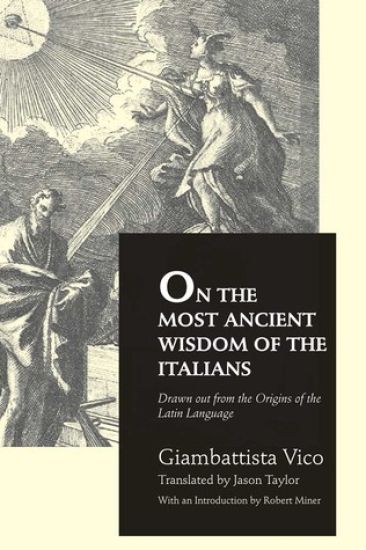
On the Most Ancient Wisdom of the Italians, originally published in 1710, is widely regarded as Vico's most significant work after the New Science and the Autobiography. Subtitled "The Book of Metaphysics," it was one of three planned volumes of a larger work that was never published, and it marks Vico's transition from rhetorician to philosopher of historical knowledge. This edition incorporates translations from the Italian of a contemporary review and Vico's responses, published in 1711 and 1712. L. M. Palmer's translation helps make more accessible a treatise of vital importance for an understanding of Vico's epistemology, psychology, and philosophy of mathematics.
A pioneering treatise that aroused great controversy when it was first published in 1725, Vico's New Science is acknowledged today to be one of the few works of authentic genius in the history of social theory. It represents the most ambitious attempt before Comte at comprehensive science of human society and the most profound analysis of the class struggle prior to Marx.
Giambattista Vico is now acknowledged to be one of the most important figures in the history of European philosophy and social thought and increasingly attention is being focused on his writings. These, however have been difficult to obtain in English and many have never been translated. A real need therefore exists and to meet this Professor Pompa has here translated and introduced a selection of the central, representative texts, where the most important and seminal of Vico's ideas are developed. The volume will make a major contribution towards the study of Vico's thought and this period in the history of philosophy. It will be invaluable to students of those subjects and of the social sciences generally.
The Autobiography of Giambattista Vico is significant both as a source of insight into the influences on the eighteenth-century philosopher's intellectual development and as one of the earliest and most sophisticated examples of philosophical autobiography. Referring to himself in the third person, Vico records the course of his life and the influence that various thinkers had on the development of concepts central to his mature work. Beyond its relevance to the development of the New Science, the Autobiography is also of interest for the light it sheds on Italian culture in the seventeenth and eighteenth centuries. Still regarded by many as the best English-language translation of this classic work, the Cornell edition was widely lauded when first published in 1944. Wrote the Saturday Review of Literature: "Here was something new in the art of self-revelation. Vico wrote of his childhood, the psychological influences to which he was subjected, the social conditions under which he grew up and received an education and evolved his own way of thinking. It was so outstanding a piece of work that it was held up as a model, which it still is."