Kirjojen hintavertailu – 12 859 819 kirjaa ja 27 kauppaa

Kirjailija

Gianni Vattimo

Kirjat ja teokset yhdessä paikassa: 45 kirjaa, julkaisuja vuosilta 1991–2026, suosituimpiin kuuluu Plant-Thinking. Vertaile teosten hintoja ja tarkista saatavuus suomalaisista kirjakaupoista.

45 kirjaa

Kirjojen julkaisuvuodet: 1991–2026.

The Hermeneutic Nature of Analytic Philosophy

The Hermeneutic Nature of Analytic Philosophy

Santiago Zabala; Gianni Vattimo

Columbia University Press
2008
sidottu
Contemporary philosopher-analytic as well as continental--tend to feel uneasy about Ernst Tugendhat, who, though he positions himself in the analytic field, poses questions in the Heideggerian style. Tugendhat was one of Martin Heidegger's last pupils and his least obedient, pursuing a new and controversial critical technique. Tugendhat took Heidegger's destruction of Being as presence and developed it in analytic philosophy, more specifically in semantics. Only formal semantics, according to Tugendhat, could answer the questions left open by Heidegger. Yet in doing this, Tugendhat discovered the latent "hermeneutic nature of analytic philosophy"--its post-metaphysical dimension-in which "there are no facts, but only true propositions." What Tugendhat seeks to answer is this: What is the meaning of thought following the linguistic turn? Because of the rift between analytic and continental philosophers, very few studies have been written on Tugendhat, and he has been omitted altogether from several histories of philosophy. Now that these two schools have begun to reconcile, Tugendhat has become an example of a philosopher who, in the words of Richard Rorty, "built bridges between continents and between centuries." Tugendhat is known more for his philosophical turn than for his phenomenological studies or for his position within analytic philosophy, and this creates some confusion regarding his philosophical propensities. Is Tugendhat analytic or continental? Is he a follower of Wittgenstein or Heidegger? Does he belong in the culture of analysis or in that of tradition? Santiago Zabala presents Tugendhat as an example of merged horizons, promoting a philosophical historiography that is concerned more with dialogue and less with classification. In doing so, he places us squarely within a dialogic culture of the future and proves that any such labels impoverish philosophical research.
Art’s Claim to Truth

Art’s Claim to Truth

Gianni Vattimo

Columbia University Press
2008
sidottu
First collected in Italy in 1985, Art's Claim to Truth is considered by many philosophers to be one of Gianni Vattimo's most important works. Newly revised for English readers, the book begins with a challenge to Plato, Aristotle, Kant, and Hegel, who viewed art as a metaphysical aspect of reality rather than a futuristic anticipation of it. Following Martin Heidegger's interpretation of the history of philosophy, Vattimo outlines the existential ontological conditions of aesthetics, paying particular attention to the works of Kandinsky, which reaffirm the ontological implications of art. Vattimo then builds on Hans-Georg Gadamer's theory of aesthetics and provides an alternative to a rationalistic-positivistic criticism of art. This is the heart of Vattimo's argument, and with it he demonstrates how hermeneutical philosophy reaffirms art's ontological status and makes clear the importance of hermeneutics for aesthetic studies. In the book's final section, Vattimo articulates the consequences of reclaiming the ontological status of aesthetics without its metaphysical implications, holding Aristotle's concept of beauty responsible for the dissolution of metaphysics itself. In its direct engagement with the works of Gadamer, Heidegger, and Luigi Pareyson, Art's Claim to Truth offers a better understanding of the work of Vattimo and a deeper knowledge of ontology, hermeneutics, and the philosophical examination of truth.
Dialogue with Nietzsche

Dialogue with Nietzsche

Gianni Vattimo

Columbia University Press
2008
pokkari
For more than forty years, Gianni Vattimo, one of Europe's most important and influential philosophers, has been a leading participant in the postwar turn that has brought Nietzsche back to the center of philosophical enquiry. In this collection of his essays on the subject, which is a dialogue both with Nietzsche and with the Nietzschean tradition, Vattimo explores the German philosopher's most important works and discusses his views on the Ubermensch, time, history, truth, hermeneutics, ethics, and aesthetics. He also presents a different, more "Italian" Nietzsche, one that diverges from German and French characterizations. Many contemporary French and poststructuralist philosophers offer literary or aesthetic readings of Nietzsche's work that downplay its political import. Shaped by the revolutionary tradition of 1968, Vattimo's interpretations take Nietzsche seriously as a political philosopher and argue for and defend his relevance to projects for social and political change. He emphasizes the hermeneutic aspect of Nietzsche's philosophy, characterizing the Nietzschean project as a political hermeneutics. Vattimo also grapples with Heidegger, a philosopher who has had a profound influence on the interpretation and understanding of Nietzsche. Vattimo examines Heidegger's philosophy through its complex relationship to Nietzsche's, and he produces a Heideggerian understanding of Nietzsche that paradoxically goes against Heidegger's own readings of Nietzsche's work. Heidegger believed Nietzsche was the ultimate metaphysician; Vattimo sees him as the founder of postmetaphysical philosophy. Throughout these essays, Vattimo draws on and quotes extensively from fragments in Nietzsche's notebooks, many of which have never before been translated into English. His writing is clear, elegant, and accessible, and, for the first time, Vattimo's own intellectual developments, shifts, and continuities can be clearly discerned. The loyal testimony and unique perspective in Dialogue with Nietzsche makes a convincing case for another orientation in Nietzsche scholarship.
After the Death of God

After the Death of God

John D. Caputo; Gianni Vattimo

Columbia University Press
2007
sidottu
It has long been assumed that the more modern we become, the less religious we will be. Yet a recent resurrection in faith has challenged the certainty of this belief. In these original essays and interviews, leading hermeneutical philosophers and postmodern theorists John D. Caputo and Gianni Vattimo engage with each other's past and present work on the subject and reflect on our transition from secularism to postsecularism. As two of the figures who have contributed the most to the theoretical reflections on the contemporary philosophical turn to religion, Caputo and Vattimo explore the changes, distortions, and reforms that are a part of our postmodern faith and the forces shaping the religious imagination today. Incisively and imaginatively connecting their argument to issues ranging from terrorism to fanaticism and from politics to media and culture, these thinkers continue to reinvent the field of hermeneutic philosophy with wit, grace, and passion.
The Future of Religion

The Future of Religion

Richard Rorty; Gianni Vattimo

Columbia University Press
2007
pokkari
Though coming from different and distinct intellectual traditions, Richard Rorty and Gianni Vattimo are united in their criticism of the metaphysical tradition. The challenges they put forward extend beyond philosophy and entail a reconsideration of the foundations of belief in God and the religious life. They urge that the rejection of metaphysical truth does not necessitate the death of religion; instead it opens new ways of imagining what it is to be religious-ways that emphasize charity, solidarity, and irony. This unique collaboration, which includes a dialogue between the two philosophers, is notable not only for its fusion of pragmatism (Rorty) and hermeneutics (Vattimo) but also for its recognition of the limits of both traditional religious belief and modern secularism. In "Anticlericalism and Atheism" Rorty discusses Vattimo's work Belief and argues that the end of metaphysics paves the way for an anti-essentialist religion. Rorty's conception of religion, determined by private motives, is designed to produce the gospel's promise that henceforth God will not consider humanity as a servant but as a friend. In "The Age of Interpretation," Vattimo, who is both a devout Catholic and a frequent critic of the church, explores the surprising congruence between Christianity and hermeneutics in light of the dissolution of metaphysical truth. As in hermeneutics, interpretation is central to Christianity, which introduced the world to the principle of interiority, dissolving the experience of objective reality into "listening to and interpreting messages." The lively dialogue that concludes this volume, moderated and edited by Santiago Zabala, analyzes the future of religion together with the political, social, and historical aspects that characterize our contemporary postmodern, postmetaphysical, and post-Christian world.
Nihilism and Emancipation

Nihilism and Emancipation

Gianni Vattimo

Columbia University Press
2007
pokkari
A daring marriage of philosophical theory and practical politics, this collection is the first of Gianni Vattimo's many books to combine his intellectual pursuits with his public and political life. Vattimo is a paradoxical figure, at once a believing Christian and a vociferous critic of the Catholic Church, an outspoken liberal but not a former communist, and a recognized authority on Nietzsche and Heidegger as well as a prominent public intellectual and member of the European parliament. Building on his unique position as a philosopher and politician, Vattimo takes on some of the most pressing questions of our time: Is it still possible, long after Nietzsche proclaimed the death of God, to talk of moral imperatives, individual rights, or political freedom? Are these values still relevant in today's world? Tackling these crucial issues, Gianni Vattimo argues that nihilism is not the absence of meaning but a recognition of a plurality of meanings; it is not the end of civilization but the beginning of new social paradigms. Commonly associated with the pessimistic belief that all of existence is meaningless, nihilism, as a philosophical principle, is far less sensational-it is the ethical doctrine that there are no moral absolutes or infallible natural laws, that "truth" is inescapably subjective. Because the conditions for equality and liberty are not "naturally" given, society must actively create these ideals or it will inevitably fall prey to irrationality, prejudice, and oppression. Vattimo contends that the infighting, timidity, and confusion that have overtaken contemporary liberal thought and politics are the products a prolonged and indulgent mourning over the loss of the transcendental father figure-any institution or power structure that defines truth, knowledge, and reality. Until humanity overcomes its need for external authority-whether it be organized religion, the nation-state, or free-market capitalism-emancipation will remain unattainable. Collecting fourteen of Vattimo's most influential essays on ethics, politics, and law, Nihilism and Emancipation is a provocative reevaluation of meaning, values, and the idea of freedom in Western culture.
Religionens Fremtid

Religionens Fremtid

Richard Rorty; Gianni Vattimo

AARHUS UNIVERSITY PRESS
2007
nidottu
I dag opfatter mange mennesker sig som religiøse, uden at de dermed nødvendigvis tilslutter sig en bestemt relgion, Hvis man ønsker et indblik i den filosofiske og idehistoriske baggrund for dette, er Religionens fremtid og dens dialog mellem to af nutidens største filosoffer et godt sted at starte. Dette unikke samarbejde, som inkluderer to essays og en dialog, er ikke blot bemærkselsesværdigt på grund af dets fusion af pragmatismen (Rorty) og hermeneutikken (Vattimo), men også for dets anerkendelse af grænserne for både de traditionelle religioner og den moderne sekularisering. Den livlige dialog, som følger efter de to essays, analyserer religionens fremtid sammen med de politiske, sociale og historiske aspekter, som karakteriserer vores postmoderne, postmetafysiske og postkristen verden. Bogen afrundes med et kritisk efterord af idehistoriker Jens Viggo Nielsen, som også sætter bogens tema ind i en dansk filosofisk tradition.
Dialogue with Nietzsche

Dialogue with Nietzsche

Gianni Vattimo

Columbia University Press
2006
sidottu
For more than forty years, Gianni Vattimo, one of Europe's most important and influential philosophers, has been a leading participant in the postwar turn that has brought Nietzsche back to the center of philosophical enquiry. In this collection of his essays on the subject, which is a dialogue both with Nietzsche and with the Nietzschean tradition, Vattimo explores the German philosopher's most important works and discusses his views on the Ubermensch, time, history, truth, hermeneutics, ethics, and aesthetics. He also presents a different, more "Italian" Nietzsche, one that diverges from German and French characterizations. Many contemporary French and poststructuralist philosophers offer literary or aesthetic readings of Nietzsche's work that downplay its political import. Shaped by the revolutionary tradition of 1968, Vattimo's interpretations take Nietzsche seriously as a political philosopher and argue for and defend his relevance to projects for social and political change. He emphasizes the hermeneutic aspect of Nietzsche's philosophy, characterizing the Nietzschean project as a political hermeneutics. Vattimo also grapples with Heidegger, a philosopher who has had a profound influence on the interpretation and understanding of Nietzsche. Vattimo examines Heidegger's philosophy through its complex relationship to Nietzsche's, and he produces a Heideggerian understanding of Nietzsche that paradoxically goes against Heidegger's own readings of Nietzsche's work. Heidegger believed Nietzsche was the ultimate metaphysician; Vattimo sees him as the founder of postmetaphysical philosophy. Throughout these essays, Vattimo draws on and quotes extensively from fragments in Nietzsche's notebooks, many of which have never before been translated into English. His writing is clear, elegant, and accessible, and, for the first time, Vattimo's own intellectual developments, shifts, and continuities can be clearly discerned. The loyal testimony and unique perspective in Dialogue with Nietzsche makes a convincing case for another orientation in Nietzsche scholarship.
The Future of Religion

The Future of Religion

Richard Rorty; Gianni Vattimo

Columbia University Press
2005
sidottu
Though coming from different and distinct intellectual traditions, Richard Rorty and Gianni Vattimo are united in their criticism of the metaphysical tradition. The challenges they put forward extend beyond philosophy and entail a reconsideration of the foundations of belief in God and the religious life. They urge that the rejection of metaphysical truth does not necessitate the death of religion; instead it opens new ways of imagining what it is to be religious-ways that emphasize charity, solidarity, and irony. This unique collaboration, which includes a dialogue between the two philosophers, is notable not only for its fusion of pragmatism (Rorty) and hermeneutics (Vattimo) but also for its recognition of the limits of both traditional religious belief and modern secularism. In "Anticlericalism and Atheism" Rorty discusses Vattimo's work Belief and argues that the end of metaphysics paves the way for an anti-essentialist religion. Rorty's conception of religion, determined by private motives, is designed to produce the gospel's promise that henceforth God will not consider humanity as a servant but as a friend. In "The Age of Interpretation," Vattimo, who is both a devout Catholic and a frequent critic of the church, explores the surprising congruence between Christianity and hermeneutics in light of the dissolution of metaphysical truth. As in hermeneutics, interpretation is central to Christianity, which introduced the world to the principle of interiority, dissolving the experience of objective reality into "listening to and interpreting messages." The lively dialogue that concludes this volume, moderated and edited by Santiago Zabala, analyzes the future of religion together with the political, social, and historical aspects that characterize our contemporary postmodern, postmetaphysical, and post-Christian world.
Nihilisme Og Emancipation: Etik, Politik, Ret

Nihilisme Og Emancipation: Etik, Politik, Ret

Gianni Vattimo

AARHUS UNIVERSITY PRESS
2005
nidottu
I Nihilisme og emancipation forsoger Gianni Vattimo at gentAenke begreberne politik, etik og ret i den moderne verden, hvor uforanderlige principper er utAenkelige. Nietzsche og Heidegger har efterladt sig et metafysisk tomrum, hvor Gud er dod, og de absolutte ideologier er utrovAerdige. Udfordringen for nutidens filosoffer bliver derfor at opspore en teori omkring det moderne, som bygger pa hermeneutikkens uendelige fortolkningsmuligheder. Lov, ret og etik ma konstrueres igennem forhandlinger, demokrati og konsensus. Kun saledes undgas den polarisering, som truer med at opdele verden i supermarkedskulturen pa den ene side og fundametalismen pa den anden. Med Vattimos politisk-filosofiske tilgang konfronteres flere brandaktuelle temaer i bogen, bl.a. kulturernes herkomst, Occidentens undergang og Europas rolle i fremtidens verdenssamfund. Bogen indeholder, ud over en udforlig bibliografi, en introduktion til Gianni Vattimos tAenkning ved idehistoriker Jens Viggo Nielsen.
Nihilism and Emancipation

Nihilism and Emancipation

Gianni Vattimo

Columbia University Press
2004
sidottu
A daring marriage of philosophical theory and practical politics, this collection is the first of Gianni Vattimo's many books to combine his intellectual pursuits with his public and political life. Vattimo is a paradoxical figure, at once a believing Christian and a vociferous critic of the Catholic Church, an outspoken liberal but not a former communist, and a recognized authority on Nietzsche and Heidegger as well as a prominent public intellectual and member of the European parliament. Building on his unique position as a philosopher and politician, Vattimo takes on some of the most pressing questions of our time: Is it still possible, long after Nietzsche proclaimed the death of God, to talk of moral imperatives, individual rights, or political freedom? Are these values still relevant in today's world? Tackling these crucial issues, Gianni Vattimo argues that nihilism is not the absence of meaning but a recognition of a plurality of meanings; it is not the end of civilization but the beginning of new social paradigms. Commonly associated with the pessimistic belief that all of existence is meaningless, nihilism, as a philosophical principle, is far less sensational-it is the ethical doctrine that there are no moral absolutes or infallible natural laws, that "truth" is inescapably subjective. Because the conditions for equality and liberty are not "naturally" given, society must actively create these ideals or it will inevitably fall prey to irrationality, prejudice, and oppression. Vattimo contends that the infighting, timidity, and confusion that have overtaken contemporary liberal thought and politics are the products a prolonged and indulgent mourning over the loss of the transcendental father figure-any institution or power structure that defines truth, knowledge, and reality. Until humanity overcomes its need for external authority-whether it be organized religion, the nation-state, or free-market capitalism-emancipation will remain unattainable. Collecting fourteen of Vattimo's most influential essays on ethics, politics, and law, Nihilism and Emancipation is a provocative reevaluation of meaning, values, and the idea of freedom in Western culture.
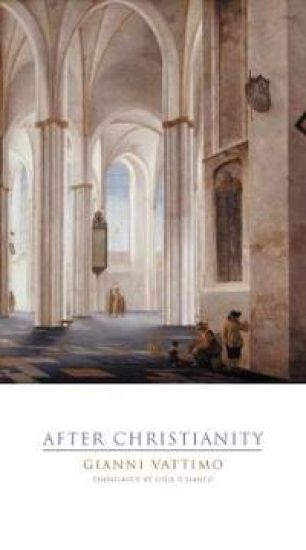
After Christianity

After Christianity

Gianni Vattimo

Columbia University Press
2002
sidottu
What has been the fate of Christianity since Nietzsche's famous announcement of the "death of God"? What is the possibility of religion, specifically Christianity, thriving in our postmodern era? In this provocative new book, Gianni Vattimo, leading Italian philosopher, politician, and framer of the European constitution, addresses these critical questions. When Vattimo was asked by a former teacher if he still believed in God, his reply was, "Well, I believe that I believe." This paradoxical declaration of faith serves as the foundation for a brilliant exposition on Christianity in the new millennium-an age characterized by a deep uncertainty of opinion-and a personal account of how Vattimo himself recovered his faith through Nietzsche and Heidegger. He first argues that secularization is in fact the fulfillment of the central Christian message, and prepares us for a new mode of Christianity. He then explains that Nietzsche's thesis concerns only the "moral god" and leaves room for the emergence of "new gods." Third, Vattimo claims that the postmodern condition of fragmentation, anti-Eurocentrism, and postcolonialism can be usefully understood in light of Joachim of Fiore's thesis concerning the "Spiritual Age" of history. Finally, Vattimo argues for the idea of "weak thought." Because philosophy in the postmetaphysical age can only acknowledge that "all is interpretation," that the "real" is always relative and not the hard and fast "truth" we once thought it to be, contemporary thought must recognize itself and its claims as "weak" as opposed to "strong" foundationalist claims of the metaphysical past. Vattimo concludes that these factors make it possible for religion and God to become a serious topic for philosophy again, and that philosophy should now formally engage religion.
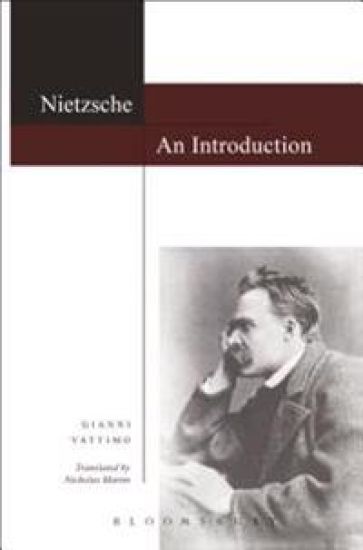
Nietzsche: An Introduction

Nietzsche: An Introduction

Gianni Vattimo

Stanford University Press
2002
sidottu
This book is both a concise and lucid introduction to Nietzsche and an original contribution to critical debates concerning Nietzsche interpretation and reception. This overview takes issue with the prevailing tendency to focus on Nietzsche's later work, which reaches its extreme with Heidegger's almost exclusive focus on the group of late notes posthumously collected as The Will to Power. Vattimo aims to mediate between two prominent hermeneutic readings of Nietzsche: Wilhelm Dilthey's view that Nietzsche's work fits into the nineteenth-century tradition of the philosophy of life and Heidegger's belief that Nietzsche is best understood as the author of a pair of ontological doctrines, the will to power and the eternal return of the same. Vattimo aims to show that Nietzsche's early interest in cultural and historical criticism can be found throughout his corpus and that it informs, and helps to explain, Nietzsche's later doctrines and writings. This allows us to understand these later doctrines in a deeper way, to see their connections with his wider concerns, and thus to make greater sense of Nietzsche's philosophy as a whole. This working hypothesis guides Vattimo through his elegant exposition of the basic views of the early and late Nietzsche, from the philological beginnings and the musings on Dionysus through the so-called positivist phase of the middle period up to the philosophy of Zarathustra and the fragmented insights that bespeak the will to power. Throughout, Vattimo's intellectual agenda is to present the philosophical relevance of a cultural criticism that does not let itself be reduced to a merely literary presentation of the psychology of decadence and nihilism, or to the grand ontological-metaphysical finale that Heidegger had in mind in his monumental Nietzsche studies. As an appendix, Vattimo provides a history of Nietzsche reception in Europe that counters the narrow Anglo-American bias of much English-language Nietzsche scholarship.
Nietzsche

Nietzsche

Gianni Vattimo

Continuum International Publishing Group Ltd.
2002
nidottu
This renowned introduction - already a standard text in Europe - is translated here for the first time. Vattimo uses Heideggerean and cultural-critical perspectives to reassess the work and thought of Nietzsche.
Nietzsche

Nietzsche

Gianni Vattimo

Continuum International Publishing Group Ltd.
2002
sidottu
In this introduction to the work of Friedrich Nietzsche, Vattimo uses Heideggerean and cultural-critical perspectives to reassess the work and thought of Nietzsche.
Belief

Belief

Gianni Vattimo

Polity Press
1999
nidottu

Halvin toimitettuna 28,60 €

In this text, Gianni Vattimo explores the theme of faith and religion. He examines concepts of charity, truth, dogmatism, morality and sin through the lens of his own life, and at the centre is the enigma of "belief" which he identifies as an inevitable feature of our cultural and personal lives.
Religion

Religion

Jacques Derrida; Gianni Vattimo

Stanford University Press
1998
sidottu
What should we make of the return to the sacred evidenced by the new vitality of churches, sects, and religious beliefs in many parts of the world today? What are the boundaries between the essential traits of religion and those of ethics and justice? Is there a "truth" to religion? This remarkable volume includes reflections on such questions by three of the most important philosophers of our time—Jacques Derrida, Gianni Vattimo, and Hans-Georg Gadamer. Together with other distinguished thinkers, they address a wide range of questions about the meaning, status, and future prospects of religion. In his meditation on the "return of religion," entitled "Faith and Knowledge: The Two Sources of 'Religion' at the Limits of Mere Reason," Derrida addresses the ways in which this return is intrinsically linked to transformations of which the new media are both the carriers and the symptom. Derrida coins this process one of globalatinization. This neologism signals, among other things, the process of a certain universalization of the Roman word or concept of religion, which tends to become hegemonic, as well as a certain performativity discernible in the new media and in contemporary structures of testimony and confession. Examples of this include, Derrida reminds us, not only the phenomenon of televangelism and televisual stagings of the pope's journeys, and not only the portrayal and self-presentation of Islam, but also the fetishization and becoming virtually absolute of the televisual and the multimedial as such. Using Being and Time as a point of reference, Vattimo suggests that religious experience is both an individual experience and a manifestation of a historical rhythm within which religion regularly appears and disappears. A commentary by Gadamer summarizes and enriches the contributions by Derrida and Vattimo. Four essays by Maurizio Ferraris, Eugenio Trias, Vincenzo Vitiello, and Aldo Giorgio Gargani complete the volume by examining other facets of the "religious."
Beyond Interpretation

Beyond Interpretation

Gianni Vattimo

Polity Press
1997
nidottu
This book by one of Europe's foremost contemporary philosophers is a concise and lucidly argued account of the meaning of hermeneutics for philosophy today. Vattimo argues that hermeneutics, understood in a general sense, has had a pervasive influence on contemporary philosophy and social thought. But its very generality is also a symptom of its malaise, for it threatens to leave hermeneutics empty of significance and wedded to a shallow relativism. In response to this danger, Vattimo proposes a radicalization of the relation of hermeneutics to its own historical roots in modernity and a rethinking of the relation between hermeneutics and nihilism - which involves, in Vattimo's account, a weakening of the strong structures of being, reality, subjectivity and above all, truth. Vattimo develops a new interpretation of hermeneutics that dispenses with the traditional bias toward aesthetic experience. His radical interpretation breaks the link between hermeneutics and metaphysical humanism, challenges the traditional opposition of the natural and human sciences, and opens new perspectives on ethics, art and religion. Beyond Interpretation will be welcomed by students and researchers in philosophy and social theory.