Kirjojen hintavertailu – 12 903 735 kirjaa ja 27 kauppaa

Kirjailija

Gil Graff

Kirjat ja teokset yhdessä paikassa: 5 kirjaa, julkaisuja vuosilta 1985–2024, suosituimpiin kuuluu Living Torah. Vertaile teosten hintoja ja tarkista saatavuus suomalaisista kirjakaupoista.

5 kirjaa

Kirjojen julkaisuvuodet: 1985–2024.

Living Torah

Living Torah

Gil Graff; David Wolpe

BLOOMSBURY PUBLISHING PLC
2024
sidottu
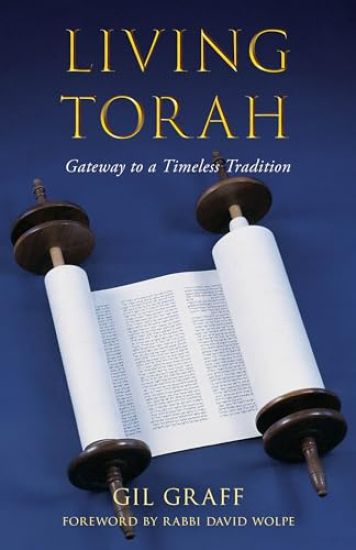
Today there are more than seven million Jews in the United States. As with Americans of all ethnicities and religious persuasions, Jews can identify with and embrace their heritage in any number of ways. Alternatively, they can choose to distance themselves from anything distinctively Jewish. For millennia, the Torah – literally, instruction – the first five books of the Hebrew Bible, has been a centerpiece of Jewish study, thought, and action. Throughout the years, the Torah has been interpreted and applied to life in varying times and places. It has long been customary for Jews to read chapters of the Torah each week as part of an annual cycle of study and synagogue ritual. In the third decade of the twenty-first century, there are Jews who question or doubt the continuing relevance of Jewish texts to their lives. Yet, the search for meaning is enduring, and most American Jews are interested in engaging with a heritage in which they take pride. It is, primarily, for such readers that this book is designed. At the same time, there are people who are not Jewish for whom a book unpacking a Jewish understanding of the Torah might be of interest. The aim of this work is to share ideas, themes, values, and practices that are all part of the living Torah, with full awareness that personal meaning is, by definition, unique to each individual. “Living Torah” describes both Torah as a vibrant text and those who lead Torah-informed lives. “Torah-informed” by no means implies uniformity of life-style. There are a number of books that explore the meaning that Judaism can hold for contemporary Jews and others interested in the wisdom expressed in its classical texts. While these books draw upon classical sources and offer interesting perspectives, none undertakes to systematically introduce the reader to the richness of the Torah text. The uniqueness of this very accessible volume is that it identifies a central theme in each of the five books of the Torah, and, following exploration of the substance of each book, looks at implications of the book’s key theme for the lives of contemporary readers The book is comprised of ten chapters, organized as follows: a chapter synopsizing a book of the Torah and identifying its central theme, followed by a chapter applying that theme to the lived experience of Jews in the twenty-first century. The themes explored are: (a) the Jews’ relationship to the land of Israel; (b) purpose in history; (c) the pursuit of holiness; (d) living in community; (e) Jewish learning.
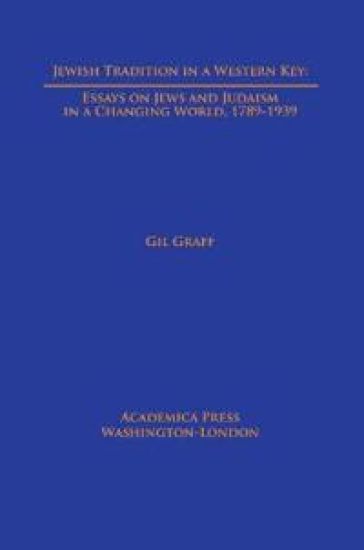
Jewish Tradition in a Western Key

Jewish Tradition in a Western Key

Gil Graff

Academica Press
2019
sidottu
The period 1789-1939 was a time of dramatic, global social, political and economic transformation, with considerable ramifications for Jews and Judaism. From the dissolution of corporate status and new-found standing as individual citizens; from diverse, religious approaches to the interplay of Judaism and modernity, to competing notions of Jewish peoplehood and nationalism; from demographic growth to mass migration and relocation, this was an era of substantial change. This collection of essays explores aspects of these significant currents, with particular attention to the project of synthesizing Jewish tradition and engagement with modernity in Western Europe and the United States. An introductory essay surveys the landscape of world Jewry during the century and a half to which the volume is devoted. Trends in Sephardic and Middle Eastern Jewry as well as Eastern European Jewry are examined alongside currents in the West. The second essay explores the changing interface between Jewish law and the law of the state in the modern era. The remaining essays focus on several individuals, starting with Samson Raphael Hirsch, who encouraged, in various ways, a fusion of Jewish tradition and modernity. Particular attention is accorded the influence of the (Berlin) Hildesheimer Rabbinical Seminary on Jews in the United States engaged in this project. Though, within a decade of 1939, the world – and world Jewry – experienced seismic shifts, many of the ideas framed during the period 1789-1939 retain currency among Jews consciously rooted in the legacy of an earlier era. Reflecting the enduring impact of ideas articulated during the period explored, one essay considers how themes central to the work of an early twentieth century public intellectual, Israel Friedlaender, find expression a century later. This volume deepens understanding of the historical underpinnings of Modern (Jewish) Orthodoxy in America, a continuing manifestation of Jewish tradition in a Western key.
Separation of Church and State

Separation of Church and State

Gil Graff

The University of Alabama Press
2003
nidottu
For the Jewish community, the end of the Middle Ages and the emergence of the modern nation-state brought the promise of equal citizenship as well as the possible loss of Jewish corporate identity. The legal maxim dina de-malkhuta dina (the law of the State is law) invoked in Talmidic times to justify the acceptance of the king's law and qualified in the Middle Ages by Maimonides and Rashbam to include the requirement of consent by the governed underwent further redefinition by Jews in the Napoleonic age. Graff focuses on the struggle between 18th and 19th-century Jewish religious reformers and traditionalists in defining the limits of dina de-malkhuta dina. He traces the motivations of the reformers who, in their zeal to gain equality for the formerly disenfranchised Jewish communities in Western Europe, were prepared to render unto the State compromising authority over Jewish religious life under the rubric of dina de-malkhuta dina was intended to strike a balance between synagogue and state and not to be used as a pretext for the liquidation of the community's corporate existence. Graff observes that the significance of dina de-malkhuta dina and its interpretation ids vital for an understanding of modern Jewish life as well as the relationship of Diaspora Jews to the Jewish community in the state of Israel.