
Kirjojen hintavertailu – 12 903 725 kirjaa ja 27 kauppaa

Kirjailija

Gilbert Baumslag

Kirjat ja teokset yhdessä paikassa: 2 kirjaa, julkaisuja vuosilta 1993–2015, suosituimpiin kuuluu Topics in Combinatorial Group Theory. Vertaile teosten hintoja ja tarkista saatavuus suomalaisista kirjakaupoista.

2 kirjaa

Kirjojen julkaisuvuodet: 1993–2015.

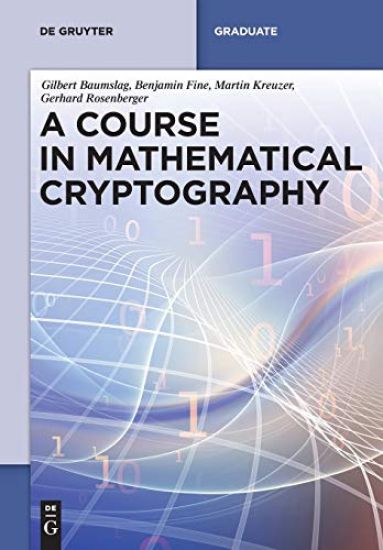
A Course in Mathematical Cryptography

A Course in Mathematical Cryptography

Gilbert Baumslag; Benjamin Fine; Martin Kreuzer; Gerhard Rosenberger

De Gruyter
2015
isokokoinen pokkari
Cryptography has become essential as bank transactions, credit card infor-mation, contracts, and sensitive medical information are sent through inse-cure channels. This book is concerned with the mathematical, especially algebraic, aspects of cryptography. It grew out of many courses presented by the authors over the past twenty years at various universities and covers a wide range of topics in mathematical cryptography. It is primarily geared towards graduate students and advanced undergraduates in mathematics and computer science, but may also be of interest to researchers in the area. Besides the classical methods of symmetric and private key encryption, the book treats the mathematics of cryptographic protocols and several unique topics such as Group-Based Cryptography Gröbner Basis Methods in Cryptography Lattice-Based Cryptography
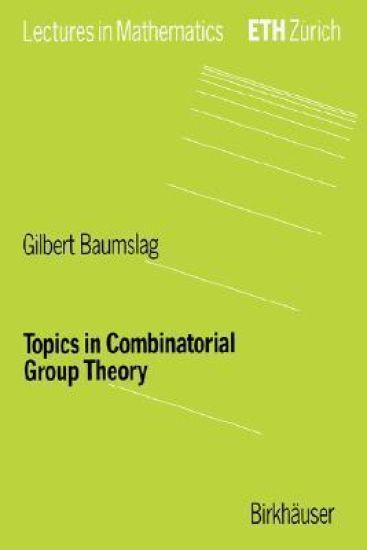
Topics in Combinatorial Group Theory

Topics in Combinatorial Group Theory

Gilbert Baumslag

Birkhauser Verlag AG
1993
nidottu
Combinatorial group theory is a loosely defined subject, with close connections to topology and logic. With surprising frequency, problems in a wide variety of disciplines, including differential equations, automorphic functions and geometry, have been distilled into explicit questions about groups, typically of the following kind: Are the groups in a given class finite (e.g., the Burnside problem)? Finitely generated? Finitely presented? What are the conjugates of a given element in a given group? What are the subgroups of that group? Is there an algorithm for deciding for every pair of groups in a given class whether they are isomorphic or not? The objective of combinatorial group theory is the systematic development of algebraic techniques to settle such questions. In view of the scope of the subject and the extraordinary variety of groups involved, it is not surprising that no really general theory exists. These notes, bridging the very beginning of the theory to new results and developments, are devoted to a number of topics in combinatorial group theory and serve as an introduction to the subject on the graduate level.