Kirjojen hintavertailu – 12 859 829 kirjaa ja 27 kauppaa

Kirjailija

Gilbert Harman

Kirjat ja teokset yhdessä paikassa: 10 kirjaa, julkaisuja vuosilta 1977–2016, suosituimpiin kuuluu An Elementary Introduction to Statistical Learning Theory. Vertaile teosten hintoja ja tarkista saatavuus suomalaisista kirjakaupoista.

10 kirjaa

Kirjojen julkaisuvuodet: 1977–2016.

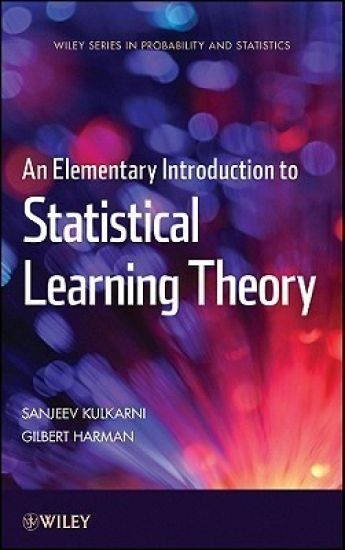
An Elementary Introduction to Statistical Learning Theory

An Elementary Introduction to Statistical Learning Theory

Sanjeev Kulkarni; Gilbert Harman

John Wiley Sons Inc
2011
sidottu
A thought-provoking look at statistical learning theory and its role in understanding human learning and inductive reasoning A joint endeavor from leading researchers in the fields of philosophy and electrical engineering, An Elementary Introduction to Statistical Learning Theory is a comprehensive and accessible primer on the rapidly evolving fields of statistical pattern recognition and statistical learning theory. Explaining these areas at a level and in a way that is not often found in other books on the topic, the authors present the basic theory behind contemporary machine learning and uniquely utilize its foundations as a framework for philosophical thinking about inductive inference. Promoting the fundamental goal of statistical learning, knowing what is achievable and what is not, this book demonstrates the value of a systematic methodology when used along with the needed techniques for evaluating the performance of a learning system. First, an introduction to machine learning is presented that includes brief discussions of applications such as image recognition, speech recognition, medical diagnostics, and statistical arbitrage. To enhance accessibility, two chapters on relevant aspects of probability theory are provided. Subsequent chapters feature coverage of topics such as the pattern recognition problem, optimal Bayes decision rule, the nearest neighbor rule, kernel rules, neural networks, support vector machines, and boosting. Appendices throughout the book explore the relationship between the discussed material and related topics from mathematics, philosophy, psychology, and statistics, drawing insightful connections between problems in these areas and statistical learning theory. All chapters conclude with a summary section, a set of practice questions, and a reference sections that supplies historical notes and additional resources for further study. An Elementary Introduction to Statistical Learning Theory is an excellent book for courses on statistical learning theory, pattern recognition, and machine learning at the upper-undergraduate and graduate levels. It also serves as an introductory reference for researchers and practitioners in the fields of engineering, computer science, philosophy, and cognitive science that would like to further their knowledge of the topic.
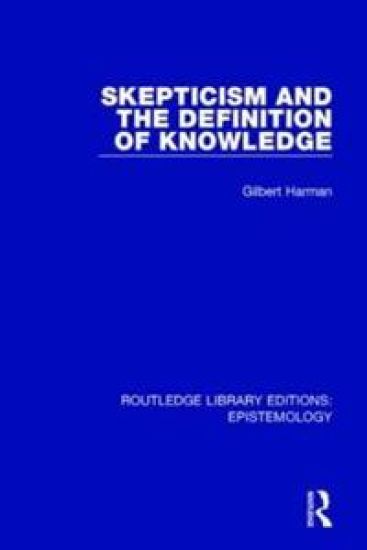
Skepticism and the Definition of Knowledge
Originally published in 1990. This study argues that scepticism is an intelligible view and that the issue scepticism raises is whether or not certain sceptical hypotheses are as plausible as the ordinary views we accept. It discusses psychological concepts, definitions of knowledge, belief and hypothetic inference (inference to the best explanation). Starting from ‘Is skepticism a problem for epistemology’, the book takes us through the argument for the possibility of scepticism, including looking at sense data and considering memory and perception.
Reliable Reasoning

Reliable Reasoning

Gilbert Harman; Sanjeev Kulkarni

Bradford Books
2012
pokkari
The implications for philosophy and cognitive science of developments in statistical learning theory. In Reliable Reasoning, Gilbert Harman and Sanjeev Kulkarni-a philosopher and an engineer-argue that philosophy and cognitive science can benefit from statistical learning theory (SLT), the theory that lies behind recent advances in machine learning. The philosophical problem of induction, for example, is in part about the reliability of inductive reasoning, where the reliability of a method is measured by its statistically expected percentage of errors-a central topic in SLT. After discussing philosophical attempts to evade the problem of induction, Harman and Kulkarni provide an admirably clear account of the basic framework of SLT and its implications for inductive reasoning. They explain the Vapnik-Chervonenkis (VC) dimension of a set of hypotheses and distinguish two kinds of inductive reasoning. The authors discuss various topics in machine learning, including nearest-neighbor methods, neural networks, and support vector machines. Finally, they describe transductive reasoning and suggest possible new models of human reasoning suggested by developments in SLT.
Explaining Value

Explaining Value

Gilbert Harman

Clarendon Press
2000
sidottu
Explaining Value is a selection of the best of Gilbert Harman's shorter writings in moral philosophy. The thirteen essays, originally published between 1967 and 1999, are divided into four sections, which focus in turn on moral relativism, values and valuing, character traits and virtue ethics, and ways of explaining aspects of morality. An indication of the breadth of interest of the book can be given by mentioning a few of the compelling questions which Harman discusses: What accounts for the existence of basic moral disagreements? Why do most people think it is worse to injure someone than to fail to save them from injury? Why do many people think it is morally permissible to treat animals in ways we would not treat people? What is it to value something and what is it to value something intrinsically? How much of morality can or should be explained in terms of human flourishing, or the possession of virtuous character traits? How do people come to be moral? Harman's distinctive approach to moral philosophy has provoked much interest; this volume offers a fascinating conspectus of his most important work in the area.
Explaining Value

Explaining Value

Gilbert Harman

Clarendon Press
2000
nidottu
Explaining Value is a selection of the best of Gilbert Harman's shorter writings in moral philosophy. The thirteen essays, originally published between 1967 and 1999, are divided into four sections, which focus in turn on moral relativism, values and valuing, character traits and virtue ethics, and ways of explaining aspects of morality. An indication of the breadth of interest of the book can be given by mentioning a few of the compelling questions which Harman discusses: What accounts for the existence of basic moral disagreements? Why do most people think it is worse to injure someone than to fail to save them from injury? Why do many people think it is morally permissible to treat animals in ways we would not treat people? What is it to value something and what is it to value something intrinsically? How much of morality can or should be explained in terms of human flourishing, or the possession of virtuous character traits? How do people come to be moral? Harman's distinctive approach to moral philosophy has provoked much interest; this volume offers a fascinating conspectus of his most important work in the area.
Reasoning, Meaning, and Mind

Reasoning, Meaning, and Mind

Gilbert Harman

Oxford University Press
1999
nidottu
Gilbert Harman presents a selection of fifteen interconnected essays on fundamental issues at the centre of analytic philosophy. The book opens with a group of four essays discussing basic principles of reasoning and rationality. The next three essays argue against the idea that certain claims are true by virtue of meaning and knowable by virtue of meaning. In the third group of essays Harman sets out his own view of meaning, arguing that it depends upon the functioning of concepts in reasoning, perception, and action, by which these concepts are related to the world. He also examines the relation between language and thought. The final three essays investigate the nature of mind, developing further the themes already set out. Reasoning, Meaning, and Mind offers an integrated presentation of this rich and influential body of work.
Reasoning, Meaning, and Mind

Reasoning, Meaning, and Mind

Gilbert Harman

Oxford University Press
1999
sidottu
Gilbert Harman presents a selection of fifteen interconnected essays on fundamental issues at the centre of analytic philosophy. The book opens with a group of four essays discussing basic principles of reasoning and rationality. The next three essays argue against the idea that certain claims are true by virtue of meaning and knowable by virtue of meaning. In the third group of essays Harman sets out his own view of meaning, arguing that it depends upon the functioning of concepts in reasoning, perception, and action, by which these concepts are related to the world. He also examines the relation between language and thought. The final three essays investigate the nature of mind, developing further the themes already set out. Reasoning, Meaning, and Mind offers an integrated presentation of this rich and influential body of work.
Moral Relativism and Moral Objectivity

Moral Relativism and Moral Objectivity

Gilbert Harman; Judith Thomson

JOHN WILEY AND SONS LTD
1995
nidottu
Do moral questions have objective answers? In this great debate, Gilbert Harman explains and argues for relativism, emotivism, and moral scepticism. In his view, moral disagreements are like disagreements about what to pay for a house; there are no correct answers ahead of time, except in relation to one or another moral framework. Independently, Judith Jarvis Thomson examines what she takes to be the case against moral objectivity, and rejects it; she argues that it is possible to find out the correct answers to some moral questions. In her view, some moral disagreements are like disagreements about whether the house has a ghost. Harman and Thomson then reply to each other. This important, lively accessible exchange will be invaluable to all students of moral theory and meta-ethics.