Kirjojen hintavertailu – 12 903 725 kirjaa ja 27 kauppaa
Kirjailija
Gillian MacNeil
Kirjat ja teokset yhdessä paikassa: 5 kirjaa, julkaisuja vuosilta 2020–2026, suosituimpiin kuuluu Transnational and Cross-Border Criminal Law. Vertaile teosten hintoja ja tarkista saatavuus suomalaisista kirjakaupoista.
Robert J. Currie; Donald K. Piragoff; Gillian MacNeil; Joseph Rikhof; Michael Nesbitt; Christopher Ram; Leah West; Robin Parker; Peter M. German; James Cohen; Sanaa Ahmed; Michelle Gallant; Joanna Harrington; W. Michael G. Osborne; Kathryn Zedde; Stephen Schneider; Frédéric Mégret; Jeffrey G. Johnston; Amélie Aubut; Adelina Iftene; Olivia Genge; Fraser M. Kelly; Elizabeth Bennett
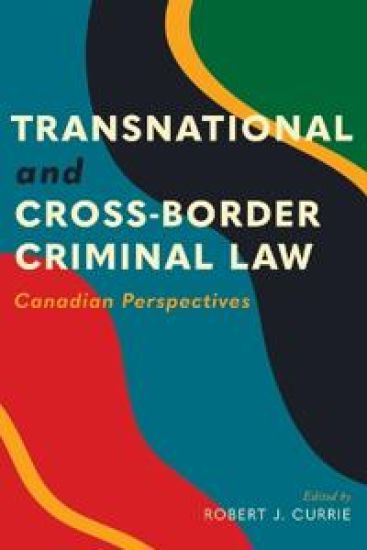
The time of globalization has seen an onslaught of criminal activity that crosses borders. The legal suppression and prosecution of transnational and cross-border crime raise unique and complex legal issues, and law enforcement, lawyers, and judges have struggled to keep up. Transnational & Cross-Border Criminal Law: Canadian Perspectives fills a pronounced gap in Canadian legal literature. Written by subject matter experts, each chapter exposes and analyzes a current and pressing issue in this realm and is designed both to serve as a resource for researchers and to provide cutting-edge insight on front-burner issues. The group of authors -- made up of prosecutors, defence lawyers, government counsel, academics, and civil society advocates -- take on a variety of subjects, including terrorism, financial crime and corruption, jurisdiction, extradition, money laundering, trafficking, maritime enforcement, cross-border evidence-gathering, and the international transfer of prisoners. This unique collection will help to advance general understanding of one of the most pressing public policy issues of our time.
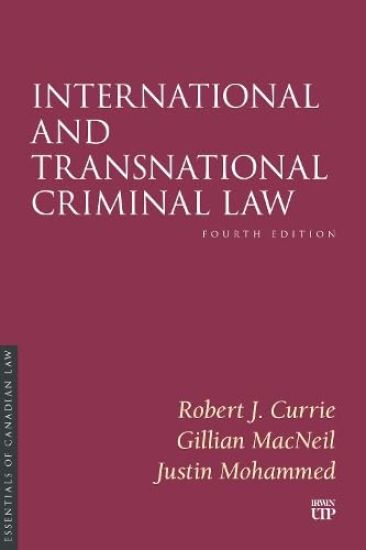
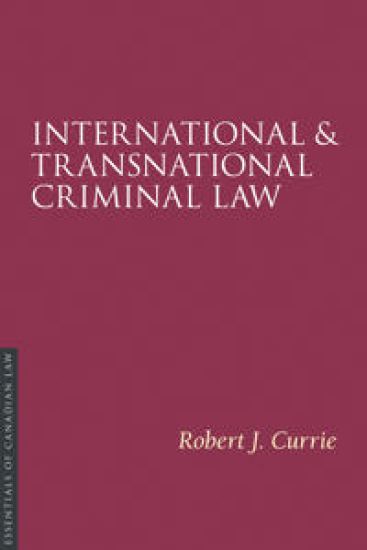
As international society has globalized, so too has crime. Both countries and the collective international community have struggled to deal with criminal activity that has global proportions and effects – from international crimes like genocide and war crimes to transnational crimes like terrorism and trafficking. The systems of law designed to suppress these crimes are complex and often poorly understood; thus, this book brings together a concise and lucid explication and analysis of international and transnational criminal law. A collaboration between leading legal scholars Robert J. Currie, Gillian MacNeil, and Justin J. Mohammed, this book is designed to help those who work in criminal law and international law respectively speak the legal language of the other, and to provide accessible explanations of the legal tools and doctrines. It highlights the work of international courts, the use of treaties, and the investigational techniques that operate in this area, but its focus on Canada makes it an invaluable resource for Canadian lawyers, judges, researchers, students and law enforcement personnel. This updated and revised 4th edition builds on the success of earlier editions, which have been cited by the Supreme Court of Canada and other Canadian courts, in providing up-to-date accounts of international developments, Canadian case law and practice, and relevant literature.
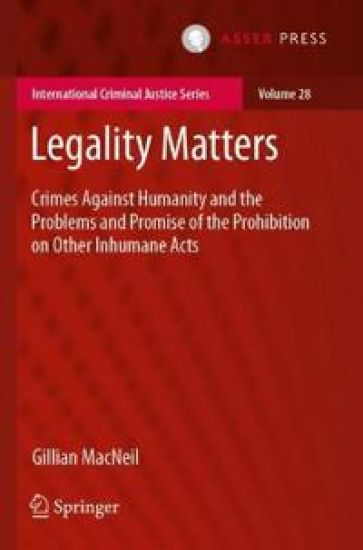
This book examines the way international criminal courts and tribunals have interpreted the crimes against humanity proscription of other inhumane acts. This clause is consistently used in spite of the long list of more specific offences forbidden as crimes against humanity. The volume proposes that the current approach is based on a misunderstanding of the nature of the clause. Properly understood, the clause is an invitation to courts to create and apply retroactive criminal laws. This leads to a problem. A prohibition on the use of retroactive criminal laws, one which admits no exceptions, is deeply embedded in international law. The author argues that it is time to revisit the assumption that retroactive criminal laws can never be deployed in a fair legal system. Drawing lessons from an exploration on the way the prohibition on retroactive laws is applied in practice, she proposes a new framework for understanding the clause proscribing the commission of other inhumane acts. This book will be of relevance to anyone interested in international criminal law or criminal law theory. Gillian MacNeil is Assistant Professor at Robson Hall, the Faculty of Law of the University of Manitoba in Winnipeg, Canada.
International criminal law has focused on the prosecution of truly international crimes -- genocide, crimes against humanity, war crimes, and aggression. The emerging field of transnational criminal law reflects the fact that our post-Cold War, post-9/11 world has seenbthe growth of transnational crimes of international concern, such as terrorism, money laundering, organized crime, and human and narcotics trafficking, as well as transnational crimes of domestic concern, which are simply ordinary domestic crimes that involve the jurisdiction of more than one state. This book surveys these two related but increasingly distinct fields with a focus on Canada, bringing together in one accessible text topics that are of increasing importance in a world of globalized crime, from a substantive perspective and through examination of the expanding range of international tribunals dealing with such crimes. This third edition updates caselaw and international practice from Canada, including substantial revisions relating to the prosecution of cross-border crimes. It also combines examinations of international courts and tribunals, transnational criminal law treaties, and recent literature to provide a unique perspective on these two international law disciplines that, while best viewed as separate, retain a common heritage and some overlapping concepts and applications.