Kirjojen hintavertailu – 12 859 819 kirjaa ja 27 kauppaa

Kirjailija

Giorgio de Santillana

Kirjat ja teokset yhdessä paikassa: 5 kirjaa, julkaisuja vuosilta 1978–2016, suosituimpiin kuuluu Le Moulin d'Hamlet: La connaissance, origine et transmission par les mythes. Vertaile teosten hintoja ja tarkista saatavuus suomalaisista kirjakaupoista.

5 kirjaa

Kirjojen julkaisuvuodet: 1978–2016.

Le Moulin d'Hamlet: La connaissance, origine et transmission par les mythes

Le Moulin d'Hamlet: La connaissance, origine et transmission par les mythes

Hertha Von Dechend; Giorgio de Santillana

Les Editions de L'Oeil Du Sphinx
2016
nidottu
Les hommes de la fin du n olithique connaissaient-ils la m canique c leste et la grande horloge cosmique ? Avaient-ils appr hend les cycles de la "grande roue" des plan tes dans l'espace, les effets de la "pr cession des quinoxes" ? Quelles taient les influences de ces derniers sur leur pens e et leur sacr ? Ont-ils pu transmettre cette science de l'astronomie avant l'invention de l' criture ? Les auteurs de ce livre nous proposent une relecture des textes sacr s et mythologiques de l'humanit fond s sur une tradition orale remontant entre autres aux poques archa ques m sopotamienne, nordique, gyptienne, grecque, hindoue ou persane. Ils d montrent qu'y affleurent des l ments "fossilis s" d'un savoir tr s ancien, beaucoup plus important qu'on ne l'imagine aujourd'hui. Ce faisant, ils contribuent ouvrir des perspectives de recherche dans le champ de l'arch o-astronomie et dans celui des mythologies compar es. Cette traduction est la seule dition fran aise de ce livre culte.
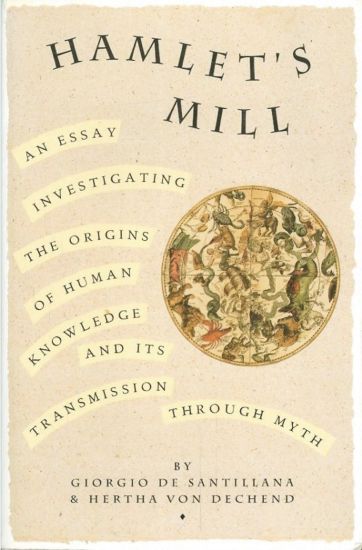
Hamlet's Mill

Hamlet's Mill

Giorgio De Santillana; Hertha Von Dechend

David R. Godine Publisher Inc
2015
pokkari

Halvin toimitettuna 31,00 €

A truly seminal and original thesis, this is a book that should be read by anyone interested in science, myth, and the interactions between the two. In this classic work of scientific and philosophical inquiry, the authors track world myths to a common origin in early man's descriptions of cosmological activity, arguing that these remnants of ancient astronomy, suppressed by the Greeks and Romans and then forgotten, were really a form of pre-literate science. Myth became the synapse by which science was transmitted. Their truly original thesis challenges basic assumptions of Western science and theories about the transmission of knowledge.
The Dawn of Day

The Dawn of Day

Friedrich Wilhelm Nietzsche; Giorgio De Santillana

Dover Publications Inc.
2007
nidottu
One of the most important philosophers of the nineteenth century, Friedrich Nietzsche's influence on modern thought has extended beyond the borders of philosophy. His works have helped shape modern anthropology, psychology, theology, and sociology. Poets, novelists, and artists have also been touched by Nietzsche's powerful concepts and perspectives. Edited by a noted Nietzsche scholar, this authoritative compendium is a vital assembly of nearly all of Nietzsche's early works. Marking the advent of his mature philosophy, these aphorisms and prose poems examine the impulses that lead human beings to seek the comforts of religion, morality, metaphysics, and art. Nietzsche proposes greater individualism and personality development, addresses issues of society and family, and discusses visions of free spirits with the courage to be rid of idealist prejudices. Written in his distinctive, often paradoxical style, The Dawn of Day presents practically every theme touched upon in Nietzsche's later philosophical essays. It is an essential guide and a fundamental basis for the understanding of the great philosopher and his work.
The Crime of Galileo

The Crime of Galileo

Giorgio de Santillana

University of Chicago Press
1978
nidottu
"In the gallery of what might be called the martyrs of thought, the image of Galileo recanting before the Italian Inquisition stirs the minds of educated modern men second only to the picture of Socrates drinking the Hemlock. That image of Galileo is out of focus . . . because it has been distorted by three centuries of rationalist prejudice and clerical polemics. To refocus it clearly, within the logic of its own time . . . de Santillana has written The Crime of Galileo, a masterly intellectual whodunit which traces not the life but the mental footsteps of Galileo on his road to personal tragedy."—Time