
Kirjojen hintavertailu – 12 903 724 kirjaa ja 27 kauppaa

Kirjailija

Gladys Hooi Chuan Wong

Kirjat ja teokset yhdessä paikassa: 3 kirjaa, julkaisuja vuodelta 2022, suosituimpiin kuuluu Innovation In 3d Printing Technology: Manufacturing, Food And Biomedical Engineering - Bioprinting: Principles And Applications; Digital Gastronomy: From 3d Food Printing To Personalized Nutrition; 3d Printing And Additive Manufacturing (5th Edition). Vertaile teosten hintoja ja tarkista saatavuus suomalaisista kirjakaupoista.

3 kirjaa

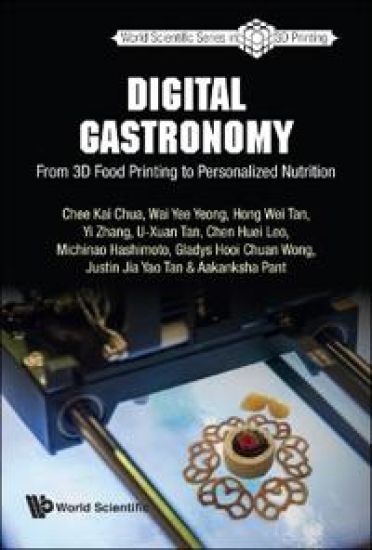
Digital Gastronomy: From 3d Food Printing To Personalized Nutrition

Digital Gastronomy: From 3d Food Printing To Personalized Nutrition

Chee Kai Chua; Wai Yee Yeong; Hong Wei Tan; Yi Zhang; U-xuan Tan; Chen Huei Leo; Michinao Hashimoto; Gladys Hooi Chuan Wong; Justin Jia Yao Tan; Aakanksha Pant

WORLD SCIENTIFIC PUBLISHING CO PTE LTD
2022
sidottu
The food industry has seen many changes over the last several decades — new technologies have been introduced into the way we cook, manufacture, and present food products to consumers. Digital gastronomy, which combines new computational abilities such as three-dimensional (3D) printing with traditional food preparation, has allowed consumers to design and manufacture food with personalized shapes, colours, textures, and even nutrition. In addition to the personalization of food, 3D printing of food has other advantages such as promoting automation in food preparation and food sustainability through 3D-printed cell-based meats and alternative proteins. Entire meals can be constructed just by 3D food printing alone. In this textbook, the background, principles, commercial food printers, materials, regulations, business development, as well as the emerging technologies and future outlook of 3D food printing are explored. In terms of 3D-printed materials, four main classes are reviewed: namely, desserts / snacks (comprising dairy products, chocolate, sugars, and dough), fruits / vegetables, meats /alternative proteins, and pharmaceuticals / nutraceuticals. This textbook has been written to offer readers keen to learn more about 3D food printing in terms of concepts, processes, applications, and developments of 3D food printing. No prior knowledge is required. At the end of each chapter, a set of problems offers undergraduate and postgraduate students practice on the main ideas discussed within the chapter. For tertiary-level lecturers and university professors, the topic on 3D food printing can be associated to other subjects in food and nutrition, pharmaceutical and nutraceutical sciences, and food engineering. Related Link(s)
Digital Gastronomy: From 3d Food Printing To Personalized Nutrition

Digital Gastronomy: From 3d Food Printing To Personalized Nutrition

Chee Kai Chua; Wai Yee Yeong; Hong Wei Tan; Yi Zhang; U-xuan Tan; Chen Huei Leo; Michinao Hashimoto; Gladys Hooi Chuan Wong; Justin Jia Yao Tan; Aakanksha Pant

WORLD SCIENTIFIC PUBLISHING CO PTE LTD
2022
nidottu
The food industry has seen many changes over the last several decades — new technologies have been introduced into the way we cook, manufacture, and present food products to consumers. Digital gastronomy, which combines new computational abilities such as three-dimensional (3D) printing with traditional food preparation, has allowed consumers to design and manufacture food with personalized shapes, colours, textures, and even nutrition. In addition to the personalization of food, 3D printing of food has other advantages such as promoting automation in food preparation and food sustainability through 3D-printed cell-based meats and alternative proteins. Entire meals can be constructed just by 3D food printing alone. In this textbook, the background, principles, commercial food printers, materials, regulations, business development, as well as the emerging technologies and future outlook of 3D food printing are explored. In terms of 3D-printed materials, four main classes are reviewed: namely, desserts / snacks (comprising dairy products, chocolate, sugars, and dough), fruits / vegetables, meats /alternative proteins, and pharmaceuticals / nutraceuticals. This textbook has been written to offer readers keen to learn more about 3D food printing in terms of concepts, processes, applications, and developments of 3D food printing. No prior knowledge is required. At the end of each chapter, a set of problems offers undergraduate and postgraduate students practice on the main ideas discussed within the chapter. For tertiary-level lecturers and university professors, the topic on 3D food printing can be associated to other subjects in food and nutrition, pharmaceutical and nutraceutical sciences, and food engineering. Related Link(s)
Innovation In 3d Printing Technology: Manufacturing, Food And Biomedical Engineering - Bioprinting: Principles And Applications; Digital Gastronomy: From 3d Food Printing To Personalized Nutrition; 3d Printing And Additive Manufacturing (5th Edition)

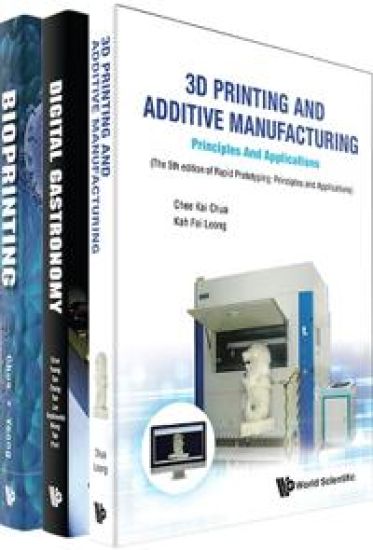
Innovation In 3d Printing Technology: Manufacturing, Food And Biomedical Engineering - Bioprinting: Principles And Applications; Digital Gastronomy: From 3d Food Printing To Personalized Nutrition; 3d Printing And Additive Manufacturing (5th Edition)

Chee Kai Chua; Wai Yee Yeong; Hong Wei Tan; Yi Zhang; U-xuan Tan; Chen Huei Leo; Michinao Hashimoto; Gladys Hooi Chuan Wong; Justin Jia Yao Tan; Aakanksha Pant; Kah Fai Leong

WORLD SCIENTIFIC PUBLISHING CO PTE LTD
2022
nidottu
Connecting the Dots: The Synergy of 3D Printing InnovationsThese three books collectively illustrate the versatile and transformative nature of 3D printing technology. Bioprinting: Principles and Applications sets the stage by exploring how 3D printing is revolutionizing healthcare through the creation of biological tissues and organs. Digital Gastronomy extends the discussion to the culinary realm, showcasing the creative and practical applications of 3D printing in food design and production. Finally, 3D Printing and Additive Manufacturing provides a comprehensive overview of the technology's impact across various sectors, highlighting its potential to drive innovation and efficiency in manufacturing.