Kirjojen hintavertailu – 12 903 725 kirjaa ja 27 kauppaa

Kirjailija

Glen Biglaiser

Kirjat ja teokset yhdessä paikassa: 4 kirjaa, julkaisuja vuosilta 2002–2012, suosituimpiin kuuluu Politics and Foreign Direct Investment. Vertaile teosten hintoja ja tarkista saatavuus suomalaisista kirjakaupoista.

4 kirjaa

Kirjojen julkaisuvuodet: 2002–2012.

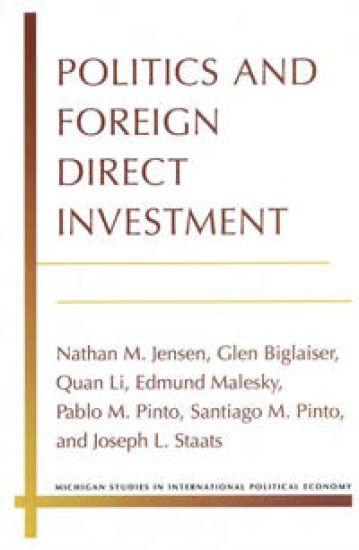
Politics and Foreign Direct Investment

Politics and Foreign Direct Investment

Nathan Jensen; Glen Biglaiser; Quan Li; Edmund Malesky; Pablo Pinto; Santiago Pinto; Joseph Staats

The University of Michigan Press
2012
nidottu
For decades, free trade was advocated as the vehicle for peace, prosperity, and democracy in an increasingly globalized market. More recently, the proliferation of foreign direct investment has raised questions about its impact upon local economies and politics. Here, seven scholars bring together their wide-ranging expertise to investigate the factors that determine the attractiveness of a locale to investors and the extent of their political power. Multinational corporations prefer to invest where legal and political institutions support the rule of law, protections for property rights, and democratic processes. Corporate influence on local institutions, in turn, depends upon the relative power of other players and the types of policies at issue.
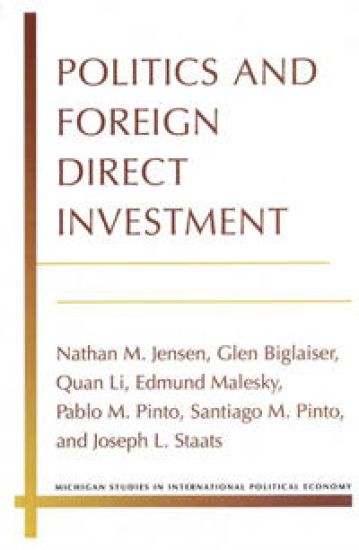
Politics and Foreign Direct Investment

Politics and Foreign Direct Investment

Nathan Jensen; Glen Biglaiser; Quan Li; Edmund Malesky; Pablo Pinto; Santiago Pinto; Joseph Staats

The University of Michigan Press
2012
sidottu
For decades, free trade was advocated as the vehicle for peace, prosperity, and democracy in an increasingly globalized market. More recently, the proliferation of foreign direct investment has raised questions about its impact upon local economies and politics. Here, seven scholars bring together their wide-ranging expertise to investigate the factors that determine the attractiveness of a locale to investors and the extent of their political power. Multinational corporations prefer to invest where legal and political institutions support the rule of law, protections for property rights, and democratic processes. Corporate influence on local institutions, in turn, depends upon the relative power of other players and the types of policies at issue.

Guardians of the Nation?

Guardians of the Nation?

Glen Biglaiser

University of Notre Dame Press
2002
nidottu
Central to the question of how to promote economic growth in Latin America is the role different types of regimes play in determining economic performance. Guardians of the Nation? challenges conventional wisdom regarding the expected advantages of military rule for economic growth. Glen Biglaiser explains why many military regimes in Latin America have not performed noticeably better than their democratic counterparts. Biglaiser argues that economic policy-making under military regimes is essentially an unintended by-product of the military's strategy to retain power. Using this premise, he examines the economic performance of regimes in Argentina, Chile, and Uruguay. Biglaiser shows that the appointment of neoliberal economists occurred not because military rulers possessed inherent interest in following market-oriented policies, but because they saw the appointments as a way to solidify their power. Biglaiser's study also depicts Pinochet's one-man rule as unique vis-à-vis the military regimes in Argentina and Uruguay. He concludes by demonstrating that his study is also applicable for understanding economic policy choice under democratic rule, and by comparing the similarities and differences between presidential and parliamentary governments.
Guardians of the Nation?

Guardians of the Nation?

Glen Biglaiser

University of Notre Dame Press
2002
sidottu
Central to the question of how to promote economic growth in Latin America is the role different types of regimes play in determining economic performance. Guardians of the Nation? challenges conventional wisdom regarding the expected advantages of military rule for economic growth. Glen Biglaiser explains why many military regimes in Latin America have not performed noticeably better than their democratic counterparts. Biglaiser argues that economic policy-making under military regimes is essentially an unintended by-product of the military's strategy to retain power. Using this premise, he examines the economic performance of regimes in Argentina, Chile, and Uruguay. Biglaiser shows that the appointment of neoliberal economists occurred not because military rulers possessed inherent interest in following market-oriented policies, but because they saw the appointments as a way to solidify their power. Biglaiser's study also depicts Pinochet's one-man rule as unique vis-à-vis the military regimes in Argentina and Uruguay. He concludes by demonstrating that his study is also applicable for understanding economic policy choice under democratic rule, and by comparing the similarities and differences between presidential and parliamentary governments.