Kirjojen hintavertailu – 12 859 819 kirjaa ja 27 kauppaa
Kirjailija
Götz Aly
Kirjat ja teokset yhdessä paikassa: 27 kirjaa, julkaisuja vuosilta 1994–2025, suosituimpiin kuuluu Das letzte Kapitel. Vertaile teosten hintoja ja tarkista saatavuus suomalaisista kirjakaupoista.
Bis zur Besetzung Ungarns durch die Deutschen im Jahre 1944 konnten die ca. 800.000 ungarischen Juden einigermaßen sicher leben. Mit den deutschen Truppen rückte das :Kommando Eichmann9 in Budapest ein. Binnen sieben Wochen deportierte diese Gruppe in Zusammenarbeit mit ungarischen Behörden 440.000 Juden nach Auschwitz.
A controversial book when originally published in Germany, The Nazi Census documents the origins of the census in modern Germany, along with the parallel development of machines that helped first collect data on Germans, then specifically on Jews and other minorities. G\u00f6tz Aly and Karl Heinz Roth begin by examining the history of statistical technology in Germany, from the Hollerith machine in the 1890s through the development and licensing of IBM punch-card technology. Aly and Roth explain that census data was collected on non-Germans in order to satisfy the state's desire to track racial groups for alleged security reasons. Later this information led to disastrous results for those groups and others that were tracked in similar ways. Ultimately, as G\u00f6tz Aly and Karl Heinz Roth point out in this short, rigorously researched book, the techniques the Nazis employed to track, gather information, and control populations initiated the modern system of citizen registration. Aly and Roth argue that what led to the devastating effects of the Nazi census was the ends to which they used their data, not their means. It is the employment of \u0022normal\u0022 methods of collection that the authors examine historically as it applies to the Nazi regime, and also the way contemporary methods of classification and control still affect the modern world.
A groundbreaking study of the numerous academics and technocrats without whom Hitler's crude anti-Semitism could never have been translated into a systematic policy of genocide. ARCHITECTS OF ANNIHILATION follows the activities of the demographers, economists, geographers and planners in the period between the disorderly excesses of the November 1938 pogrom and the fully-effective operation of the gas chambers at Auschwitz in summer 1942. The authors, both journalists and historians, argue that this group of intellectuals, often combining academic, civil service and Party functions, made an indispensable contribution to the planning and execution of the Final Solution. More than that, in the economic and demographic rationale of these experts, the Final Solution was only one element in a far-reaching programme of self-sufficiency which privileged the German Aryan population.
Two of Germany's most provocative investigative historians examine the frightening role of young educated careerists in building the Holocaust's ideological and material infrastructure. Moving from the waning Weimar Republic to Auschwitz's fully operating gas chambers, Architects of Annihilation shows how the unthinkable technocratic solutions to Germany's wartime problems were not only thought but spelled out and implemented. Documenting the eager participation of some of the country's best and brightest, it rejects interpretations that identify only Nazi leaders as the perpetrators of the Holocaust. For Hitler's thinkers--career-minded demographers, geographers, economists, civil servants, and academics in the Third Reich's think tanks and bureaucratic offices--Europe was a drawing board on which to work out their grand designs. They were encouraged to rationalize production methods, standardize products, introduce an international division of labor, and modernize and simplify social structures. Ultimately, their work on everything from food shortages to birth control led to the sinister plan to adjust the ratio between productive or unproductive population groups. The ideas of these ever more radical and ideologically aggressive technocrats culminated in proposals that--using carefully guarded scientific and academic euphemisms--advocated state-directed mass extermination as a necessary and logical component of social modernization. And, not well known outside of Germany, these thinkers proposed not only one final solution but serial genocides, planned in detail to be carried out over several decades. This groundbreaking and controversial account of Hitler's planners received widespread attention when it appeared in Germany. Now a masterful translation makes it available to an English-speaking audience for the first time.
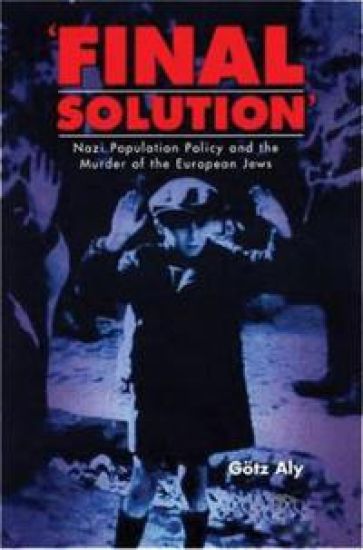
How did it come about that a modern European state in the middle of the twentieth century planned and carried out the industrially organized mass murder of six million Jews, male and female, adults and children? Making extensive use of Russian, German, and Polish archives, Aly has provided the most exact and detailed reconstruction of the 'Final Solution' yet achieved. As well as looking at the ideological imperative in the Nazi state to 'solve the Jewish question' and at Hitler's own role, Aly investigates the actions of those running the Reich Security Headquarters in Berlin and of those numerous lesser figures on the ground who were in the eye of the storm, grappling with the planning failures inherent in Nazi resettlement plans and experiencing mounting difficulties in trying to be rid of 'their' Jews. Aly illustrates, through the evidence he builds into an overall mosaic, the lunacy of Nazi race policy, and the variety of agencies that went into the gradual shaping of a policy of all-out genocide.
"The chapters in this volume painfully drive home the point that certainly as far as Germany is concerned, the lessons of the Third Reich have not yet been learned... These significant attempts by younger recruits to the larger medical establishment to change things through eye-opening reflection and analysis, however uncomfortable, need support."-Michael H. Kater, author of Doctors under Hitler, in the foreword. The infamous Nuremberg Doctors' Trials of 1946-47 revealed horrifying crimes -ranging from grotesque medical experiments on humans to mass murder-committed by physicians and other health care workers in Nazi Germany. But far more common, argue the authors of Cleansing the Fatherland, were the doctors who profited professionally and financially from the killings but were never called to task-and, indeed, were actively shielded by colleagues in postwar German medical organizations. The authors examine the role of German physicians in such infamous operations as the "T 4" euthanasia program (code-named for the Berlin address of its headquarters at Number 4 Tiergartenstrasse). They also reveal details of countless lesser known killings-all ordered by doctors and all in the name of public health. Maladjusted adolescents, the handicapped, foreign laborers too illto work, even German civilians who suffered mental breakdowns after air raids were "selected for treatment." (One physician who persisted in speaking of "killings" was officially reprimanded for his "negative attitude.") The book also includes original documents-never before published in English-that give unique and chilling insight into the everyday workings of Nazi medicine. Among them: * Minutes from a 1940 meeting of the Conference of German Mayors, at which a Nazi official gives the assembled politicians detailed instructions for the secret burial of murdered mental patients. * A pre-Nazi era questionnaire sent by the head of a state mental institution to parents of disabled children. (Sample question: "Would you agree to a painless shortening of your child's life after an expert had determined him incurably imbecilic?" Sample answer: "Yes, but I would prefer not to know.") * The diary of Dr. Hermann Voss, chief anatomist at the Reichs University of Posen (and later a highly respected physician in postwar Germany), who delights in the flowers blooming outside his window and worries that the overstock of Polish cadavers from his Gestapo suppliers might cause his crematory oven to break down. * Letters of Dr. Friedrich Mennecke, director of the notorious Eichberg Clinic, who writes with cloying sentimentality to the wife he calls "mommy" and comments offhandedly about visiting concentration camps to select "patients" for death. Today, as reports of mass death in Europe are once again cast in terms of public hygiene, and as euthanasia is advocated-even applauded-on U. S. television, the relevance of what Michael H. Kater here calls "the lessons of the Third Reich" is perhaps greater than ever. Against this background, Cleansing the Fatherland sends a stark message that is difficult to ignore.