Kirjojen hintavertailu – 12 903 735 kirjaa ja 27 kauppaa

Kirjailija

Graziella Parati

Kirjat ja teokset yhdessä paikassa: 5 kirjaa, julkaisuja vuosilta 1996–2018, suosituimpiin kuuluu Migrant Writers and Urban Space in Italy. Vertaile teosten hintoja ja tarkista saatavuus suomalaisista kirjakaupoista.

5 kirjaa

Kirjojen julkaisuvuodet: 1996–2018.

Migrant Writers and Urban Space in Italy

Migrant Writers and Urban Space in Italy

Graziella Parati

Springer International Publishing AG
2018
nidottu
This book is about migrants’ lives in urban space, in particular Rome and Milan. At the core of the book is literature as written by migrants, members of a “second generation,” and a filmmaker who defines himself as native. It argues that the narrative authored by migrants, refugees, second generation women, and one “native Italian” perform a reparative reading of Italian spaces in order to engender reparative narratives. Eve Sedgwick wrote about our (now) traditional way of reading based on unveiling and on, mainly, negative affect. We are trained to tear the text apart, dig into it, and uncover the anxieties that define our age. Migrants writers seem to employ both positive and negative affects in defining the past, present, and future of the spaces they inhabit. Their recuperative acts of writing, constitute powerful models of changes in/on place. As they look at Italian exclusionary spaces, they also rewrite them into a present whose transitiveness allows to imagine a process of citizenship and belong constructed from below.
Migrant Writers and Urban Space in Italy

Migrant Writers and Urban Space in Italy

Graziella Parati

Springer International Publishing AG
2017
sidottu
This book is about migrants’ lives in urban space, in particular Rome and Milan. At the core of the book is literature as written by migrants, members of a “second generation,” and a filmmaker who defines himself as native. It argues that the narrative authored by migrants, refugees, second generation women, and one “native Italian” perform a reparative reading of Italian spaces in order to engender reparative narratives. Eve Sedgwick wrote about our (now) traditional way of reading based on unveiling and on, mainly, negative affect. We are trained to tear the text apart, dig into it, and uncover the anxieties that define our age. Migrants writers seem to employ both positive and negative affects in defining the past, present, and future of the spaces they inhabit. Their recuperative acts of writing, constitute powerful models of changes in/on place. As they look at Italian exclusionary spaces, they also rewrite them into a present whose transitiveness allows to imagine a process of citizenship and belong constructed from below.
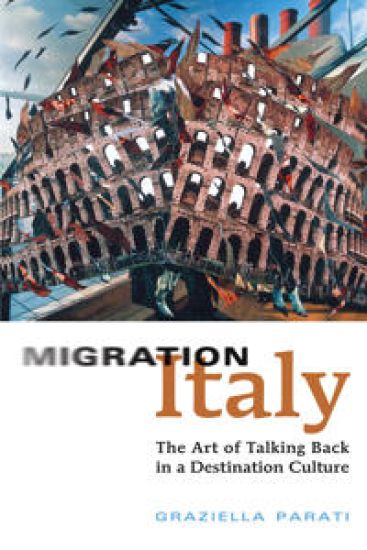
Migration Italy

Migration Italy

Graziella Parati

University of Toronto Press
2014
pokkari
In terms of migration, Italy is often thought of as a source country - a place from which people came rather than one to which people go. However, in the past few decades, Italy has indeed become a destination for many people from poor or war-torn countries seeking a better life in a stable environment. Graziella Parati's Migration Italy examines immigration to Italy in the past twenty years, and explores the processes of cultural hybridization that have occurred. Working from a cultural studies viewpoint, Parati constructs a theoretical framework for discussing Italy as a country of immigration. She gives special attention to immigrant literature, positing that it functions as an act of resistance, a means to talk back to the laws that regulate the lives of migrants. Parati also examines Italian cinema, demonstrating how native and non-native filmmakers alike create parallels between old and new migrations, complicating the definitions of sameness and difference. These definitions and the complexities inherent in the different cultural, legal, and political positions of Italy's people are at the heart of Migration Italy, a unique work of immense importance for understanding society in both modern-day Italy and, indeed, the entire European continent.
The Cultures of Italian Migration

The Cultures of Italian Migration

Anthony Julian Tamburri; Graziella Parati

Fairleigh Dickinson University Press
2011
sidottu
The Cultures of Italian Migration allows the adjective "Italian" to qualify people's movements along diverse trajectories and temporal dimensions. Discussions on migrations to and from Italy meet in that discursive space where critical concepts like "home," "identity," "subjectivity," and "otherness" eschew stereotyping. This volume demonstrates that interpretations of old migrations are necessary in order to talk about contemporary Italy. New migrations trace new non linear paths in the definition of a multicultural Italy whose roots are unmistakably present throughout the centuries. Some of these essays concentrate on topics that are historically long-term, such as emigration from Italy to the Americas and southern Pacific Ocean. Others focus on the more contemporary phenomena of immigration to Italy from other parts of the world, including Africa. This collection ultimately offers an invitation to seek out new and different modes of analyzing the migratory act.
Public History, Private Stories

Public History, Private Stories

Graziella Parati

University of Minnesota Press
1996
nidottu
Explores the way Italian women writers craft identities through writing. In this important volume, Graziella Parati examines the ways in which Italian women writers articulate their identities through autobiography-a public act that is also the creation of a private life. Considering autobiographical writings by five women writers from the seventeenth century to the present, Parati draws important connections between self-writing and the debate over women’s roles, both traditional and transgressive. Parati considers the first prose autobiography written by an Italian woman -Camilla FaÀ Gonzaga’s 1622 memoir-as her beginning point, citing it as a central “pre-text.” In her memoir, Gonzaga makes explicit her conflict over the public silence imposed on her, yet succeeds in writing herself into history through self-narrative. Parati then examines Enif Robert’s autobiography, in which Robert strives to enter the public sphere of the post-World War I futurist movement by writing about her fight to overcome cancer of the uterus. Next, Parati considers Fausta Cialente’s life story, an account of her family's life in Trieste from World War I through the fascist era, as well as the narrative in which Rita Levi Montalcini describes her life as a woman, a Nobel-Prize winning scientist, and a Jew who lived under fascism in the thirties and forties. Finally, Parati analyzes Luisa Passerini's look back on her involvement with the student movement of 1968. Through her discussion of these women’s writings, Parati demonstrates the complex negotiations over identity contained within them, negotiations that challenge dichotomies between male and female, maternal and paternal, and private and public. Public History, Private Stories is a compelling exploration of the disparate identities created by these women through the act of writing autobiography.