
Kirjailija
Greg Noble
Kirjat ja teokset yhdessä paikassa: 9 kirjaa, julkaisuja vuosilta 2011–2026, suosituimpiin kuuluu Migrant, Habitus. Vertaile teosten hintoja ja tarkista saatavuus suomalaisista kirjakaupoista.
9 kirjaa
Kirjojen julkaisuvuodet: 2011–2026.
Doing Diversity Differently in a Culturally Complex World
Megan Watkins; Greg Noble
Bloomsbury Academic
2021
nidottu
Doing Diversity Differently in a Culturally Complex World explores the challenges facing multicultural education in the 21st century. It argues that the ideas fashioned in 1970s ‘multiculturalism’ are no longer adequate for the culturally complex world in which we now live. Much multicultural education celebrates superficial forms of difference and avoids difficult questions around culture in an age of transnational flows and hybrid identities. Megan Watkins and Greg Noble explore the understandings of multiculturalism that exist amongst teachers, parents and students. They demonstrate that ideas around culture and identity don’t match the complexities of the social contexts of schooling in migrant-based nations such as Australia, the UK, the USA, Canada and New Zealand. Doing Diversity Differently in a Culturally Complex World draws on comprehensive research undertaken in Australian schools. It examines how a diverse range of schools address the challenges that ‘superdiversity’ poses, considering how the strengths and limitations of each school’s approach reflect wider logics of traditional multiculturalism. In contrast, the authors argue for a transformative multiculturalism involving a critically reflexive approach to understanding the processes, relations and identities of the contemporary world. With a Foreword by Fazal Rivzi, Emeritus Professor, University of Illinois at Urbana-Champaign, USA and Professor of Global Studies in Education, University of Melbourne, Australia.
Doing Diversity Differently in a Culturally Complex World
Megan Watkins; Greg Noble
Bloomsbury Academic
2021
sidottu
Doing Diversity Differently in a Culturally Complex World explores the challenges facing multicultural education in the 21st century. It argues that the ideas fashioned in 1970s ‘multiculturalism’ are no longer adequate for the culturally complex world in which we now live. Much multicultural education celebrates superficial forms of difference and avoids difficult questions around culture in an age of transnational flows and hybrid identities. Megan Watkins and Greg Noble explore the understandings of multiculturalism that exist amongst teachers, parents and students. They demonstrate that ideas around culture and identity don’t match the complexities of the social contexts of schooling in migrant-based nations such as Australia, the UK, the USA, Canada and New Zealand. Doing Diversity Differently in a Culturally Complex World draws on comprehensive research undertaken in Australian schools. It examines how a diverse range of schools address the challenges that ‘superdiversity’ poses, considering how the strengths and limitations of each school’s approach reflect wider logics of traditional multiculturalism. In contrast, the authors argue for a transformative multiculturalism involving a critically reflexive approach to understanding the processes, relations and identities of the contemporary world. With a Foreword by Fazal Rivzi, Emeritus Professor, University of Illinois at Urbana-Champaign, USA and Professor of Global Studies in Education, University of Melbourne, Australia.
Cultural Pedagogies and Human Conduct
Megan Watkins; Greg Noble; Catherine Driscoll
Routledge
2019
nidottu
Pedagogy is often glossed as the ‘art and science of teaching’ but this focus typically ties it to the instructional practices of formalised schooling. Like the emerging work on ‘public pedagogies’, the notion of cultural pedagogies signals the importance of the pedagogic in realms other than institutionalised education, but goes beyond the notion of public pedagogies in two ways: it includes spaces which are not so public, and it includes an emphasis on material and non-human actors. This collection foregrounds this broader understanding of pedagogy by framing enquiry through a series of questions and across a range of settings. How, for example, are the processes of ‘teaching’ and ‘learning’ realised within and across the pedagogic processes specific to various social sites? What ensembles of people, things and practices are brought together in specific institutional and everyday settings to accomplish these processes? This collection brings together researchers whose work across the interdisciplinary nexus of cultural studies, sociology, media studies, education and museology offers significant insights into these ‘cultural pedagogies’ – the practices and relations through which cumulative changes in how we act, feel and think occur. Cultural Pedagogies and Human Conduct opens up debate across disciplines, theoretical perspectives and empirical foci to explore both what is pedagogical about culture and what is cultural about pedagogy.
Cultural Pedagogies and Human Conduct
Megan Watkins; Greg Noble; Catherine Driscoll
Routledge
2015
sidottu
Pedagogy is often glossed as the ‘art and science of teaching’ but this focus typically ties it to the instructional practices of formalised schooling. Like the emerging work on ‘public pedagogies’, the notion of cultural pedagogies signals the importance of the pedagogic in realms other than institutionalised education, but goes beyond the notion of public pedagogies in two ways: it includes spaces which are not so public, and it includes an emphasis on material and non-human actors. This collection foregrounds this broader understanding of pedagogy by framing enquiry through a series of questions and across a range of settings. How, for example, are the processes of ‘teaching’ and ‘learning’ realised within and across the pedagogic processes specific to various social sites? What ensembles of people, things and practices are brought together in specific institutional and everyday settings to accomplish these processes? This collection brings together researchers whose work across the interdisciplinary nexus of cultural studies, sociology, media studies, education and museology offers significant insights into these ‘cultural pedagogies’ – the practices and relations through which cumulative changes in how we act, feel and think occur. Cultural Pedagogies and Human Conduct opens up debate across disciplines, theoretical perspectives and empirical foci to explore both what is pedagogical about culture and what is cultural about pedagogy.
Cultures of Schooling (RLE Edu L Sociology of Education)
Mary Kalantzis; Bill Cope; Greg Noble; Scott Poynting
Routledge
2014
nidottu
This volume examines the ways schools respond to cultural and linguistic diversity. A richness of accumulated experience is portrayed in this study of six Australian secondary schools; partial success, near success or instructive failure as the culture of the school itself was transformed in an attempt to meet the educational needs of its students. Set in the context of a general historical background to the development of multicultural education in Australia, a theoretical framework is developed with which to analyze the move from the traditional curriculum of cultural assimilation to the progressivist curriculum of cultural pluralism. The book analyzes the limitations of the progressivist model of multicultural education and suggests a new ‘post-progressivist’ model, in evidence already in an incipient and as yet tentative ‘self-corrective’ trend in the case-study schools.
Disposed to Learn explores the relationship between ethnicity and dispositions towards learning, with a focus on primary school students of Chinese, Pasifika and Anglo Australian backgrounds. The authors challenge the tendency towards the essentializing of ethnicity within multiculturalism to argue for a more nuanced understanding of the relationship between culture and academic performance. Drawing on the work of Bourdieu, they examine how home and school practices produce particular attributes that are embodied as dispositions towards learning - the scholarly habitus. These home and school practices entail different modes of discipline which help or hinder student engagement. The book underlies the need for a better understanding of cultural diversity in schooling to address issues of educational inclusion.
Disposed to Learn explores the relationship between ethnicity and dispositions towards learning, with a focus on primary school students of Chinese, Pasifika and Anglo Australian backgrounds. The authors challenge the tendency towards the essentializing of ethnicity within multiculturalism to argue for a more nuanced understanding of the relationship between culture and academic performance. Drawing on the work of Bourdieu, they examine how home and school practices produce particular attributes that are embodied as dispositions towards learning - the scholarly habitus. These home and school practices entail different modes of discipline which help or hinder student engagement. The book underlies the need for a better understanding of cultural diversity in schooling to address issues of educational inclusion.
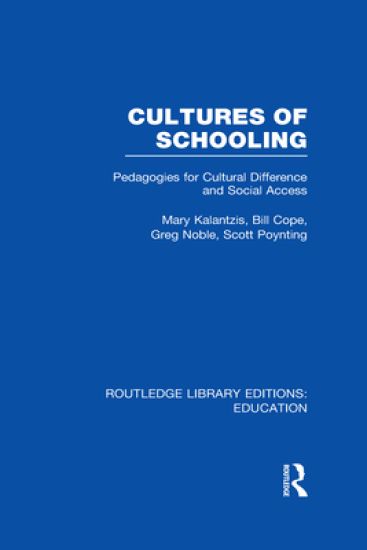
Cultures of Schooling (RLE Edu L Sociology of Education)
Mary Kalantzis; Bill Cope; Greg Noble; Scott Poynting
Routledge
2011
sidottu
This volume examines the ways schools respond to cultural and linguistic diversity. A richness of accumulated experience is portrayed in this study of six Australian secondary schools; partial success, near success or instructive failure as the culture of the school itself was transformed in an attempt to meet the educational needs of its students. Set in the context of a general historical background to the development of multicultural education in Australia, a theoretical framework is developed with which to analyze the move from the traditional curriculum of cultural assimilation to the progressivist curriculum of cultural pluralism. The book analyzes the limitations of the progressivist model of multicultural education and suggests a new ‘post-progressivist’ model, in evidence already in an incipient and as yet tentative ‘self-corrective’ trend in the case-study schools.