Kirjojen hintavertailu – 12 903 725 kirjaa ja 27 kauppaa

Kirjailija

Greg Simons

Kirjat ja teokset yhdessä paikassa: 5 kirjaa, julkaisuja vuosilta 2009–2025, suosituimpiin kuuluu Mass Media and Modern Warfare. Vertaile teosten hintoja ja tarkista saatavuus suomalaisista kirjakaupoista.

5 kirjaa

Kirjojen julkaisuvuodet: 2009–2025.

Mass Media and Modern Warfare

Mass Media and Modern Warfare

Greg Simons

Ashgate Publishing Limited
2009
sidottu
Mass media are essential to democratic society; in contrast, the War on Terror has been interpreted as an assault on democracy and freedom by Islamic fundamentalists. The building and maintenance of public support is essential in modern warfare due to the increasing politicization of warfare, where losses and gains are measured in political rather than military terms. And if progress cannot be demonstrated during a war, then by default one is assumed to be losing. Greg Simons tackles the complicated yet essential role of mass media in society. Taking the Global War on Terror as a prime example, the author adopts a multidisciplinary approach to analyze the various facets of war and the role of the media within it. Assessing in particular the Russian fight against terrorism, this book provides a broader perspective and understanding of contemporary struggles.
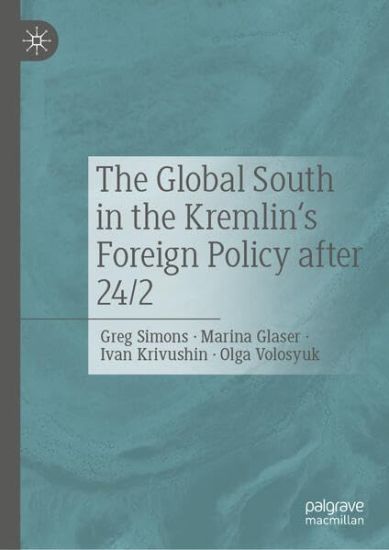
The Global South in the Kremlin's Foreign Policy after 24/2

The Global South in the Kremlin's Foreign Policy after 24/2

Greg Simons; Marina Glaser; Ivan Krivushin; Olga Volosyuk

Springer Nature Switzerland AG
2025
sidottu
This book offers the first in-depth analysis of the evolution of Russia's relations with the Global South across political, military-political, and economic domains. Though formally part of the Global North, Russia has, since 2007, increasingly positioned itself as an independent--and often opposing--actor to the West, aligning more closely with the Global South. This volume explores Russia's foreign policy during the 2022-2024 war with Ukraine and confrontation with the West, analyzing it at both global and regional levels. The contributors propose models for understanding the Kremlin's shifting strategies, including doctrinal orientations, redefinitions of national interest, and the role of personal leadership. The book also examines the tools of Russian foreign policy in the evolving geopolitical context. It highlights key areas such as Russia's efforts to reshape BRICS as a geo-economic counterweight to the West, its renewed activism in Sub-Saharan Africa, complex Middle Eastern diplomacy, and its strategic turn to Latin America--all within the broader pivot to the Global South. Placed in long-term historical context--from the medieval era to the 2000s--the book combines theoretical and applied analysis. It is written for a multidisciplinary audience and is suitable for academic and classroom use.
Rethinking Warfare in the 21st Century

Rethinking Warfare in the 21st Century

Iulian Chifu; Greg Simons

Cambridge University Press
2025
pokkari
This book seeks to critically review and evaluate the changes and consistencies in how warfare is interpreted and represented by academics, mass media outlets and political actors in the 21st century. The authors suggest that it is essential to understand the evolution and transformation of contemporary warfare's conceptualisation and practice in order to make sense of the current global geopolitical transformations that are in process, from a unipolar to multipolar global order. They therefore examine the various key actors in international relations from conceptual, theoretical and empirical perspectives through thematic chapters that demonstrate the increasingly central role played by intangible factors in the representation and management of contemporary armed conflict. The book stresses the need to reflect and rethink the potentially highly problematic trajectory of the global community within the framework of 21st century warfare's political and informational influence and effects.
Rethinking Warfare in the 21st Century

Rethinking Warfare in the 21st Century

Iulian Chifu; Greg Simons

Cambridge University Press
2023
sidottu
This book seeks to critically review and evaluate the changes and consistencies in how warfare is interpreted and represented by academics, mass media outlets and political actors in the 21st century. The authors suggest that it is essential to understand the evolution and transformation of contemporary warfare's conceptualisation and practice in order to make sense of the current global geopolitical transformations that are in process, from a unipolar to multipolar global order. They therefore examine the various key actors in international relations from conceptual, theoretical and empirical perspectives through thematic chapters that demonstrate the increasingly central role played by intangible factors in the representation and management of contemporary armed conflict. The book stresses the need to reflect and rethink the potentially highly problematic trajectory of the global community within the framework of 21st century warfare's political and informational influence and effects.
Religion, Politics and Nation-Building in Post-Communist Countries
The increasing significance and visibility of relationships between religion and public arenas and institutions following the fall of communism in Europe provide the core focus of this fascinating book. Leading international scholars consider the religious and political role of Christian Orthodoxy in the Russian Federation, Romania, Georgia and Ukraine alongside the revival of old, indigenous religions, often referred to as 'shamanistic' and look at how, despite Islam’s long history and many adherents in the south, Islamophobic attitudes have increasingly been added to traditional anti-Semitic, anti-Western or anti-liberal elements of Russian nationalism. Contrasts between the church’s position in the post-communist nation building process of secular Estonia with its role in predominantly Catholic Poland are also explored. Religion, Politics and Nation-Building in Post-Communist Countries gives a broad overview of the political importance of religion in the Post-Soviet space but its interest and relevance extends far beyond the geographical focus, providing examples of the challenges in the spheres of public, religious and social policy for all transitional countries.