

Kirjojen hintavertailu – 12 903 724 kirjaa ja 27 kauppaa

Kirjailija

Gregory D. Mele

Kirjat ja teokset yhdessä paikassa: 3 kirjaa, julkaisuja vuosilta 2014–2019, suosituimpiin kuuluu Flowers of Battle The Complete Martial Works of Fiore dei Liberi Vol 1. Vertaile teosten hintoja ja tarkista saatavuus suomalaisista kirjakaupoista.

3 kirjaa

Kirjojen julkaisuvuodet: 2014–2019.

Flowers of Battle The Complete Martial Works of Fiore dei Liberi Vol III

Flowers of Battle The Complete Martial Works of Fiore dei Liberi Vol III

Ken Mondschein; Gregory D. Mele

FreeLance Academy Press
2019
sidottu

Halvin toimitettuna 113,40 €

The warriors of medieval Italy practised a complex and complete martial art, which included the wielding of sword, axe and spear with wrestling, knife-fighting and mounted combat. In the waning years of the 14th century, Fiore dei Liberi was a famed master of this art, whose students included some of the most renowned and dangerous fighting men of his day. Credited by fencing historians as the father of Italian swordmanship, toward the end of his life, Master Fiore preserved his teachings in a series of illustrated manuscripts, four of which have survived to the present day, and have become the basis of a worldwide effort to reconstruct this lost martial art. This magnum opus, Il Fior di Batalgia (The Flower of Battle), composed in early 1409, is one of the oldest, most extensive, and most clearly elucidated martial arts treatises from the medieval period. Flowers of Battle is a multi-volume series of lavishly illustrated hardcover books, combining full colour facsimiles of the Master's original manuscripts, professional, annotated translations, and extensive peer-reviewed essays. Volume III, Florius de Arte Luctandi, presents a translation, transcription and reproduction of chronologically the last, most recently discovered, and visually most lush Flower of Battle manuscript. This posthumous work raises more questions than it answers: for whom was the manuscript creared and why? Why was it translated into a complex, humanistic Latin, and from what prior source? Why are there clear nomenclatures and instruction differences between this and the other three manuscripts, and do these changes reflect an evolution in the Master's thinking, or errors in transmission? Mondschein and Mele tackle these questions and more in a lavishly illustrated introduction that seeks to set the manuscript in context, as an objet d'art, as an example of Renaissance patronage, and as a practical martial arts memorial. Series Note: Vol. I: Historical Overview and the Getty Manuscript Vol. II: Flos Duellatorum Vol. III: Florius de Arte Luctandi Vol. IV: The Pierpont-Morgan Manuscript and General Concordance Vol. V: Leaves of Battle – Fiore dei Liberi’s Martial Heirs and Influence
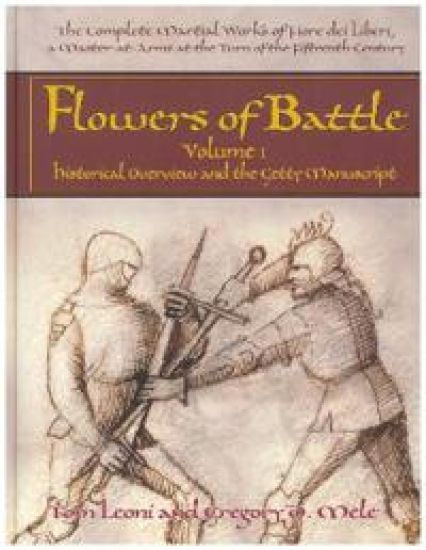
Flowers of Battle The Complete Martial Works of Fiore dei Liberi Vol 1

Flowers of Battle The Complete Martial Works of Fiore dei Liberi Vol 1

Tom Leoni; Gregory D. Mele

FreeLance Academy Press
2018
sidottu
The `Getty Manuscript’ (Il Fior di Battaglia/The Flower of Battle) by the greatest fencing-master of the late 1300s, Fiore Furlan dei Liberi, instructs the reader in the intricacies of combat. Lively illustrations of charging horses and armoured knights accompany the text; through words and pictures, the manuscript teaches a variety of fighting techniques including single combat on foot with sword, dagger and axe, and mounted combat in all its variations. Fiore’s magnum opus, The Flower of Battle, composed in 1409, is one of the oldest, most extensive and most clearly elucidated martial arts treatises from the medieval period. It is a record of a complete medieval martial tradition, and provides unique insights into the life and milieu of the professional fighting man at the birth of the Italian Renaissance. Fiore preserved his teachings in a series of illustrated manuscripts, four of which have survived to the present day. The first volume in this new five-part series (see SERIES NOTE) presents a complete translation, transcription and reproduction of the largest and most complete of those four manuscripts. It includes chapters on the life of Fiore dei Liberi, his students and patrons, arms and armour in the Getty Manuscript, duelling and chivalric culture in Italy at the close of the 14th century, a detailed analysis of the manuscripts' use of pedagogy, number and metaphor and The Flower of Battle's relationship to other medieval combat manuscripts. 190 illustrations, 90 in colour. SERIES NOTE: This is the first volume in a new five-volume series from Freelance Academy Press. Flowers of Battle is a series of lavishly illustrated hardbacks, combining full-colour facsimiles of the original manuscripts with professional, annotated translations and extensive, peer-reviewed essays. The Flowers of Battle Series Includes: Vol. I: Historical Overview and the Getty Manuscript Vol. II: Flos Duellatorum Vol. III: Florius de Arte Luctandi Vol. IV: The Pierpont-Morgan Manuscript and General Concordance Vol. V: Leaves of Battle – Fiore dei Liberi’s Martial Heirs and Influence

The Book of Historic Fashion

The Book of Historic Fashion

Nicole Allen; Gregory D. Mele

FreeLance Academy Press
2014
nidottu

Halvin toimitettuna 41,70 €

The Late Middle Ages (c.1350 - 1500) provides us with many of our stock, childhood images of the 'Middle Ages': the knight in shining armour, the joust, lords and ladies dressed in rich, voluminous robes and elegant dresses. Yet it is a paradox, for at the start of the period, Europe had endured the worst pandemic of recorded history: the Black Death, the climate was rapidly cooling, causing massive crop failures and France and England were locked in the brutal, dynastic struggle of the Hundred Years War. Meanwhile, in the second half of the period, intrepid merchants became the new knighthood of Europe, seeking new wealth in Asia and Africa, and launching what has been called the 'Age of Discovery' while a new interest in Classical culture would give birth to the Renaissance. All of these elements have long intrigued and inspired writers, researchers and reenactors to take a trip through the looking glass to this lost world. In the Book of Historic Fashion: A Newcomer's Guide to Medieval Clothing (1300 - 1450), authors Allen and Mele provide a visual snap shot of the courtly elegance and common wear of the period. Filled with hundreds of sketches taken from original sources, mechanical drawings and detailed 'layer drawings' demonstrating how the clothing was worn, this entrée both introduces the period and helps newcomers find their way forward in the study of primary and secondary sources. Whether you are a teacher or professor who wants your students to understand what the clothing of the day really looked like, a costume designers working in theater, TV and film looking for visual reference or just new to medieval reenacting who wants guidance on what to wear in order to be appropriately dressed at events, this volume is for you.