Kirjojen hintavertailu – 12 903 725 kirjaa ja 27 kauppaa

Kirjailija

Gregory K. Ingram

Kirjat ja teokset yhdessä paikassa: 10 kirjaa, julkaisuja vuosilta 2007–2014, suosituimpiin kuuluu Education, Land, and Location. Vertaile teosten hintoja ja tarkista saatavuus suomalaisista kirjakaupoista.

10 kirjaa

Kirjojen julkaisuvuodet: 2007–2014.

Education, Land, and Location

Education, Land, and Location

Gregory K. Ingram; Daphne A. Kenyon

Lincoln Institute of Land Policy
2014
nidottu
Because most children throughout the world attend elementary and secondary schools near their homes, where they live usually determines where they go to school. In the United States, the relationship between residential location and education has been especially strong given the dominance of local funding and local control of K-12 education. School quality varies markedly among the more than 14,000 school districts across the United States and within many of the country's large urban districts. Housing prices reflect school quality; houses in better school districts or more advantaged neighborhoods of large districts sell at a premium. In other words, school quality is capitalized into the price of land. The chapters in this volume explore the links between education, location, and land based on the proceedings of the 8th Annual Land Policy Conference of the Lincoln Institute of Land Policy. Three policy outcomes are the focus: academic achievement of schoolchildren; racial, ethnic, and socioeconomic segregation; and equality of opportunity, all of which have broad relevance to U. S. public policy. The topics include the expansion of school choice, especially through charter schools and home schooling; the importance of cognitive skills for economic growth; the role of the property tax in school finance and alternative revenue sources; the structure of school districts; transportation to school; effects of school location; and housing policies that can unlink education and location. This volume features the papers presented at the Lincoln Institute's 8th annual Land Policy Conference in June 2013.
Municipal Revenues and Land Policies

Municipal Revenues and Land Policies

Gregory K. Ingram; Yu–hung Hong

Lincoln Institute of Land Policy
2010
nidottu
Based on the proceedings of Lincoln Institute of Land Policy's fourth annual cross-disciplinary land policy conference, this volume collects scholarly work by a wide range of experts in land policy, tax policy, economics, and urban planning. Municipal Revenues and Land Policies offers analysis of a variety of municipal revenue instruments such as intergovernmental transfers, property tax, tax increment financing, and local option sales and income taxes. Other nontraditional public good financing mechanisms including business improvement districts, homeowners' associations, impact fees, certificates of additional construction potential, debt financing, and public-private partnerships are examined. The analysis focuses on comparing the viability of these municipal revenue sources in the face of fiscal uncertainty.
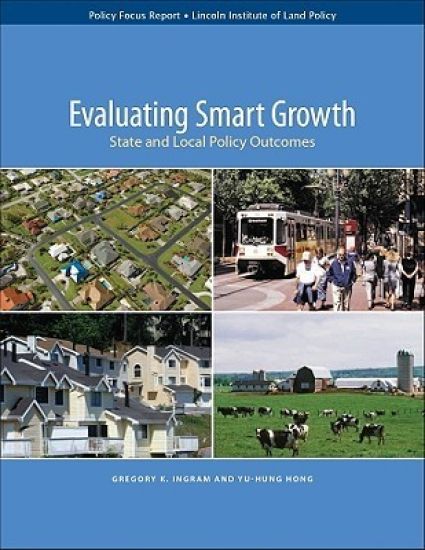
Smart Growth Policies – An Evaluation of Programs and Outcomes

Smart Growth Policies – An Evaluation of Programs and Outcomes

Gregory K. Ingram; Armando Carbonell; Yu–hung Hong; Anthony Flint

Lincoln Institute of Land Policy
2009
nidottu
The Lincoln Institute of Land Policy collaborated with 14 leading land use researchers and planners to measure and compare outcomes in four states with statewide smart growth programs (Florida, Maryland, New Jersey, and Oregon) and four states without such programs (Colorado, Indiana, Texas, and Virginia).
Property Rights and Land Policies

Property Rights and Land Policies

Gregory K. Ingram; Yu–hung Hong

Lincoln Institute of Land Policy
2009
nidottu
The Lincoln Institute's third annual land policy conference explored the connections between property rights and land policies in developed and developing country contexts. The chapter authors discuss a range of topics including regulatory takings, the use of eminent domain and expropriation in land assembly, the emergence of private property rights in transition economies, marketable emission permits, natural resource management, and the impacts of tenure choice on land and housing development.