Kirjojen hintavertailu – 12 859 818 kirjaa ja 27 kauppaa

Kirjailija

Gregory L Ulmer

Kirjat ja teokset yhdessä paikassa: 7 kirjaa, julkaisuja vuosilta 1994–2020, suosituimpiin kuuluu Konsult. Vertaile teosten hintoja ja tarkista saatavuus suomalaisista kirjakaupoista.

Nimi esiintyy myös muodoissa: Gregory L. Ulmer

7 kirjaa

Kirjojen julkaisuvuodet: 1994–2020.

Applied Grammatology

Applied Grammatology

Gregory L. Ulmer

Johns Hopkins University Press
2020
pokkari
Originally published in 1984. In Applied Grammatology, Gregory Ulmer provides an extraordinary introduction to the third, "applied" phase of grammatology, the "science of writing," outlined by Jacques Derrida in Of Grammatology. Ulmer looks to the later experimental works of Derrida (beginning with Glas and continuing through Truth in Painting and The Post Card). In these, he discovers a critical methodology radically different from the deconstruction for which Derrida is known. At the same time, he finds the source of a new pedagogy for all the humanities, one based on grammatology and appropriate to the era of audiovisual communications in which we live. Detractors of Derrida often accuse him of superficial wordplay and of using images and puns as nonfunctional subversions of academic conventions. Ulmer argues that there is, in fact, a fully developed use of homonyms in Derrida's style, which produces its own distinctive knowledge and insight. Derrida's experiments with images, moreover—his expansion of descriptions of everyday objects such as umbrellas, matchboxes, and post cards into cognitive models—serve to reveal a simplicity underlying intellectual discourse, which could be used to eliminate the gap separating the general public from specialists in cultural studies. Comparing the stylistic innovations of Derrida with Jacques Lacan's use of puns and diagrams, with the German performance artist Joseph Beuys's demonstration of models, and with the "montage writing" of the films of Sergei Eisenstein, Ulmer explores the possibility of deriving a postmodernist pedagogy from Derrida's texts. The first study to suggest the full potential of the program available in Derrida's writings, Applied Grammatology is also the first outline of a Derridean alternative to deconstructionism. With its shift away from Derrida's philosophical studies to his experimental texts, Ulmer's book aims to inaugurate a new movement in the American adaptation of contemporary French theory.

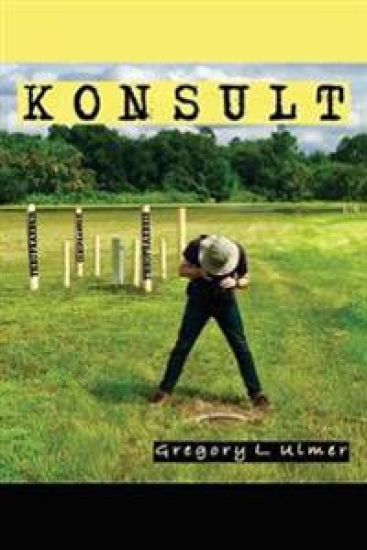
Konsult

Konsult

Gregory L Ulmer

Parlor Press
2019
sidottu
Electracy and Transmedia Studies ​​​​​​​Series Editors: Jan Rune Holmevik and Cynthia HaynesA motto guiding Gregory L. Ulmer's career is from the poet Basho: not to follow in the footsteps of the masters, but to seek what they sought. The responsibility of humanities disciplines today is to do for the digital apparatus (social machine) what the classical Greeks did for alphabetic writing. Ulmer frames online learning as a mode of invention (heuretics), beginning with the invention of konsult itself. Konsult: Theopraxesis describes the invention of a genre of learning that is to digital media what Plato's dialogue was to alphabetic writing. The Greeks invented the practices of writing (rhetoric and logic) native to the new institution of school (the Academy), fostering a new behavior of selfhood (Socrates). Ulmer adopts this historical precedent as a relay, an inventory for what must be invented again today: a genre of learning, an educational institution, identity behavior. The insight of electracy is that each apparatus augments and institutionalizes one of the primary faculties of human intelligence: theoria in literacy; praxis in orality; poiesis in electracy. Needed today are not practices of writing, but "theopraxesis" of media. The analytical information economy of literacy required separation and isolation (siloing) of institutionalized intelligence. The multimodality of electracy enables syncretism of faculties into holistic performance: thinking-doing-making; knowledge-purpose-affect. The interface metaphor of Plato's dialogue was an oral conversation during which the illiterate interlocutor is introduced to dialectical reason as Idea. The interface metaphor of konsult is scientific consulting during which anelectrate students encounter plasmatic desire as simulacrum. This new learning is organized around an updating of Justice native to electracy. Gregory L. Ulmer is Professor Emeritus, English and Media Studies, University of Florida. He is Coordinator of the Florida Research Ensemble, and Joseph Beuys Chair of the European Graduate School. His recent books include Electracy (2015), Avatar Emergency (2012), and Miami Virtue (2012). His current project is Konsult Experiment (www.konsultexperiment.com) a blog affiliated with the Electracy and Transmedia Studies series, edited by Jan Holmevik and Cynthia Haynes for Parlor Press.
Konsult

Konsult

Gregory L Ulmer

Parlor Press
2019
pokkari
Electracy and Transmedia Studies Series Editors: Jan Rune Holmevik and Cynthia HaynesA motto guiding Gregory L. Ulmer's career is from the poet Basho: not to follow in the footsteps of the masters, but to seek what they sought. The responsibility of humanities disciplines today is to do for the digital apparatus (social machine) what the classical Greeks did for alphabetic writing. Ulmer frames online learning as a mode of invention (heuretics), beginning with the invention of konsult itself. Konsult: Theopraxesis describes the invention of a genre of learning that is to digital media what Plato's dialogue was to alphabetic writing. The Greeks invented the practices of writing (rhetoric and logic) native to the new institution of school (the Academy), fostering a new behavior of selfhood (Socrates). Ulmer adopts this historical precedent as a relay, an inventory for what must be invented again today: a genre of learning, an educational institution, identity behavior. The insight of electracy is that each apparatus augments and institutionalizes one of the primary faculties of human intelligence: theoria in literacy; praxis in orality; poiesis in electracy. Needed today are not practices of writing, but "theopraxesis" of media. The analytical information economy of literacy required separation and isolation (siloing) of institutionalized intelligence. The multimodality of electracy enables syncretism of faculties into holistic performance: thinking-doing-making; knowledge-purpose-affect. The interface metaphor of Plato's dialogue was an oral conversation during which the illiterate interlocutor is introduced to dialectical reason as Idea. The interface metaphor of konsult is scientific consulting during which anelectrate students encounter plasmatic desire as simulacrum. This new learning is organized around an updating of Justice native to electracy. Gregory L. Ulmer is Professor Emeritus, English and Media Studies, University of Florida. He is Coordinator of the Florida Research Ensemble, and Joseph Beuys Chair of the European Graduate School. His recent books include Electracy (2015), Avatar Emergency (2012), and Miami Virtue (2012). His current project is Konsult Experiment (www.konsultexperiment.com) a blog affiliated with the Electracy and Transmedia Studies series, edited by Jan Holmevik and Cynthia Haynes for Parlor Press.
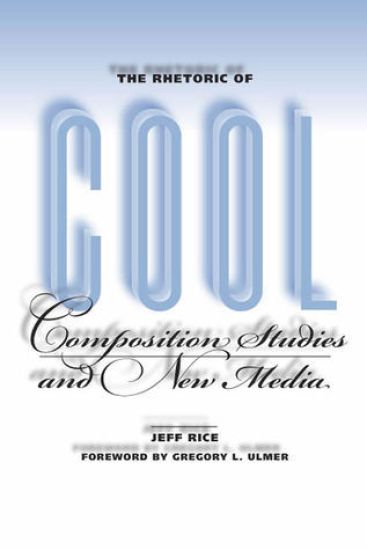
The Rhetoric of Cool

The Rhetoric of Cool

Jeff Rice; Gregory L. Ulmer

Southern Illinois University Press
2007
nidottu
The Rhetoric of Cool: Composition Studies and New Media offers a historical critique of composition studies' rebirth narrative, using that critique to propose a new rhetoric for new media work. Author Jeff Rice returns to critical moments during the rebirth of composition studies when the discipline chose not to emphasize technology, cultural studies, and visual writing, which are now fundamental to composition studies. Rice redefines these moments in order to invent a new electronic practice. ""The Rhetoric of Cool"" addresses the disciplinary claim that composition studies underwent a rebirth in 1963. At that time, three writers reviewed technology, cultural studies, and visual writing outside composition studies and independently used the word cool to describe each position. Starting from these three positions, Rice focuses on chora, appropriation, commutation, juxtaposition, nonlinearity, and imagery - rhetorical gestures conducive to new media work - to construct the rhetoric of cool. An innovative work that approaches computers and writing issues from historical, critical, theoretical, and practical perspectives, ""The Rhetoric of Cool"" challenges current understandings of writing and new media and proposes a rhetorical rather than an instrumental response for teaching writing in new media contexts.
Heuretics

Heuretics

Gregory L. Ulmer

Johns Hopkins University Press
1994
pokkari
In Heuretics-a word defined as "the branch of logic that treats the art of discovery or invention"-Gregory Ulmer sets forth new methods appropriate for conducting cultural studies research in an age of electronic hypermedia.