Kirjojen hintavertailu – 12 903 724 kirjaa ja 27 kauppaa

Kirjailija

Guadalupe Valdés

Kirjat ja teokset yhdessä paikassa: 12 kirjaa, julkaisuja vuosilta 1996–2016, suosituimpiin kuuluu Innovative Strategies for Heritage Language Teaching. Vertaile teosten hintoja ja tarkista saatavuus suomalaisista kirjakaupoista.

Nimi esiintyy myös muodoissa: Guadalupe Valdes

12 kirjaa

Kirjojen julkaisuvuodet: 1996–2016.

Innovative Strategies for Heritage Language Teaching

Innovative Strategies for Heritage Language Teaching

Ana Roca; Guadalupe Valdés

Georgetown University Press
2016
pokkari
Heritage language (HL) learning and teaching presents particularly difficult challenges. Melding cutting-edge research with innovations in teaching practice, the contributors in this volume provide practical knowledge and tools that introduce new solutions informed by linguistic, sociolinguistic, and educational research on heritage learners. Scholars address new perspectives and orientations on designing HL programs, assessing progress and proficiency, transferring research knowledge into classroom practice, and the essential question of how to define a heritage learner. Articles offer analysis and answers on multiple languages, and the result is a unique and essential text-the only comprehensive guide for heritage language learning based on the latest theory and research with suggestions for the classroom.
Innovative Strategies for Heritage Language Teaching

Innovative Strategies for Heritage Language Teaching

Ana Roca; Guadalupe Valdés

Georgetown University Press
2016
sidottu
Heritage language (HL) learning and teaching presents particularly difficult challenges. Melding cutting-edge research with innovations in teaching practice, the contributors in this volume provide practical knowledge and tools that introduce new solutions informed by linguistic, sociolinguistic, and educational research on heritage learners. Scholars address new perspectives and orientations on designing HL programs, assessing progress and proficiency, transferring research knowledge into classroom practice, and the essential question of how to define a heritage learner. Articles offer analysis and answers on multiple languages, and the result is a unique and essential text-the only comprehensive guide for heritage language learning based on the latest theory and research with suggestions for the classroom.
Common Core, Bilingual and English Language Learners

Common Core, Bilingual and English Language Learners

Guadalupe Valdés; Kate Menken; Mariana Castro

Caslon, Inc.
2015
nidottu
Provides 130 expert responses to 95 questions regarding ELLs and the Common Core. Topics include sociopolitical context of reform; demographic changes; language for academic purposes; language teaching and learning in content areas; policy, leadership, and advocacy; programs and instruction; family and community involvement; changing roles of ESL educators; planning professional development; and assessment and accountability.
Spanish as a Heritage Language in the United States

Spanish as a Heritage Language in the United States

Guadalupe Valdés

Georgetown University Press
2012
pokkari
There is growing interest in heritage language learners - individuals who have a personal or familial connection to a nonmajority language. Spanish learners represent the largest segment of this population in the United States. In this comprehensive volume, experts offer an interdisciplinary overview of research on Spanish as a heritage language in the United States. They also address the central role of education within the field. Contributors offer a wealth of resources for teachers while proposing future directions for scholarship.
Latino Children Learning English

Latino Children Learning English

Guadalupe Valdes; Sarah Capitelli; Laura Alvarez

Teachers' College Press
2010
nidottu
This timely and incisive book examines the ways in which English language proficiencies develop in newly arrived immigrant students. Beginning by describing the challenges faced by children who currently attend segregated schools in many parts of the country, the authors offer a detailed account of the developing English language proficiencies of K–3 children from one after-school intervention program. Using the experiences of these children as a lens, the authors debunk commonly held views of young children as rapid and effortless learners of new languages. Essential reading for classroom teachers, students, researchers, and policymakers, this authoritative book: Offers principles for designing an integrated practice for educating English language learners. Describes interactions between volunteer “English Buddies” and ELL children to highlight ways in which children begin to comprehend and produce English. Includes examples of materials and activities that can be used with young ELL children to engage them in new-language interactions. Analyzes the effectiveness of current practices designed to accelerate the second language acquisition process.
Developing Minority Language Resources

Developing Minority Language Resources

Guadalupe Valdés; Fishman Joshua A.; Rebecca Chávez; William Perez

Channel View Publications
2006
Sidottu
This book documents ongoing language shift to English among Latino professionals in California 67% of which studied Spanish formally in high school and 54% of which studied Spanish in college. Taking into account the recommendations about the teaching of Spanish as a heritage language made by these professionals, the book then describes current instructional practices used in the teaching of Spanish as an academic subject at the high school and university levels to “heritage” language students who, although educated entirely in English, acquired Spanish at home as their first language. The suggestions made by the Professionals concentrated almost exclusively on Spanish language maintenance (e.g., making cultural/historical connections; showing relevance and significance of language to students’ lives, teaching other subjects in Spanish, teaching legal, medical, business terms in Spanish). The study of goals currently guiding instruction for heritage speakers of Spanish at both the high school and the college levels, on the other hand, raise questions about the potential contribution of educational institutions to the maintenance and retention of Spanish among the current Spanish-speaking population of California.
Developing Minority Language Resources

Developing Minority Language Resources

Guadalupe Valdés; Joshua A. Fishman; Rebecca Chávez; William Perez

Multilingual Matters
2006
nidottu
This book documents ongoing language shift to English among Latino professionals in California 67% of which studied Spanish formally in high school and 54% of which studied Spanish in college. Taking into account the recommendations about the teaching of Spanish as a heritage language made by these professionals, the book then describes current instructional practices used in the teaching of Spanish as an academic subject at the high school and university levels to “heritage” language students who, although educated entirely in English, acquired Spanish at home as their first language. The suggestions made by the Professionals concentrated almost exclusively on Spanish language maintenance (e.g., making cultural/historical connections; showing relevance and significance of language to students’ lives, teaching other subjects in Spanish, teaching legal, medical, business terms in Spanish). The study of goals currently guiding instruction for heritage speakers of Spanish at both the high school and the college levels, on the other hand, raise questions about the potential contribution of educational institutions to the maintenance and retention of Spanish among the current Spanish-speaking population of California.
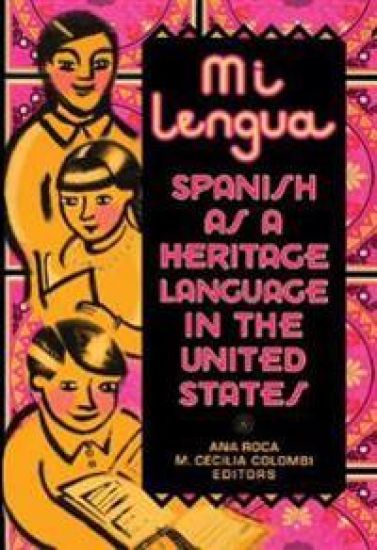
Mi lengua

Mi lengua

Guadalupe Valdés

Georgetown University Press
2003
pokkari
An increasing number of U. S. Latinos are seeking to become more proficient in Spanish. The Spanish they may have been exposed to in childhood may not be sufficient when they find themselves as adults in more demanding environments, academic or professional. Heritage language learners appear in a wide spectrum of proficiency, from those who have a low level of speaking abilities, to those who may have a higher degree of bilingualism, but not fluent. Whatever the individual case may be, these heritage speakers of Spanish have different linguistic and pedagogical needs than those students learning Spanish as a second or foreign language. The members of the American Association of Teachers of Spanish and Portuguese (AATSP) have identified teaching heritage learners as their second greatest area of concern (after proficiency testing). Editors Ana Roca and Cecilia Colombi saw a great need for greater availability and dissemination of scholarly research in applied linguistics and pedagogy that address the development and maintenance of Spanish as a heritage language and the teaching of Spanish to U. S. Hispanic bilingual students in grades K-16. The result is Mi lengua: Spanish as a Heritage Language in the United States. Mi lengua delves into the research, theory, and practice of teaching Spanish as a heritage language in the United States. The editors and contributors examine theoretical considerations in the field of Heritage Language Development (HLD) as well as community and classroom-based research studies at the elementary, secondary, and university levels. Some chapters are written in Spanish and each chapter presents a practical section on pedagogical implications that provides practice-related suggestions for the teaching of Spanish as a heritage language to students from elementary grades to secondary and college and university levels.
Expanding Definitions of Giftedness

Expanding Definitions of Giftedness

Guadalupe Valdes

Routledge Member of the Taylor and Francis Group
2003
sidottu
This book is about bilingual young people who have been selected by their families to carry out the hard work of interpreting and translating to mediate communication between themselves and the outside world--between minority and majority communities. It examines the experiences of these young interpreters and the skills they develop in order to fulfill this role. The authors' purpose in this volume is to contribute to extending current definitions of gifted and talented, by proposing and offering evidence that the young people who are selected to serve as family interpreters perform at remarkably high levels of accomplishment when compared with others of their age, experience, and environment, and should thus clearly be included in the 1993 U. S. federal definition of giftedness. They maintain that not only are these capabilities currently overlooked by existing assessment procedures, but also that there is little understanding of the ways in which the unique talents of young interpreters might be nurtured and developed in academic settings. A strong case is made that in order for such students to be identified as gifted on the basis of their bilingual abilities, the field of gifted and talented education must embrace the concept that bilingualism is a strength. The field must also make developing bilingualism a focus of programs designed to meet the needs of the increasingly multilingual student population in the United States. The research this book reports--part of a larger five-year study of giftedness through linguistic and cultural lenses, funded by OERI through the National Research Center on the Gifted and Talented--was conducted by researchers whose background is very much outside the field of gifted education. Rather, their focus is on language, working within the traditions of qualitative sociolinguistics. Thus, this book offers a unique approach to the exploration of giftedness. It asks researchers and practitioners ordinarily accustomed to working with quantitative data to examine and make sense of detailed and rich analyses of students' linguistic performance, and argues that it is only by understanding the challenges of such bilingual interactions that the field of gifted and talented education can expand and reframe its vision of giftedness.
Expanding Definitions of Giftedness

Expanding Definitions of Giftedness

Guadalupe Valdes

Routledge Member of the Taylor and Francis Group
2003
nidottu
This book is about bilingual young people who have been selected by their families to carry out the hard work of interpreting and translating to mediate communication between themselves and the outside world--between minority and majority communities. It examines the experiences of these young interpreters and the skills they develop in order to fulfill this role. The authors' purpose in this volume is to contribute to extending current definitions of gifted and talented, by proposing and offering evidence that the young people who are selected to serve as family interpreters perform at remarkably high levels of accomplishment when compared with others of their age, experience, and environment, and should thus clearly be included in the 1993 U. S. federal definition of giftedness. They maintain that not only are these capabilities currently overlooked by existing assessment procedures, but also that there is little understanding of the ways in which the unique talents of young interpreters might be nurtured and developed in academic settings. A strong case is made that in order for such students to be identified as gifted on the basis of their bilingual abilities, the field of gifted and talented education must embrace the concept that bilingualism is a strength. The field must also make developing bilingualism a focus of programs designed to meet the needs of the increasingly multilingual student population in the United States. The research this book reports--part of a larger five-year study of giftedness through linguistic and cultural lenses, funded by OERI through the National Research Center on the Gifted and Talented--was conducted by researchers whose background is very much outside the field of gifted education. Rather, their focus is on language, working within the traditions of qualitative sociolinguistics. Thus, this book offers a unique approach to the exploration of giftedness. It asks researchers and practitioners ordinarily accustomed to working with quantitative data to examine and make sense of detailed and rich analyses of students' linguistic performance, and argues that it is only by understanding the challenges of such bilingual interactions that the field of gifted and talented education can expand and reframe its vision of giftedness.
Learning and not Learning English

Learning and not Learning English

Guadalupe Valdes

Teachers' College Press
2001
nidottu
Focusing on the lives and experiences of four Mexican children in an American middle school, the critically acclaimed author of Con Respeto examines both the policy and the instructional dilemmas that surround the English language education of immigrant children in this country. Using samples and analysis of the children's oral and written language as well as an examination of their classrooms, school, and community, this book addresses the difficulties surrounding the teaching and learning of English for second language learners. This comprehensive volume discusses: * classroom activities * the amount of time it takes to ""learn"" English * how English language learning affects learning in other areas * the consequences of linguistic isolation * how ESL students are tested It also presents exclusive data on academic English development at various stages in a two-year process that raise important questions about current ESL teaching policies.
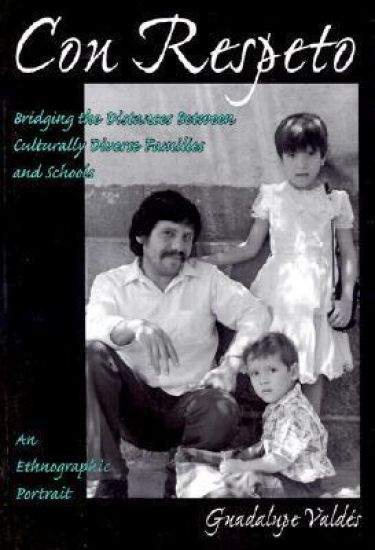
Con Respeto

Con Respeto

Guadalupe Valdes

Teachers' College Press
1996
nidottu
Con Respeto: Bridging the Distances Between Culturally Diverse Families and Schools—An Ethnographic Portrait presents a study of ten Mexican immigrant families, with a special focus on mothers, that describes how such families go about the business of surviving and learning to succeed in a new world. Guadalupe Valdés examines what appears to be a lack of interest in education by Mexican parents and shows, through extensive quotations and numerous anecdotes, that these families are both rich and strong in family values, and that they bring with them clear views of what constitutes success and failure. The book's conclusion questions the merit of typical family intervention programs designed to promote school success and suggests that these interventions—because they do not genuinely respect the values of diverse families—may have long-term negative consequences for children. Con Respeto will be a valuable resource in graduate courses in foundations, ethnographic research, sociology and anthropology of education, multicultural education, and child development; and will be of particular interest to professors and researchers of multicultural education, bilingual education, ethnographic research methods, and sociology and anthropology of education.