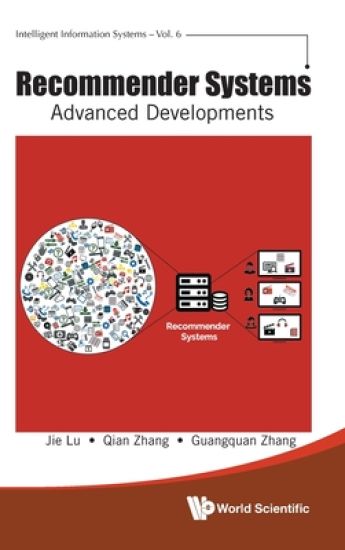
Recommender Systems: Advanced Developments
Jie Lu; Qian Zhang; Guang-quan Zhang
World Scientific Publishing Co Pte Ltd
2020
sidottu
Recommender systems provide users (businesses or individuals) with personalized online recommendations of products or information, to address the problem of information overload and improve personalized services. Recent successful applications of recommender systems are providing solutions to transform online services for e-government, e-business, e-commerce, e-shopping, e-library, e-learning, e-tourism, and more. This unique compendium not only describes theoretical research but also reports on new application developments, prototypes, and real-world case studies of recommender systems. The comprehensive volume provides readers with a timely snapshot of how new recommendation methods and algorithms can overcome challenging issues. Furthermore, the monograph systematically presents three dimensions of recommender systems — basic recommender system concepts, advanced recommender system methods, and real-world recommender system applications. By providing state-of-the-art knowledge, this excellent reference text will immensely benefit researchers, managers, and professionals in business, government, and education to understand the concepts, methods, algorithms and application developments in recommender systems.