Kirjojen hintavertailu – 12 859 828 kirjaa ja 27 kauppaa

Kirjailija

Guillermo Perry

Kirjat ja teokset yhdessä paikassa: 6 kirjaa, julkaisuja vuosilta 1998–2009, suosituimpiin kuuluu Inequality in Latin America. Vertaile teosten hintoja ja tarkista saatavuus suomalaisista kirjakaupoista.

6 kirjaa

Kirjojen julkaisuvuodet: 1998–2009.

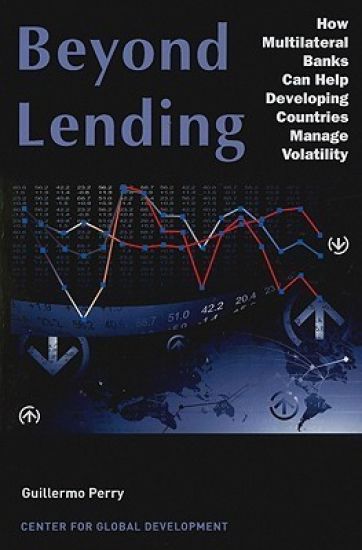
Beyond Lending

Beyond Lending

Guillermo Perry

Centre for Global Development
2009
nidottu
When he began this book in early 2008, Guillermo Perry argued that developing countries remained highly vulnerable to external risks such as commodity price declines, capital flow reversals, and natural disasters. The economic crisis that has since ensued confirmed Perry's analysis. It has also made his proposal more important than ever: multilateral development banks (MDBs) should move beyond lending to provide innovative risk-management tools for developing countries to manage volatility. The risk that MDBs will fall into complacency as the short-term demand for traditional loans increases during the crisis should not deter innovations to ensure long-term stability. Contents 1. Causes and Consequences of High Volatility in Developing Countries 2. The Role of Financial Insurance and Hedging 3. Dealing with Liquidity Shocks and the Procyclicality of Private Capital Flows 4. Dealing with Currency Risks 5. Dealing with Commodity Price, Terms of Trade, and Output Risks 6. Dealing with Natural Disaster Risks 7. Why Multilateral Development Bank Practices Are So Far from Their Potential 8. An Agenda Going Forward

Informality

Informality

Guillermo Perry; Omar S. Arias; Pablo Fajnzylber; William F. Maloney; Andrew Mason; Jaime Saavedra-Chanduvi

World Bank Publications
2007
nidottu
Informality: Exit and Exclusion analyzes informality in Latin America, exploring root causes and reasons for and implications of its growth. The authors use two distinct but complementary lenses: informality driven by ""exclusion"" from state benefits or the circuits of the modern economy, and driven by voluntary ""exit"" decisions resulting from private cost-benefit calculations that lead workers and firms to opt out of formal institutions. They find both lenses have considerable explanatory power to understand the causes and consequences of informality in the region.""Informality: Exit and Exclusion"" concludes that reducing informality levels and overcoming the ""culture of informality"" will require actions to increase aggregate productivity in the economy, reform poorly designed regulations and social policies, and increase the legitimacy of the state by improving the quality and fairness of state institutions and policies. Although the study focuses on Latin America, its analysis, approach, and conclusions are relevant for all developing countries."" Informality: Exit and Exclusion"" will be of value to professionals and academics studying labor market, social protection, tax, microenterprise development, and urban public policies, and to those working in government, international organizations, research institutions, and universities.
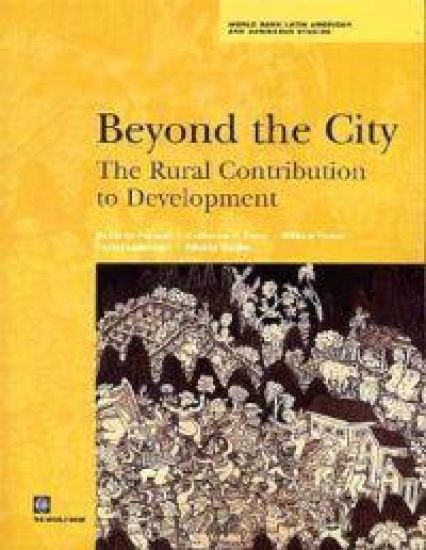
Beyond the City

Beyond the City

David De Ferranti; Guillermo Perry; Daniel Lederman; Alberto Valdes; William Foster

World Bank Publications
2005
nidottu
This book evaluates the contribution of rural development and policies to growth, poverty alleviation, and environmental degradation in Latin America and the Caribbean.
Inequality in Latin America

Inequality in Latin America

David Ferranti; Guillermo Perry; Francisco Ferreira

World Bank Publications
2004
nidottu
With the exception of Sub-Saharan Africa, Latin America and the Caribbean has been one of the regions of the world with the greatest inequality. Inequality in Latin America and the Caribbean: Breaking with History? explores why the region suffers from such persistent inequality, identifies how it hampers development, and suggests ways to achieve greater equity in the distribution of wealth, incomes and opportunities. The study draws on data from 20 countries based on household surveys covering 3.6 million people, and reviews extensive economic, sociological and political science studies on inequality in Latin America. To address the deep historical roots of inequality in Latin America, and the powerful contemporary economic, political and social mechanisms that sustain it, Inequality in Latin America and the Caribbean outlines four broad areas for action by governments and civil society groups to break this destructive pattern: Build more open political and social institutions, that allow the poor and historically subordinate groups to gain a greater share of agency, voice and power in society. Ensure that economic institutions and policies seek greater equity, through sound macroeconomic management and equitable, efficient crisis resolution institutions, that avoid the large regressive redistributions that occur during crises, and that allow for saving in good times to enhance access by the poor to social safety nets in bad times. Increase access by the poor to high-quality public services, especially education, health, water and electricity, as well as access to farmland and the rural services. Protect and enforce the property rights of the urban poor. Reform income transfer programs so that they reach the poorest families.
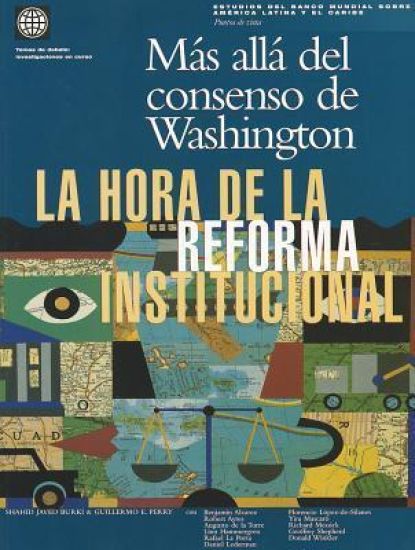
Beyond the Washington Consensus Institutions M

Beyond the Washington Consensus Institutions M

Guillermo Perry

World Bank Publications
1998
nidottu
This report examines the precise nature of the required institutional reforms needed to achieve higher sustained rates of growth and to make a dent in poverty reduction and provides a framework for their design and implementation. The more modest objective is to examine how the concepts of the new institutional economics are useful for analyzing and designing institutions and to evaluate how political economy concepts can be used to develop strategies for implementing institutional reforms. Employing some of these concepts, the report demonstrates that sound institutional reform can be technically and politically viable in the following key sectors: banking; capital markets and legal institutions; educational institutions; judicial reforms; and public administration.