
Kirjailija
Günter Harder
Kirjat ja teokset yhdessä paikassa: 10 kirjaa, julkaisuja vuosilta 1982–2026, suosituimpiin kuuluu Cohomology of Arithmetic Groups. Vertaile teosten hintoja ja tarkista saatavuus suomalaisista kirjakaupoista.
Nimi esiintyy myös muodoissa: Gunter Harder
10 kirjaa
Kirjojen julkaisuvuodet: 1982–2026.
Eisenstein Cohomology for GLN and the Special Values of Rankin–Selberg L-Functions
Günter Harder; Anantharam Raghuram
Princeton University Press
2019
pokkari
This book studies the interplay between the geometry and topology of locally symmetric spaces, and the arithmetic aspects of the special values of L-functions. The authors study the cohomology of locally symmetric spaces for GL(N) where the cohomology groups are with coefficients in a local system attached to a finite-dimensional algebraic representation of GL(N). The image of the global cohomology in the cohomology of the Borel–Serre boundary is called Eisenstein cohomology, since at a transcendental level the cohomology classes may be described in terms of Eisenstein series and induced representations. However, because the groups are sheaf-theoretically defined, one can control their rationality and even integrality properties. A celebrated theorem by Langlands describes the constant term of an Eisenstein series in terms of automorphic L-functions. A cohomological interpretation of this theorem in terms of maps in Eisenstein cohomology allows the authors to study the rationality properties of the special values of Rankin–Selberg L-functions for GL(n) x GL(m), where n + m = N. The authors carry through the entire program with an eye toward generalizations. This book should be of interest to advanced graduate students and researchers interested in number theory, automorphic forms, representation theory, and the cohomology of arithmetic groups.
Eisenstein Cohomology for GLN and the Special Values of Rankin–Selberg L-Functions
Günter Harder; Anantharam Raghuram
PRINCETON UNIVERSITY PRESS
2019
sidottu
This book studies the interplay between the geometry and topology of locally symmetric spaces, and the arithmetic aspects of the special values of L-functions. The authors study the cohomology of locally symmetric spaces for GL(N) where the cohomology groups are with coefficients in a local system attached to a finite-dimensional algebraic representation of GL(N). The image of the global cohomology in the cohomology of the Borel–Serre boundary is called Eisenstein cohomology, since at a transcendental level the cohomology classes may be described in terms of Eisenstein series and induced representations. However, because the groups are sheaf-theoretically defined, one can control their rationality and even integrality properties. A celebrated theorem by Langlands describes the constant term of an Eisenstein series in terms of automorphic L-functions. A cohomological interpretation of this theorem in terms of maps in Eisenstein cohomology allows the authors to study the rationality properties of the special values of Rankin–Selberg L-functions for GL(n) x GL(m), where n + m = N. The authors carry through the entire program with an eye toward generalizations. This book should be of interest to advanced graduate students and researchers interested in number theory, automorphic forms, representation theory, and the cohomology of arithmetic groups.
This second volume introduces the concept of shemes, reviews some commutative algebra and introduces projective schemes. The finiteness theorem for coherent sheaves is proved, here again the techniques of homological algebra and sheaf cohomology are needed. In the last two chapters, projective curves over an arbitrary ground field are discussed, the theory of Jacobians is developed, and the existence of the Picard scheme is proved. Finally, the author gives some outlook into further developments- for instance etale cohomology- and states some fundamental theorems.
This book and the following second volume is an introduction into modern algebraic geometry. In the first volume the methods of homological algebra, theory of sheaves, and sheaf cohomology are developed. These methods are indispensable for modern algebraic geometry, but they are also fundamental for other branches of mathematics and of great interest in their own. In the last chapter of volume I these concepts are applied to the theory of compact Riemann surfaces. In this chapter the author makes clear how influential the ideas of Abel, Riemann and Jacobi were and that many of the modern methods have been anticipated by them. For this second edition the text was completely revised and corrected. The author also added a short section on moduli of elliptic curves with N-level structures. This new paragraph anticipates some of the techniques of volume II.
This book and the following second volume is an introduction into modern algebraic geometry. In the first volume the methods of homological algebra, theory of sheaves, and sheaf cohomology are developed. These methods are indispensable for modern algebraic geometry, but they are also fundamental for other branches of mathematics and of great interest in their own. In the last chapter of volume I these concepts are applied to the theory of compact Riemann surfaces. In this chapter the author makes clear how influential the ideas of Abel, Riemann and Jacobi were and that many of the modern methods have been anticipated by them. For this second edition the text was completely revised and corrected. The author also added a short section on moduli of elliptic curves with N-level structures. This new paragraph anticipates some of the techniques of volume II.
This second volume introduces the concept of shemes, reviews some commutative algebra and introduces projective schemes. The finiteness theorem for coherent sheaves is proved, here again the techniques of homological algebra and sheaf cohomology are needed. In the last two chapters, projective curves over an arbitrary ground field are discussed, the theory of Jacobians is developed, and the existence of the Picard scheme is proved. Finally, the author gives some outlook into further developments- for instance etale cohomology- and states some fundamental theorems.
The 1-2-3 of Modular Forms
Jan Hendrik Bruinier; Gerard van der Geer; Günter Harder; Don Zagier
Springer-Verlag Berlin and Heidelberg GmbH Co. K
2008
nidottu
This book grew out of three series of lectures given at the summer school on "Modular Forms and their Applications" at the Sophus Lie Conference Center in Nordfjordeid in June 2004. The first series treats the classical one-variable theory of elliptic modular forms. The second series presents the theory of Hilbert modular forms in two variables and Hilbert modular surfaces. The third series gives an introduction to Siegel modular forms and discusses a conjecture by Harder. It also contains Harder's original manuscript with the conjecture. Each part treats a number of beautiful applications.
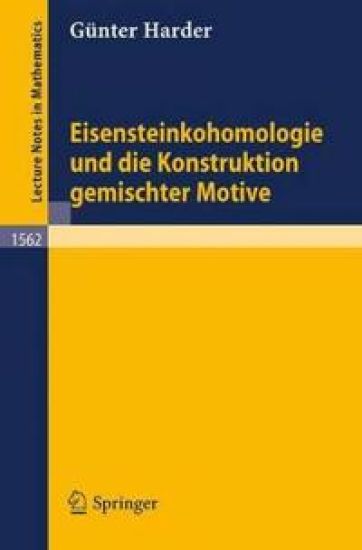
Eisensteinkohomologie und die Konstruktion gemischter Motive
Günter Harder
Springer-Verlag Berlin and Heidelberg GmbH Co. K
1993
nidottu
The aim of this book is to show that Shimura varieties provide a tool to construct certain interesting objects in arithmetic algebraic geometry. These objects are the so-called mixed motives: these are of great arithmetic interest. They can be viewed as quasiprojective algebraic varieties over Q which have some controlled ramification and where we know what we have to add at infinity to compactify them. The existence of certain of these mixed motives is related to zeroes of L-functions attached to certain pure motives. This is the content of the Beilinson-Deligne conjectures which are explained in some detail in the first chapter of the book. The rest of the book is devoted to the description of the general principles of construction (Chapter II) and the discussion of several examples in Chapter II-IV. In an appendix we explain how the (topological) trace formula can be used to get some understanding of the problems discussed in the book. Only some of this material is really proved: the book also contains speculative considerations, which give some hints as to how the problems could be tackled. Hence the book should be viewed as the outline of a programme and it offers some interesting problems which are of importance and can be pursued by the reader. In the widest sense the subject of the paper is number theory and belongs to what is called arithmetic algebraic geometry. Thus the reader should be familiar with some algebraic geometry, number theory, the theory of Liegroups and their arithmetic subgroups. Some problems mentioned require only part of this background knowledge.
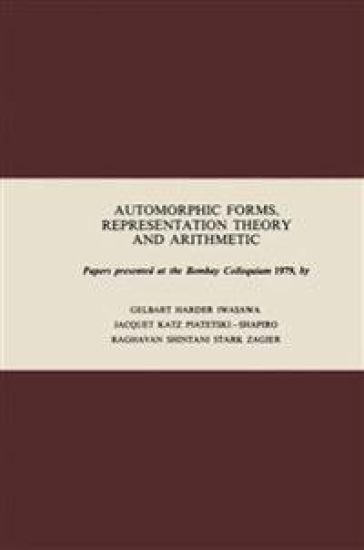
Automorphic Forms, Representation Theory and Arithmetic
Steve Gelbart; Gunter Harder; Kenkichi Iwasawa; H. Jaquet; N.M. Katz; Ilya Piatetski-Shapiro; S. Raghavan; Terry Shintani; H.M. Stark; D Zagier
Springer-Verlag Berlin and Heidelberg GmbH Co. K
1982
nidottu
International Colloquium an Automorphic Forms, Representation Theory and Arithmetic. Published for the Tata Institute of Fundamental Research, Bombay