Kirjojen hintavertailu – 12 859 818 kirjaa ja 27 kauppaa

Kirjailija

Gustav Kobbé

Kirjat ja teokset yhdessä paikassa: 59 kirjaa, julkaisuja vuosilta 2005–2026, suosituimpiin kuuluu Famous American Songs. Vertaile teosten hintoja ja tarkista saatavuus suomalaisista kirjakaupoista.

Nimi esiintyy myös muodoissa: Gustav Kobbe

59 kirjaa

Kirjojen julkaisuvuodet: 2005–2026.
Wagner's Life and Works

Wagner's Life and Works

Gustav Kobbé

Hansebooks
2017
pokkari
Wagner's Life and Works - Vol. 1 is an unchanged, high-quality reprint of the original edition of 1896. Hansebooks is editor of the literature on different topic areas such as research and science, travel and expeditions, cooking and nutrition, medicine, and other genres. As a publisher we focus on the preservation of historical literature. Many works of historical writers and scientists are available today as antiques only. Hansebooks newly publishes these books and contributes to the preservation of literature which has become rare and historical knowledge for the future.
Wagner's Life and Works

Wagner's Life and Works

Gustav Kobbé

Hansebooks
2017
pokkari
Wagner's Life and Works - Vol. 2, Second Edition is an unchanged, high-quality reprint of the original edition of 1896. Hansebooks is editor of the literature on different topic areas such as research and science, travel and expeditions, cooking and nutrition, medicine, and other genres. As a publisher we focus on the preservation of historical literature. Many works of historical writers and scientists are available today as antiques only. Hansebooks newly publishes these books and contributes to the preservation of literature which has become rare and historical knowledge for the future.
How to Appreciate Music

How to Appreciate Music

Gustav Kobbe

Createspace Independent Publishing Platform
2017
nidottu
"In households where there is no pianoforte we seem to breathe a foreign atmosphere," says Oscar Bie, in his history of the instrument and its players; and he adds with perfect truth that it has become an essential part of our life, giving its form to our whole musical culture and stamping its characteristics upon our whole conception of music. Surely out of every ten musical persons, layman or professional, at least nine almost invariably have received their first introduction to music through the pianoforte and have derived the greater part of their musical knowledge from it. Even composers like Wagner and Meyerbeer, whose work is wholly associated with opera, had their first lessons in music on the pianoforte, and Meyerbeer achieved brilliant triumphs as a concert pianist before he turned his attention to the operatic stage.
The Loves of Great Composers

The Loves of Great Composers

Gustav Kobbe

Createspace Independent Publishing Platform
2017
nidottu
This work has been selected by scholars as being culturally important and is part of the knowledge base of civilization as we know it. This work is in the public domain in the United States of America, and possibly other nations. Within the United States, you may freely copy and distribute this work, as no entity (individual or corporate) has a copyright on the body of the work. Scholars believe, and we concur, that this work is important enough to be preserved, reproduced, and made generally available to the public. To ensure a quality reading experience, this work has been proofread and republished using a format that seamlessly blends the original graphical elements with text in an easy-to-read typeface. We appreciate your support of the preservation process, and thank you for being an important part of keeping this knowledge alive and relevant.
Wagner and his Isolde

Wagner and his Isolde

Gustav Kobbé

Cambridge University Press
2014
pokkari
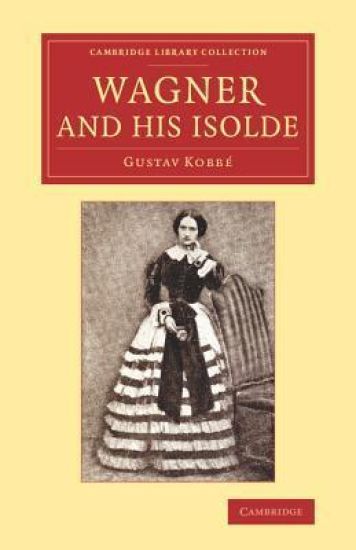
The German poet Mathilde Wesendonck (1828–1902), author of the texts of the Wesendonck Lieder, was the wife of Wagner's patron, the wealthy silk merchant Otto Wesendonck. From 1852 until 1858, the Wagners lived next to the Wesendoncks in Zurich and an intense relationship developed between Wagner and Mathilde, subsequently reflected in the impossible love at the heart of his opera Tristan und Isolde. Prepared by the American musicologist Gustav Kobbé (1857?1918), who provides a helpful connecting narrative, this 1905 translation of a selection of 'the most intimate and striking' of Wagner's impassioned letters to Mathilde charts the course of the opera's creation. Written between 1853 and 1863, the letters show Wagner thinking aloud not only about Tristan but also the planning of Parsifal. As Mathilde's letters to Wagner were destroyed, the exact nature of their relationship and of her inspiration musically will never be fully established.