Kirjojen hintavertailu – 12 903 725 kirjaa ja 27 kauppaa

Kirjailija

György Szeidl

Kirjat ja teokset yhdessä paikassa: 4 kirjaa, julkaisuja vuosilta 2014–2027, suosituimpiin kuuluu Introduction to Continuum Mechanics of Solid Bodies. Vertaile teosten hintoja ja tarkista saatavuus suomalaisista kirjakaupoista.

Nimi esiintyy myös muodoissa: Gyorgy Szeidl

4 kirjaa

Kirjojen julkaisuvuodet: 2014–2027.

Introduction to Continuum Mechanics of Solid Bodies
Introduction to Continuum Mechanics of Solid Bodies is a comprehensive textbook which guides students through the essential principles and applications of this critical field. With a focus on clarity and accessibility, this book offers a balanced introduction to tensor algebra, analysis, and the notational systems used in continuum mechanics. This textbook is structured into eight meticulously crafted chapters, covering topics such as nonlinear deformations, kinematic quantities, stress tensors, and the fundamental laws governing solid bodies. Readers will gain a deep understanding of energy principles, virtual work, and constitutive theories, including nonlinear elasticity and heat effects in linear theory. Each chapter is enriched with practical examples and problem sets, with solutions provided at the end of the book, ensuring that students can apply theoretical concepts to real-world scenarios. The inclusion of appendices further supports learning by providing detailed mathematical transformations and problem solutions. Designed for advanced undergraduate and graduate students in mechanical engineering, applied mechanics, and related fields, this book is an indispensable resource for those studying continuum mechanics, equipping students with the knowledge and tools to excel in their studies and professional endeavours. Figure slides are available at www.routledge.com/9781041426141 for qualified textbook adoption.
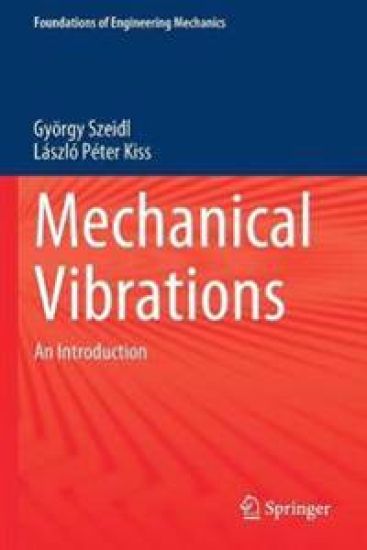
Mechanical Vibrations

Mechanical Vibrations

György Szeidl; László Péter Kiss

Springer Nature Switzerland AG
2021
nidottu
This book presents a unified introduction to the theory of mechanical vibrations. The general theory of the vibrating particle is the point of departure for the field of multidegree of freedom systems. Emphasis is placed in the text on the issue of continuum vibrations. The presented examples are aimed at helping the readers with understanding the theory. This book is of interest among others to mechanical, civil and aeronautical engineers concerned with the vibratory behavior of the structures. It is useful also for students from undergraduate to postgraduate level. The book is based on the teaching experience of the authors.
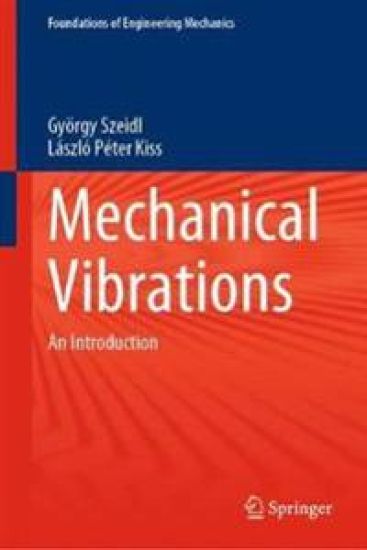
Mechanical Vibrations

Mechanical Vibrations

György Szeidl; László Péter Kiss

Springer Nature Switzerland AG
2020
sidottu
This book presents a unified introduction to the theory of mechanical vibrations. The general theory of the vibrating particle is the point of departure for the field of multidegree of freedom systems. Emphasis is placed in the text on the issue of continuum vibrations. The presented examples are aimed at helping the readers with understanding the theory. This book is of interest among others to mechanical, civil and aeronautical engineers concerned with the vibratory behavior of the structures. It is useful also for students from undergraduate to postgraduate level. The book is based on the teaching experience of the authors.
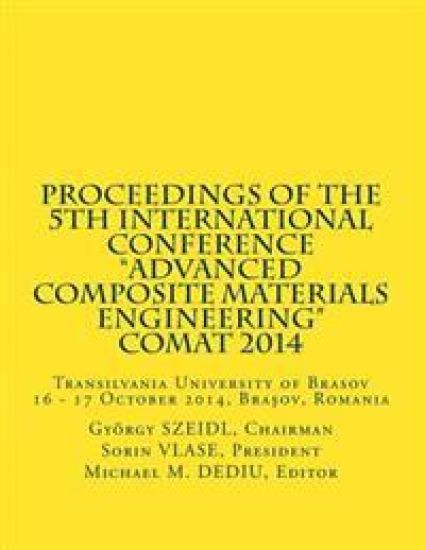
Proceedings of the 5th International Conference: Transilvania University of Brasov 16 - 17 October 2014, Brasov, Romania
After receiving many favorable comments and having interesting discussions regarding the Proceedings of the 4th International Conference "Advanced Composite Materials Engineering" COMAT 2012, and the Proceedings of the 5th International Conference "Computational Mechanics and Virtual Engineering" COMEC 2013, we are pleased to present these Proceedings of the 5th International Conference "Advanced Composite Materials Engineering" and the 3rd International Conference "Research & Innovation in Engineering" COMAT 2014. This conference was organized with the important support of Transilvania University of Brasov, Romanian Academy of Technical Sciences and Romanian Society of Theoretical and Applied Mechanics, to whom we thank very much. This conference was dedicated to Professor Ioan Goia, at his 80th birthday, because he was a great Professor at Transilvania University of Brasov for many years, and he supported these conferences from the very beginning. He is an extraordinary Professor, who had astonishing accomplishments, kindness, patience, dedication and optimism. Professor Ioan Goia is a great example for the younger generations, and he is always remembered for his great devotion to teaching and helping students. The research and innovation in engineering in general, and in particular advanced composite materials engineering, are ever more important in everyday activities, and they include, between many other techniques, geometric models, analysis, simulation, optimization and decision making tools, within a computer-generated environment, that accelerates product development, which is the main purpose of any engineering effort. The applications are very diverse and include manufacturing, aerospace, civil engineering structures, communication, geotechnics, flow problems, automotive engineering, predictive surgery, transportation, geo-environmental modeling, biomechanics, electromagnetism, medicine, prediction of natural physical events, and metal forming, just to mention a few. These Proceedings of COMAT 2014 include 50 papers, which analyze many important practical applications. The topics range from energy release rate evaluation in sandwich composite structures to structural synthesis, analysis and design of the modular anthropomorphic grippers for industrial robots, from in-plane vibrations of pinned-fixed heterogeneous curved beams under a concentrated force to modeling and simulation of an acoustic cloak, from the finite elements analysis vs. experimental buckling behavior of the thinwalled plane gussets to the mathematical model of a special vehicle clutch servomechanism. We want to thank very much Professor Sorin Vlase for his remarkable effort and dedication for the organization of this international conference, Professor Gy rgy Szeidl for his distinguished chairmanship, and the organizing committee for their continuous assistance. We also thank all the conference participants their interesting presentations, and Mrs. Sophia Dediu for her assistance in preparing this volume. There is, certainly, much more that can be said about these engineering research than we presented here. We hope that the papers included here will provide ideas for our audience, and will stimulate more research, development and applications. We look forward to receiving comments and suggestions from our readers.