Kirjojen hintavertailu – 12 903 725 kirjaa ja 27 kauppaa

Kirjailija

H. G. Guterbock

Kirjat ja teokset yhdessä paikassa: 12 kirjaa, julkaisuja vuosilta 1957–2013, suosituimpiin kuuluu Hittite Dictionary of the Oriental Institute of the University of Chicago Volume P, fascicle 2 (para- to pattar). Vertaile teosten hintoja ja tarkista saatavuus suomalaisista kirjakaupoista.

Nimi esiintyy myös muodoissa: H G Guterbock

12 kirjaa

Kirjojen julkaisuvuodet: 1957–2013.

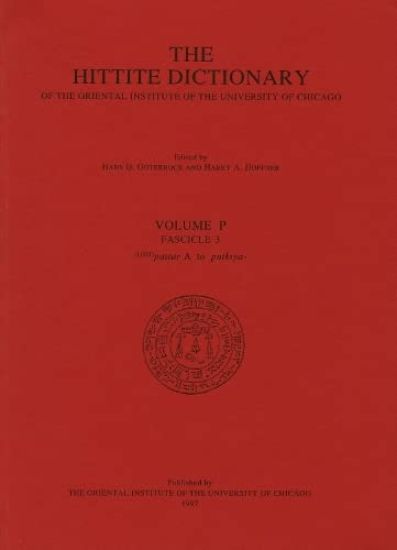
Hittite Dictionary of the Oriental Institute of the University of Chicago Volume P, fascicle 3 (pattar to putkiya-)

Hittite Dictionary of the Oriental Institute of the University of Chicago Volume P, fascicle 3 (pattar to putkiya-)

T P J van den Hout; H G Guterbock; Harry A Hoffner

Oriental Institute of the University of Chicago
1997
nidottu
The Hittite language is the earliest preserved member of the Indo-European family of languages. It was written on clay tablets in central Asia Minor over a five hundred year span (ca. 1650-1180 B. C.) which witnessed the rise, the floruit, and the decline of many political powers in the Near East. The Hittite Dictionary of the Oriental Institute of the University of Chicago (CHD) is a comprehensive, bilingual Hittite-English dictionary. The CHD is not just a list of words and their meanings, but rather a dictionary that reflects and illustrates the ideas and material world of Hittite society through its lexicon. Published letter by letter, the CHD is a long-term project and the result of a painstaking process of cultural, historical, and lexical investigation for all those interested in Hittite culture and history. The CHD is the only such project in the English speaking world.
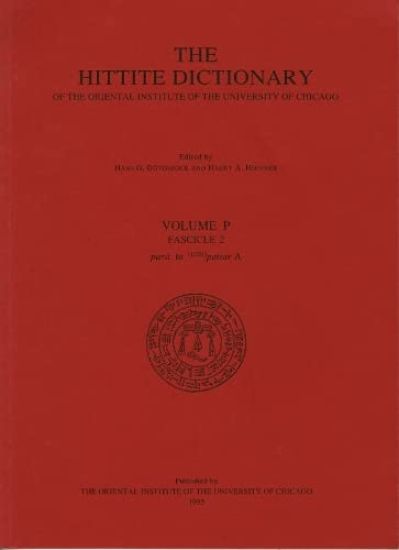
Hittite Dictionary of the Oriental Institute of the University of Chicago Volume P, fascicle 2 (para- to pattar)

Hittite Dictionary of the Oriental Institute of the University of Chicago Volume P, fascicle 2 (para- to pattar)

H. G. Guterbock; Harry A. Hoffner; T. P. J. van den Hout

Oriental Institute of the University of Chicago
1995
nidottu
The Hittite language is the earliest preserved member of the Indo-European family of languages. It was written on clay tablets in central Asia Minor over a five hundred year span (ca. 1650-1180 B. C.) which witnessed the rise, the floruit, and the decline of many political powers in the Near East. The Hittite Dictionary of the Oriental Institute of the University of Chicago (CHD) is a comprehensive, bilingual Hittite-English dictionary. The CHD is not just a list of words and their meanings, but rather a dictionary that reflects and illustrates the ideas and material world of Hittite society through its lexicon. Published letter by letter, the CHD is a long-term project and the result of a painstaking process of cultural, historical, and lexical investigation for all those interested in Hittite culture and history. The CHD is the only such project in the English speaking world.
Authority and Law in the Ancient Orient

Authority and Law in the Ancient Orient

John Albert Wilson; E. a. Speiser; H. G. Guterbock

Literary Licensing, LLC
2013
sidottu
Authority And Law In The Ancient Orient is a scholarly book written by John Albert Wilson. The book explores the concept of authority and law in the ancient civilizations of the Middle East, such as Babylon, Egypt, and Israel. Wilson examines the various sources of authority in these societies, including religious, political, and familial sources. He also delves into the legal systems of these civilizations, analyzing the role of law in maintaining social order and resolving disputes. The book provides a detailed historical account of the development of authority and law in the ancient Near East, and offers insights into the cultural and social norms that shaped these concepts. It is a valuable resource for scholars and students of ancient history, law, and anthropology. Additional Authors Include I. Mendelsohn, Daniel H. H. Ingalls And Derk Bodde. Edited By Henry M. Hoenigswald. Supplement To The Journal Of The American Oriental Society, Number 17, July-September 1954. This scarce antiquarian book is a facsimile reprint of the old original and may contain some imperfections such as library marks and notations. Because we believe this work is culturally important, we have made it available as part of our commitment for protecting, preserving, and promoting the world's literature in affordable, high quality, modern editions, that are true to their original work.
Hittite Dictionary of the Oriental Institute of the University of Chicago Volume S, fascicle 1 (sa- to saptamenzu)

Hittite Dictionary of the Oriental Institute of the University of Chicago Volume S, fascicle 1 (sa- to saptamenzu)

H. G. Guterbock; Harry A. Hoffner; T. P. J. van den Hout

Oriental Institute of the University of Chicago
2002
nidottu
The Hittite language is the earliest preserved member of the Indo-European family of languages. It was written on clay tablets in central Asia Minor over a five hundred year span (ca. 1650-1180 B. C.) which witnessed the rise, the floruit, and the decline of many political powers in the Near East. The Hittite Dictionary of the Oriental Institute of the University of Chicago (CHD) is a comprehensive, bilingual Hittite-English dictionary. The CHD is not just a list of words and their meanings, but rather a dictionary that reflects and illustrates the ideas and material world of Hittite society through its lexicon. Published letter by letter, the CHD is a long-term project and the result of a painstaking process of cultural, historical, and lexical investigation for all those interested in Hittite culture and history. The CHD is the only such project in the English speaking world.
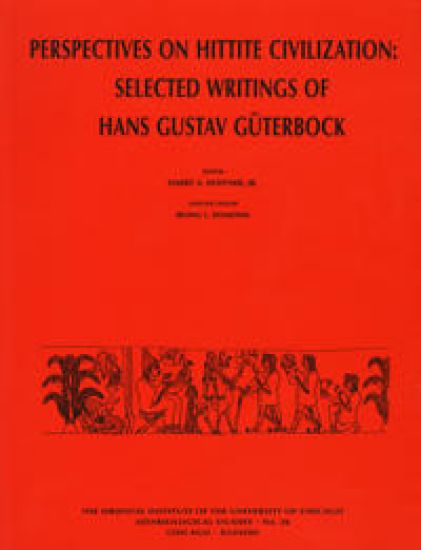
Perspectives on Hittite Civilization

Perspectives on Hittite Civilization

H. G. Guterbock; Harry A. Hoffner

Oriental Institute of the University of Chicago
1997
nidottu
The thirty-three articles in this collection (originally published between 1948 and 1992) were chosen from the corpus of bibliographical items authored by Hans Gustav Gueterbock over a span of more than sixty years. They give a rich and varied picture of ancient Hittite culture by one who literally grew up with the new discipline and experienced firsthand its most dramatic discoveries. Both the choice of articles and their sequence in this volume were selected by Professor Gueterbock. Articles deal with almost every conceivable aspect of ancient Hittite culture: history, literature, divination, mythology/theology, religious ceremonies, architecture, ethnic diversity, law, diplomacy, social structure, and administration. This diversity demonstrates Gueterbock's proficiency in all areas of Hittitological research.
Hittite Dictionary of the Oriental Institute of the University of Chicago Volume P, fascicles 1-3

Hittite Dictionary of the Oriental Institute of the University of Chicago Volume P, fascicles 1-3

H. G. Guterbock; Harry A. Hoffner; T. P. J. van den Hout

Oriental Institute of the University of Chicago
1997
sidottu
The Hittite language is the earliest preserved member of the Indo-European family of languages. It was written on clay tablets in central Asia Minor over a five hundred year span (ca. 1650-1180 B. C.) which witnessed the rise, the floruit, and the decline of many political powers in the Near East. The Hittite Dictionary of the Oriental Institute of the University of Chicago (CHD) is a comprehensive, bilingual Hittite-English dictionary. The CHD is not just a list of words and their meanings, but rather a dictionary that reflects and illustrates the ideas and material world of Hittite society through its lexicon. Published letter by letter, the CHD is a long-term project and the result of a painstaking process of cultural, historical, and lexical investigation for all those interested in Hittite culture and history. The CHD is the only such project in the English speaking world.
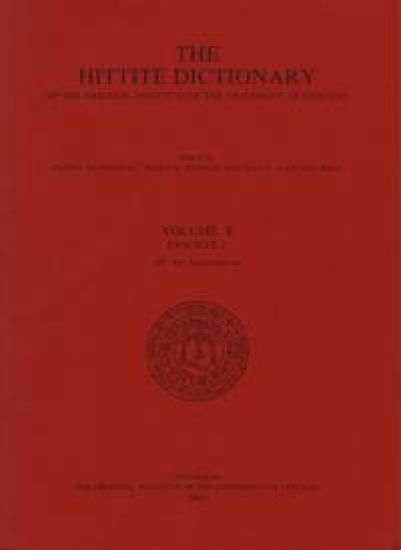
Hittite Dictionary of the Oriental Institute of the University of Chicago. Volume P, fascicle 1 (pa- to para)

Hittite Dictionary of the Oriental Institute of the University of Chicago. Volume P, fascicle 1 (pa- to para)

H G Guterbock; Harry A Hoffner; T P J van den Hout

Oriental Institute of the University of Chicago
1994
nidottu
The Hittite language is the earliest preserved member of the Indo-European family of languages. It was written on clay tablets in central Asia Minor over a five hundred year span (ca. 1650-1180 B. C.) which witnessed the rise, the floruit, and the decline of many political powers in the Near East. The Hittite Dictionary of the Oriental Institute of the University of Chicago (CHD) is a comprehensive, bilingual Hittite-English dictionary. The CHD is not just a list of words and their meanings, but rather a dictionary that reflects and illustrates the ideas and material world of Hittite society through its lexicon. Published letter by letter, the CHD is a long-term project and the result of a painstaking process of cultural, historical, and lexical investigation for all those interested in Hittite culture and history. The CHD is the only such project in the English speaking world.
Hittite Dictionary of the Oriental Institute of the University of Chicago Volume L-N, fascicle 3 (miyahuwant- to nai-)

Hittite Dictionary of the Oriental Institute of the University of Chicago Volume L-N, fascicle 3 (miyahuwant- to nai-)

H. G. Guterbock; Harry A. Hoffner; T. P. J. van den Hout

Oriental Institute of the University of Chicago
1986
nidottu
The Hittite language is the earliest preserved member of the Indo-European family of languages. It was written on clay tablets in central Asia Minor over a five hundred year span (ca. 1650-1180 B. C.) which witnessed the rise, the floruit, and the decline of many political powers in the Near East. The Hittite Dictionary of the Oriental Institute of the University of Chicago (CHD) is a comprehensive, bilingual Hittite-English dictionary. The CHD is not just a list of words and their meanings, but rather a dictionary that reflects and illustrates the ideas and material world of Hittite society through its lexicon. Published letter by letter, the CHD is a long-term project and the result of a painstaking process of cultural, historical, and lexical investigation for all those interested in Hittite culture and history. The CHD is the only such project in the English speaking world.
Hittite Dictionary of the Oriental Institute of the University of Chicago Volume L-N, fascicle 2 (-ma to miyahuwant-)

Hittite Dictionary of the Oriental Institute of the University of Chicago Volume L-N, fascicle 2 (-ma to miyahuwant-)

H. G. Guterbock; Harry A. Hoffner; T. P. J. van den Hout

Oriental Institute of the University of Chicago
1983
nidottu
The Hittite language is the earliest preserved member of the Indo-European family of languages. It was written on clay tablets in central Asia Minor over a five hundred year span (ca. 1650-1180 B. C.) which witnessed the rise, the floruit, and the decline of many political powers in the Near East. The Hittite Dictionary of the Oriental Institute of the University of Chicago (CHD) is a comprehensive, bilingual Hittite-English dictionary. The CHD is not just a list of words and their meanings, but rather a dictionary that reflects and illustrates the ideas and material world of Hittite society through its lexicon. Published letter by letter, the CHD is a long-term project and the result of a painstaking process of cultural, historical, and lexical investigation for all those interested in Hittite culture and history. The CHD is the only such project in the English speaking world.
Hittite Dictionary of the Oriental Institute of the University of Chicago Volume L-N, fascicle 1 (la- to ma-)

Hittite Dictionary of the Oriental Institute of the University of Chicago Volume L-N, fascicle 1 (la- to ma-)

H. G. Guterbock; Harry A. Hoffner; T. P. J. van den Hout

Oriental Institute of the University of Chicago
1980
nidottu
The Hittite language is the earliest preserved member of the Indo-European family of languages. It was written on clay tablets in central Asia Minor over a five hundred year span (ca. 1650-1180 B. C.) which witnessed the rise, the floruit, and the decline of many political powers in the Near East. The Hittite Dictionary of the Oriental Institute of the University of Chicago (CHD) is a comprehensive, bilingual Hittite-English dictionary. The CHD is not just a list of words and their meanings, but rather a dictionary that reflects and illustrates the ideas and material world of Hittite society through its lexicon. Published letter by letter, the CHD is a long-term project and the result of a painstaking process of cultural, historical, and lexical investigation for all those interested in Hittite culture and history. The CHD is the only such project in the English speaking world.
Soundings at Tell Fakhariyah

Soundings at Tell Fakhariyah

Calvin W. McEwan; Linda S. Braidwood; H. Frankfort; H. G. Guterbock

Oriental Institute of the University of Chicago
1957
sidottu
An imposing array of scholars have united to pay a debt of piety to the late C. W. McEwan, whose untimely death in 1950 forestalled the publication of his campaign at Tell Fakhariyah, which took place in 1940. That the important results obtained by McEwan have thus been rescued is greatly to the credit of the editor and director of the Oriental Institute, Carl H. Kraeling, and the architect R. C. Haines, who prepared for publication the highly competent but necessarily incomplete topographic and architectural data assembled in the field by the late Harold D. Hill.