Kirjojen hintavertailu – 12 903 725 kirjaa ja 27 kauppaa

Kirjailija

H. Haken

Kirjat ja teokset yhdessä paikassa: 4 kirjaa, julkaisuja vuosilta 1973–2011, suosituimpiin kuuluu Self-Organization and the City. Vertaile teosten hintoja ja tarkista saatavuus suomalaisista kirjakaupoista.

4 kirjaa

Kirjojen julkaisuvuodet: 1973–2011.

Relative Information

Relative Information

Guy Jumarie; G.J. Klir; H. Haken

Springer-Verlag Berlin and Heidelberg GmbH Co. K
2011
nidottu
For four decades, information theory has been viewed almost exclusively as a theory based upon the Shannon measure of uncertainty and information, usually referred to as Shannon entropy. Since the publication of Shannon's seminal paper in 1948, the theory has grown extremely rapidly and has been applied with varied success in almost all areas of human endeavor. At this time, the Shannon information theory is a well established and developed body of knowledge. Among its most significant recent contributions have been the use of the complementary principles of minimum and maximum entropy in dealing with a variety of fundamental systems problems such as predic­ tive systems modelling, pattern recognition, image reconstruction, and the like. Since its inception in 1948, the Shannon theory has been viewed as a restricted information theory. It has often been argued that the theory is capable of dealing only with syntactic aspects of information, but not with its semantic and pragmatic aspects. This restriction was considered a v~rtue by some experts and a vice by others. More recently, however, various arguments have been made that the theory can be appropriately modified to account for semantic aspects of in­ formation as well. Some of the most convincing arguments in this regard are in­ cluded in Fred Dretske's Know/edge & Flow of Information (The M. LT. Press, Cambridge, Mass., 1981) and in this book by Guy lumarie.

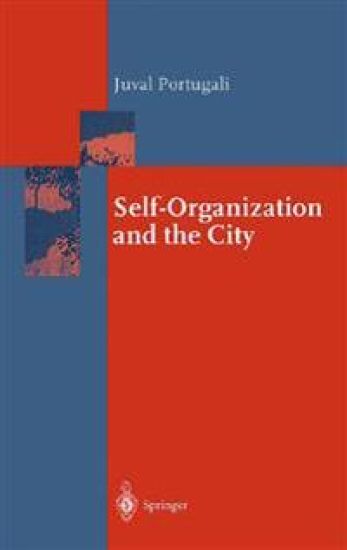
Self-Organization and the City

Self-Organization and the City

Juval Portugali; H. Haken

Springer-Verlag Berlin and Heidelberg GmbH Co. K
2010
nidottu
Cities first came into existence more than five thousand years ago. How to deal with these partly fascinating, partly frightening creatures of mankind, both practically and intellectually, concerns all of us and, in particular, presents areal challenge to city planners. Each historical epoch has had its own par­ ticular attitudes associated with the "Zeitgeist". Accordingly, the planning and steering of cities were based on quite different criteria. But in spite of these differences, the concept of planning and steering was, and still is, the cornerstone of our dealing with cities. Nevertheless, the planner's dilemma is becoming more and more visible: cities and megacities seem to be un­ plannable. In this book, Juval Portugali intro duces a new idea: Cities are self­ organizing systems. To substantiate his revolutionary concept, he uses several interlinked methods. On the one hand, and to my own delight, he employs in his arguments theoretical tools developed in the interdisciplinary field of synergetics. On the other hand, jointly with his co-workers, he has performed detailed model calculations on cellular nets. It has been a great pleasure and a wonderful experience for me to discuss these concepts with Juval Portugali over a number of years. I was repeatedly and deeply impressed by the way he established profound and often surprising links to other fields of science.
Self-Organization and the City

Self-Organization and the City

Juval Portugali; H. Haken

Springer-Verlag Berlin and Heidelberg GmbH Co. K
1999
sidottu
Cities first came into existence more than five thousand years ago. How to deal with these partly fascinating, partly frightening creatures of mankind, both practically and intellectually, concerns all of us and, in particular, presents areal challenge to city planners. Each historical epoch has had its own par­ ticular attitudes associated with the "Zeitgeist". Accordingly, the planning and steering of cities were based on quite different criteria. But in spite of these differences, the concept of planning and steering was, and still is, the cornerstone of our dealing with cities. Nevertheless, the planner's dilemma is becoming more and more visible: cities and megacities seem to be un­ plannable. In this book, Juval Portugali intro duces a new idea: Cities are self­ organizing systems. To substantiate his revolutionary concept, he uses several interlinked methods. On the one hand, and to my own delight, he employs in his arguments theoretical tools developed in the interdisciplinary field of synergetics. On the other hand, jointly with his co-workers, he has performed detailed model calculations on cellular nets. It has been a great pleasure and a wonderful experience for me to discuss these concepts with Juval Portugali over a number of years. I was repeatedly and deeply impressed by the way he established profound and often surprising links to other fields of science.
Quantenfeldtheorie des Festkörpers

Quantenfeldtheorie des Festkörpers

H. Haken

Vieweg+teubner Verlag
1973
nidottu
Die Festkörperphysik ist eines der großen Hauptgebiete der heutigen Physik. Der Festkörper stellt mit seinen verwickelten elektrischen, optischen, thermischen und magnetischen Eigenschaften ein äußerst reizvolles Objekt moderner Grundlagen­ forschung dar. In der Tat gelingt es hier, die oft sehr komplizierten Erscheinungen aufzuklären und bis in die Details hinein zu verfolgen. Das damit verbundene tief­ greifende Verständnis der physikalischen Vorgänge im Festkörper führt darüber­ hinaus zu äußerst wichtigen Anwendungen, z. B. in der Nachrichten-und Computer­ technik. Der Studierende, der sich in dieses Gebiet einarbeiten will, stellt allerdings sehr rasch fest, daß hier in großem Umfang Begriffsbildungen und Methoden der Quantenfeld­ theorie verwendet werden. Diese Methoden gestatten es nicht nur, die physikalischen Vorgänge im Festkörper in eleganter Weise zu beschreiben, sondern sie haben auch zu grundsätzlich neuen Erkenntnissen geführt. Als hervorragendes Beispiel sei hier nur die Erklärung der Supraleitung erwähnt. Andererseits wird dem Studierenden in einer Kursvorlesung, etwa der Quanten­ mechanik, kaum die Möglichkeit geboten, dieses wichtige Gebiet kennenzulernen. Aufgabe dieses Buches soll es sein, diese Lücke zu schließen, indem es den Leser in einfacher Weise an die Begriffsbildungen und Methoden der Quantenfeldtheorie her­ anführt. So sollte ein Leser, der mit den mathematischen Kenntnissen der ersten drei Semes·ter und den Grundbegriffen der Quantenmechanik vertraut ist, ohne weiteres in der Lage sein, sich mit Hilfe dieses Buches in die Quantenfeldtheorie des Fest­ körpers einzuarbeiten.