Kirjojen hintavertailu – 12 859 819 kirjaa ja 27 kauppaa
Kirjailija
H. Jefferson Powell
Kirjat ja teokset yhdessä paikassa: 9 kirjaa, julkaisuja vuosilta 1993–2022, suosituimpiin kuuluu A Community Built on Words. Vertaile teosten hintoja ja tarkista saatavuus suomalaisista kirjakaupoista.
Americans often think about constitutional law in terms of high-profile decisions by the Supreme Court – decisions that divide the justices by ideology, not law. This focus often leads to the erroneous conclusion that constitutional law arguments are, and can only be, political in substance. In The Practice of American Constitutional Law, H. Jefferson Powell demonstrates that there is a longstanding, shared practice of constructing and evaluating constitutional law claims that transcends current political disagreements. Powell describes how lawyers and judges identify constitutional problems by using a specifiable method of inquiry that enables them to agree on what the questions are, and thus what any plausible answer must address, even when disagreement over the most persuasive answers remains. Rather than being simply politics by other means, constitutional law is the successful practice of giving substance to the Constitution as supreme law.
Americans often think about constitutional law in terms of high-profile decisions by the Supreme Court – decisions that divide the justices by ideology, not law. This focus often leads to the erroneous conclusion that constitutional law arguments are, and can only be, political in substance. In The Practice of American Constitutional Law, H. Jefferson Powell demonstrates that there is a longstanding, shared practice of constructing and evaluating constitutional law claims that transcends current political disagreements. Powell describes how lawyers and judges identify constitutional problems by using a specifiable method of inquiry that enables them to agree on what the questions are, and thus what any plausible answer must address, even when disagreement over the most persuasive answers remains. Rather than being simply politics by other means, constitutional law is the successful practice of giving substance to the Constitution as supreme law.
Targeting Americans: The Constitutionality of the U. S. Drone War focuses on the legal debate surrounding drone strikes, the use of which has expanded significantly under the Obama Presidency as part of the continuing war against terror. Despite the political salience of the legal questions raised by targeted killing, the author asserts that there has been remarkably little careful analysis of the fundamental legal question: the constitutionality of the policy. From a position of deep practical expertise in constitutional issues, Prof. Powell provides a dispassionate and balanced analysis of the issues posed by U. S. targeted killing policy, using the killing of Anwar al-Awlaki in September 2011 as a focus for discussion. While Powell concludes that the al-Awlaki strike was constitutional under 2001 legislation, he rejects the Obama administration's broader claims of authority for its drone policies. Furthermore, he argues, citizens acting as combatants in al-Qaeda and associated groups are not entitled to due process protections: by due process standards, the administration's procedures are legally inadequate. A fundamental theme of the book is that the conclusion that an action or policy is constitutional should not be confused with claims about its wisdom, morality, or legality under international norms. Part of the purpose of constitutional analysis is to draw attention to these other normative concerns and not, as is too often the case, to occlude them.
The authors of this book share a concern for the state of law and democracy in our country, which to many seems to have deteriorated badly. Deep changes are visible in a wide array of phenomena: judicial opinions, the teaching of law, legal practice, international relations, legal scholarship, congressional deliberations, and the culture of contemporary politics. In each of these intersections between law, culture, and politics, traditional expectations have been transformed in ways that pose a threat to the continued vitality and authority of law and democracy. The authors analyze specific instances in which such a decline has occurred or is threatened, tracing them to "the empire of force," a phrase borrowed from Simone Weil. This French intellectual applied the term not only to the brute force used by police and soldiers but, more broadly, to the underlying ways of thinking, talking, and imagining that make that sort of force possible, including propaganda, unexamined ideology, sentimental clichés, and politics by buzzwords, all familiar cultural forms. Based on the underlying crisis and its causes, the editors and authors of these essays agree that neither law nor democracy can survive where the empire of force dominates. Yet each manages to find a ground for hope in our legal and democratic culture. H. Jefferson Powell is Frederic Cleaveland Professor of Law and Divinity at Duke University and has served in both the federal and state governments, as a deputy assistant attorney general and as principal deputy solicitor general in the U. S. Department of Justice and as special counsel to the attorney general of North Carolina. His latest book is Constitutional Conscience: The Moral Dimension of Judicial Decision. James Boyd White is Hart Wright Professor of Law emeritus and Professor of English emeritus, at the University of Michigan. His latest book is Living Speech: Resisting the Empire of Force." An extraordinary collection of provocative, insightful, and inspiring essays on the future of law and democracy in the twenty-first century."---Geoffrey R. Stone, Edward H. Levi Distinguished Service Professor of Law, University of Chicago"These thoughtful essays diagnose democracy's perilous present, and---more importantly---they explore avenues to democracy's rescue through humanization of law."---Kenneth L. Karst, David G. Price and Dallas P. Price Professor of Law Emeritus, UCLAContributorsMartin Böhmer, Universidad de San Andres, Buenos Aires, ArgentinaM. Cathleen Kaveny, University of Notre DameHoward Lesnick, University of PennsylvaniaThe Honorable John T. Noonan Jr., Ninth Circuit Court of AppealsH. Jefferson Powell, Duke UniversityJedediah Purdy, Duke UniversityJed Rubenfeld, Yale UniversityA. W. Brian Simpson, University of MichiganBarry Sullivan, Jenner and Block LLP, ChicagoJoseph Vining, University of MichiganRobin West, Georgetown UniversityJames Boyd White, University of Michigan
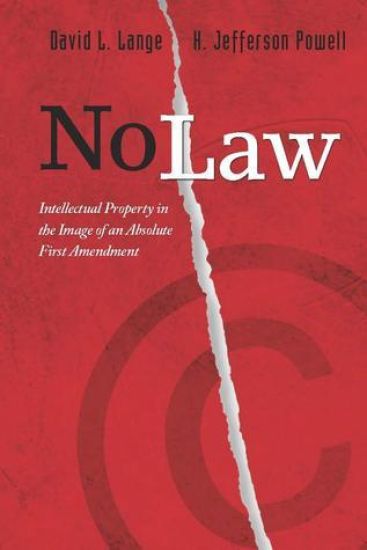
The original text of the Constitution grants Congress the power to create a regime of intellectual property protection. The first amendment, however, prohibits Congress from enacting any law that abridges the freedoms of speech and of the press. While many have long noted the tension between these provisions, recent legal and cultural developments have transformed mere tension into conflict. No Law offers a new way to approach these debates. In eloquent and passionate style, Lange and Powell argue that the First Amendment imposes absolute limits upon claims of exclusivity in intellectual property and expression, and strips Congress of the power to restrict personal thought and free expression in the name of intellectual property rights. Though the First Amendment does not repeal the Constitutional intellectual property clause in its entirety, copyright, patent, and trademark law cannot constitutionally license the private commodification of the public domain. The authors claim that while the exclusive rights currently reflected in intellectual property are not in truth needed to encourage intellectual productivity, they develop a compelling solution for how Congress, even within the limits imposed by an absolute First Amendment, can still regulate incentives for intellectual creations. Those interested in the impact copyright doctrines have on freedom of expression in the U. S. and the theoretical and practical aspects of intellectual property law will want to take a closer look at this bracing, resonant work.
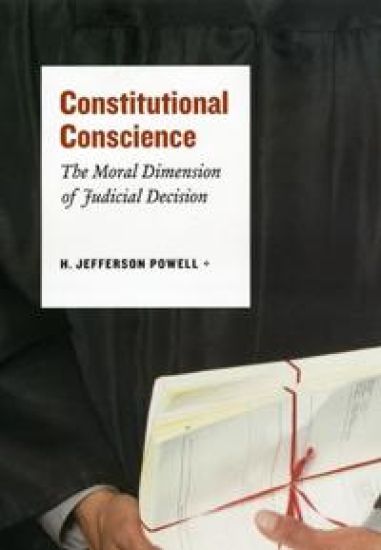
While many recent observers have accused American judges - especially Supreme Court justices - of being too driven by politics and ideology, others have argued that judges are justified in using their positions to advance personal views. Advocating a different approach - one that eschews ideology but still values personal perspective - H. Jefferson Powell makes a compelling case for the centrality of individual conscience in constitutional decision making. Powell argues that almost every controversial decision has more than one constitutionally defensible resolution. In such cases, he goes on to contend, the language and ideals of the Constitution require judges to decide in good faith, exercising what Powell calls the constitutional virtues: candor, intellectual honesty, humility about the limits of constitutional adjudication, and willingness to admit that they do not have all the answers. "Constitutional Conscience" concludes that the need for these qualities in judges - as well as lawyers and citizens - is implicit in our constitutional practices, and that without them judicial review would forfeit both its own integrity and the credibility of the courts themselves.
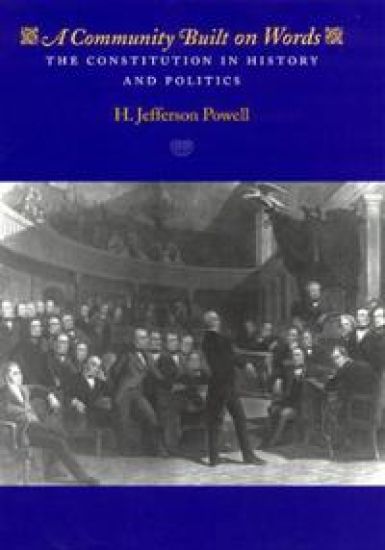
H. Jefferson Powell offers a powerful new approach to one of the central issues in American constitutional thinking today: the many ways in which constitutional arguments and outcomes are shaped both by historical circumstances and by political goals - including those of judges. Brilliantly combining history and theory, Powell analyzes a series of constitutional controversies from 1790 to 1944 to demonstrate that constitutional law from its very beginning has involved politically charged and ideologically divisive arguments. Powell then takes his conclusions one step further, claiming that it is precisely this historical tradition of argument that has given American constitutional law a remarkable coherence and integrity over time. No matter what the particular political disputes of the day might be, constitutional argument has provided a shared language through which our political community has been able to fight out its battles without ultimately fracturing.
H. Jefferson Powell offers a powerful new approach to one of the central issues in American constitutional thinking today: the many ways in which constitutional arguments and outcomes are shaped both by historical circumstances and by political goals - including those of judges. Brilliantly combining history and theory, Powell analyzes a series of constitutional controversies from 1790 to 1944 to demonstrate that constitutional law from its very beginning has involved politically charged and ideologically divisive arguments. Powell then takes his conclusions one step further, claiming that it is precisely this historical tradition of argument that has given American constitutional law a remarkable coherence and integrity over time. No matter what the particular political disputes of the day might be, constitutional argument has provided a shared language through which our political community has been able to fight out its battles without ultimately fracturing.
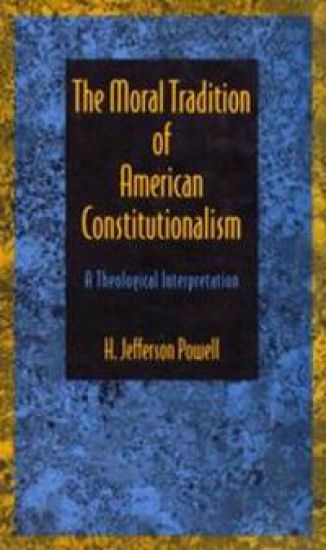
Debate over the relationship between morality and the law characterizes the contemporary discussion of American constitutionalism. Many theorists equate constitutionalism with the social morality of the American community; others deny the existence of such a community and identify constitutionalism simply as the positive law of the state. In this thoughtful and innovative book, H. Jefferson Powell presents a theological interpretation of the connection between constitutionalism and morality. Powell locates the origins of constitutional law in the Enlightenment attempt to control the violence of the state by subjecting power to reason. He then traces constitutionalism's rapid evolution into a tradition of rational inquiry centered in the practice of adjudication and embodied in a community of lawyers and judges. Finally, Powell shows how the tradition's nineteenth-century presuppositions about the autonomy and rationality of constitutional argument have been undermined in the twentieth century, within the constitutional community itself, by the acceptance of a positivist and "democratic" understanding of law. Powell shows how the continued willingness of the courts to resolve moral questions by invoking "the Constitution" has thrown the constitutional tradition into an epistemological crisis. He critiques the work of many major theorists-John Hart Ely, Bruce Ackerman, Frank Michaelman, Rogers Smith, Michael Perry, Mark Tushnet, Robert Bork, Sanford Levinson-who, he claims, persist in attempting to resolve the crisis by redefining constitutionalism as American social morality. With reference to Alasdair MacIntyre's concepts of moral tradition and social practice and John Howard Yoder's theological account of the state, Powell places his analysis of current constitutionalism within a contemporary Christian theological critique of Western liberalism. With certain exceptions, Powell concludes, there are theological grounds in the United States to prefer decision making by elected officials to decision by constitutional courts. Despite the controversial implications for judicial practice and legal argument, Powell ultimately argues that the liberal tradition of rational inquiry--American constitutionalism--be renounced by the Christian community in favor of the majoritarian political process.