Kirjailija
H L Havell
Kirjat ja teokset yhdessä paikassa: 19 kirjaa, julkaisuja vuosilta 2004–2025, suosituimpiin kuuluu Republican Rome. Vertaile teosten hintoja ja tarkista saatavuus suomalaisista kirjakaupoista.
Nimi esiintyy myös muodoissa: H. L. Havell, H.L. Havell
19 kirjaa
Kirjojen julkaisuvuodet: 2004–2025.



In order to understand the structure of The Iliad, we must keep fast hold of the guiding clue which is supplied by the author, Homer, in the first line of his poem. The subject, he tells us, is the Wrath of Achilles. The motive of the greatest of epics is wrath-blind, unreasoning fury, which knows no law, and acknowledges no right. Keeping this in view, we are able to explain what seems at first sight to be a strange anomaly in the conduct of the story-the absence of the hero from the scene of action during three-fourths of the narrative. For Achilles is not less the hero of The Iliad than Odysseus is the hero of The Odyssey, and in both cases the character of the man determines the structure of the poem.


Reproduction of the original: Stories From the Iliad by H. L Havell



Reproduction of the original: Stories From the Odyssey by H. L Havell

Stories from the Odyssey: The Odyssey
H. L. Havell
Createspace Independent Publishing Platform
2018
nidottu
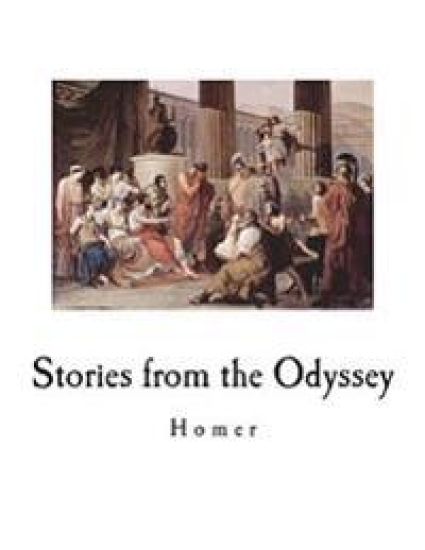
Stories from the Odyssey. The Odyssey is one of two major ancient Greek epic poems attributed to Homer. It is, in part, a sequel to the Iliad, the other work ascribed to Homer. The Odyssey is fundamental to the modern Western canon; it is the second-oldest extant work of Western literature, while the Iliad is the oldest. Scholars believe the Odyssey was composed near the end of the 8th century BC, somewhere in Ionia, the Greek coastal region of Anatolia. A proud maiden was Penelope, when Odysseus wedded her in her youthful bloom, and made her the mistress of his fair dwelling and his rich domain. One happy year they lived together, and a son was born to them, whom they named Telemachus. Then war arose between Greece and Asia, and Odysseus was summoned to join the train of chieftains who followed Agamemnon to win back Helen, his brother's wife. Ten years the war lasted; then Troy was taken, and those who had survived the struggle returned to their homes. Among these was Odysseus, who set sail with joyful heart, hoping, before many days were passed, to take up anew the thread of domestic happiness which had been so rudely broken. But since that hour he has vanished from sight, and for ten long years from the fall of Troy the house has been mourning its absent lord.
Stories from the Odyssey
H. L. Havell; Homer
Createspace Independent Publishing Platform
2016
nidottu
Stories from the OdysseyHomerRetold By H. L. HavellGREEK CLASSICSThe Odyssey is one of two major ancient Greek epic poems attributed to Homer. It is, in part, a sequel to the Iliad, the other work ascribed to Homer. The poem is fundamental to the modern Western canon, and is the second oldest extant work of Western literature, the Iliad being the oldest. Scholars believe it was composed near the end of the 8th century BC, somewhere in Ionia, the Greek coastal region of Anatolia. The impersonal character of the Homeric poems has left us entirely in the dark as to the birthplace, the history, and the date, of their author. So complete is the darkness which surrounds the name of Homer that his very existence has been disputed, and his works have been declared to be an ingenious compilation, drawn from the productions of a multitude of singers. It is not my intention here to enter into the endless and barren controversy which has raged round this question. It will be more to the purpose to try and form some general idea of the characteristics of the Greek Epic; and to do this it is necessary to give a brief review of the political and social conditions in which it was produced. The world as known to Homer is a mere fragment of territory, including a good part of the mainland of Greece, with the islands and coast districts of the g an. Outside of these limits his knowledge of geography is narrow indeed. He has heard of Sicily, which he speaks of under the name of Thrinacia; and he speaks once of Libya, or the north coast of Africa, as a district famous for its breed of sheep. There is one vague reference to the vast Scythian or Tartar race (called by Homer Thracians), who live on the milk of mares; and he mentions a copper-coloured people, the "Red-faces," who dwell far remote in the east and west. The Nile is mentioned, under the name of gyptus; and the Egyptians are celebrated by the poet as a people skilled in medicine, a statement which is repeated by Herodotus. The Phoenicians appear several times in the Odyssey, and we hear once or twice of the Sidonians, as skilled workers in metal. As soon as we pass these boundaries, we enter at once into the region of fairyland. CONTENTSINTRODUCTIONTELEMACHUS, PENELOPE, AND THE SUITORSTHE ASSEMBLY; THE VOYAGE OF TELEMACHUSTHE VISIT TO NESTOR AT PYLOSTELEMACHUS AT SPARTAODYSSEUS AND CALYPSOODYSSEUS AMONG THE PH ACIANSTHE WANDERINGS OF ODYSSEUSTHE VISIT TO HADESTHE SIRENS; SCYLLA AND CHARYBDIS; THRINACIAODYSSEUS LANDS IN ITHACAODYSSEUS AND EUM USTHE RETURN OF TELEMACHUSTHE MEETING OF TELEMACHUS AND ODYSSEUSTHE HOME-COMING OF ODYSSEUSTHE BEGGAR IRUSPENELOPE AND THE WOOERSODYSSEUS AND PENELOPETHE END DRAWS NEAR; SIGNS AND WONDERSTHE BOW OF ODYSSEUSTHE SLAYING OF THE WOOERSODYSSEUS AND PENELOPE