Kirjojen hintavertailu – 12 859 829 kirjaa ja 27 kauppaa

Kirjailija

H. Maurer

Kirjat ja teokset yhdessä paikassa: 3 kirjaa, julkaisuja vuosilta 1933–2012, suosituimpiin kuuluu Biochemisches Handlexikon. Vertaile teosten hintoja ja tarkista saatavuus suomalaisista kirjakaupoista.

3 kirjaa

Kirjojen julkaisuvuodet: 1933–2012.

Biochemisches Handlexikon

Biochemisches Handlexikon

L.W. Bass; O. Dalmer; W. Kröner; P.A. Levene; H. Maurer

Springer-Verlag Berlin and Heidelberg GmbH Co. K
1933
nidottu
Dieser Buchtitel ist Teil des Digitalisierungsprojekts Springer Book Archives mit Publikationen, die seit den Anfängen des Verlags von 1842 erschienen sind. Der Verlag stellt mit diesem Archiv Quellen für die historische wie auch die disziplingeschichtliche Forschung zur Verfügung, die jeweils im historischen Kontext betrachtet werden müssen. Dieser Titel erschien in der Zeit vor 1945 und wird daher in seiner zeittypischen politisch-ideologischen Ausrichtung vom Verlag nicht beworben.
Heavy Minerals in Colour

Heavy Minerals in Colour

M.A. Mange; H. Maurer

Springer
2012
nidottu
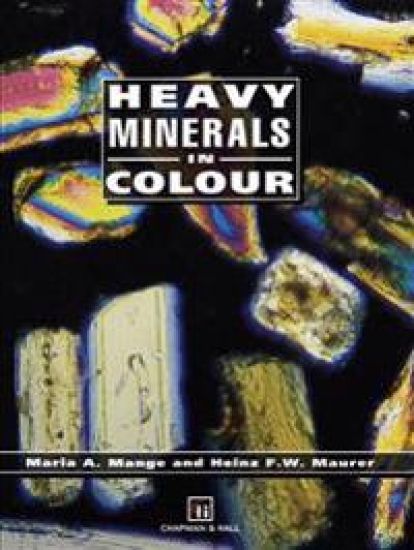
Although some handbooks on the microscopic identi­ In Part I the concept of heavy mineral analysis is fication of heavy mineral grains are available, a introduced and the relative significance of factors comprehensive manual illustrated in colour has not affecting heavy mineral assemblages is discussed. There been published until now. Because the appearance of are brief references to the commonly used laboratory minerals in grain mounts differs considerably from methods and auxiliary techniques. It concludes with those seen in a thin section, a different approach is some examples of the application of heavy mineral necessary for the identification of detrital grains. studies. Coloured photomicrographs, showing their colour Part II contains the descriptions of 61 transparent shades, pleochroism and interference tints, provide heavy mineral species, including those which are an excellent means of assisting recognition. As a commonly authigenic in sediments. Positive identi­ number of mineral grains have similar optical proper­ fication of authigenic minerals is important to avoid ties and morphology, it is equally important to confusion and to help recognition of diagenetic describe them verbally in detail, pointing out events. In the mineral descriptions considerable characteristic features and differences. emphasis is placed upon detrital morphology and This book is intended primarily as a manual that diagnostic features. Optical properties and character­ describes and illustrates the transparent heavy min­ istics are detailed, together with information on host erals most commonly found in sediments. It is hoped rocks.
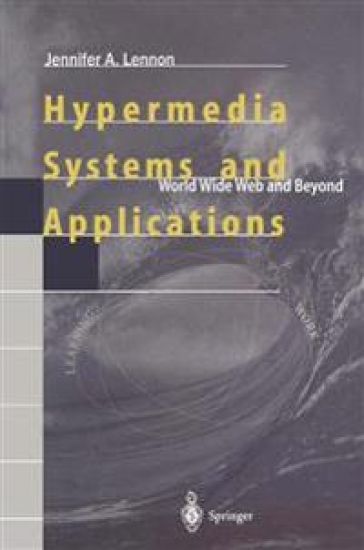
Hypermedia Systems and Applications

Hypermedia Systems and Applications

Jennifer A. Lennon; H. Maurer

Springer-Verlag Berlin and Heidelberg GmbH Co. K
1997
nidottu
It is a pleasure and an honor to write a foreword for Jennifer Lennon's book Hypermedia Systems and Applications: World Wide Web and Beyond. I am fortunate to have been able to follow the development of this book from an excellent Ph. D. thesis to what I would consider one of the best and most comprehensive books in the area. It has a good chance to become a must for teachers, researchers, and practitioners. For the sake ofthis foreword let us combine the phenomena hypermedia, the Internet, and the WWW by just calling them the Web. Well, this Web surely has become one of the "super hot topics", from both a scholarly and a commercial point ofview! We have a saying that the Web is like a dog: one year's development of the Web corresponds to seven human years. You will be familiar with Murphy's law: "Anything that can go wrong will go wrong", and with a plethora of derivatives or specializations thereof like: "If you are in an otherwise empty locker room, the only other person there is bound to have a locker just on top ofyours"; or: "If traffic is moving slowly, you are always going to be in the slowest moving lane", and so on. Well, I have coined a version that applies to the Web: "Whenever you have understood an important new development concerning the Web you can be sure that it is obsolete".