Kirjojen hintavertailu – 12 859 818 kirjaa ja 27 kauppaa

Kirjailija

H.S.M. Coxeter

Kirjat ja teokset yhdessä paikassa: 12 kirjaa, julkaisuja vuosilta 1965–2022, suosituimpiin kuuluu The Fifty-nine Icosahedra. Vertaile teosten hintoja ja tarkista saatavuus suomalaisista kirjakaupoista.

Nimi esiintyy myös muodoissa: H. S. M. Coxeter

12 kirjaa

Kirjojen julkaisuvuodet: 1965–2022.

Geometry Revisited

Geometry Revisited

H. S. M. Coxeter; S. L. Greitzer

AMERICAN MATHEMATICAL SOCIETY
2022
nidottu
Among the many beautiful and nontrivial theorems in geometry found in Geometry Revisited are the theorems of Ceva, Menelaus, Pappus, Desargues, Pascal, and Brianchon. A nice proof is given of Morley's remarkable theorem on angle trisectors. The transformational point of view is emphasized: reflections, rotations, translations, similarities, inversions, and affine and projective transformations. Many fascinating properties of circles, triangles, quadrilaterals, and conics are developed.
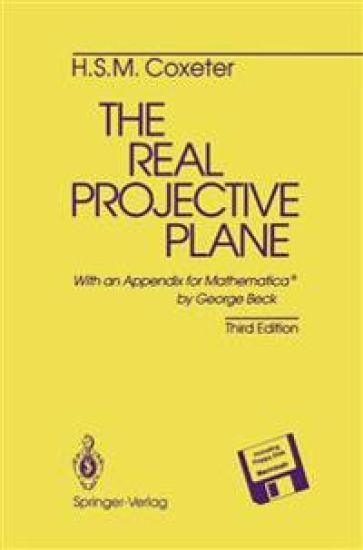
The Real Projective Plane

The Real Projective Plane

H.S.M. Coxeter

Springer-Verlag New York Inc.
2013
nidottu
Along with many small improvements, this revised edition contains van Yzeren's new proof of Pascal's theorem (§1.7) and, in Chapter 2, an improved treatment of order and sense. The Sylvester-Gallai theorem, instead of being introduced as a curiosity, is now used as an essential step in the theory of harmonic separation (§3.34). This makes the logi­ cal development self-contained: the footnotes involving the References (pp. 214-216) are for comparison with earlier treatments, and to give credit where it is due, not to fill gaps in the argument. H. S. M. C. November 1992 v Preface to the Second Edition Why should one study the real plane? To this question, put by those who advocate the complex plane, or geometry over a general field, I would reply that the real plane is an easy first step. Most of the prop­ erties are closely analogous, and the real field has the advantage of intuitive accessibility. Moreover, real geometry is exactly what is needed for the projective approach to non-Euclidean geometry. Instead of introducing the affine and Euclidean metrics as in Chapters 8 and 9, we could just as well take the locus of 'points at infinity' to be a conic, or replace the absolute involution by an absolute polarity.

The Real Projective Plane

The Real Projective Plane

H.S.M. Coxeter

Springer-Verlag New York Inc.
2011
nidottu
Along with many small improvements, this revised edition contains van Yzeren's new proof of Pascal's theorem (§1.7) and, in Chapter 2, an improved treatment of order and sense. The Sylvester-Gallai theorem, instead of being introduced as a curiosity, is now used as an essential step in the theory of harmonic separation (§3.34). This makes the logi­ cal development self-contained: the footnotes involving the References (pp. 214-216) are for comparison with earlier treatments, and to give credit where it is due, not to fill gaps in the argument. H. S. M. C. November 1992 v Preface to the Second Edition Why should one study the real plane? To this question, put by those who advocate the complex plane, or geometry over a general field, I would reply that the real plane is an easy first step. Most of the prop­ erties are closely analogous, and the real field has the advantage of intuitive accessibility. Moreover, real geometry is exactly what is needed for the projective approach to non· Euclidean geometry. Instead of introducing the affine and Euclidean metrics as in Chapters 8 and 9, we could just as well take the locus of 'points at infinity' to be a conic, or replace the absolute involution by an absolute polarity.
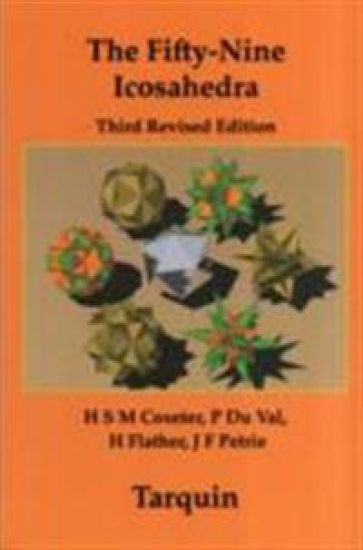
The Fifty-nine Icosahedra

The Fifty-nine Icosahedra

H. S. M. Coxeter; P. Du Val; H. T. Flather

TARQUIN PUBLICATIONS
2011
nidottu
Kate and David Crennell produced a third edition for Tarquin some years ago. The plans and illustrations of all 59 of the stellations of the icosahedron were redrawn and there was a new introduction by Professor Coxeter. This edition has now been revised and updated and now includes colour plates for the first time. Many readers will wish to use the plates and descriptions included in The Fifty-nine Icosahedra to draw and make paper models of some or all of the stellations of the icosahedron and in so doing, gain a greater understanding of the stellation process. For a thorough understanding of the process of stellation and for splendid examples of beautiful polyhedra, this book will be a valuable addition to any mathematics library. As Richard Guy put it in the Preface of the Third Edition: "We mathematicians know how beautiful our subject is, but are often frustrated when we try to explain this to the man-in-the-street. But here at least is one place where we can simply say, 'Look '"
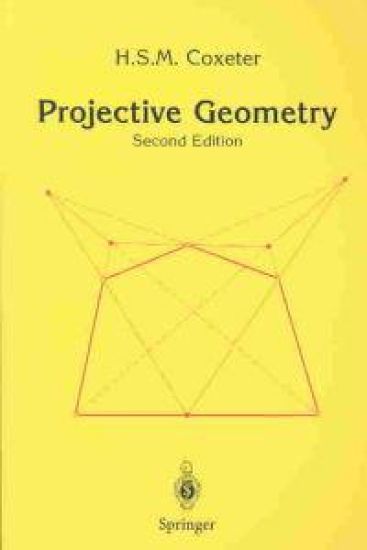
Projective Geometry

Projective Geometry

H.S.M. Coxeter

Springer-Verlag New York Inc.
2003
nidottu
In Euclidean geometry, constructions are made with ruler and compass. Projective geometry is simpler: its constructions require only a ruler. In projective geometry one never measures anything, instead, one relates one set of points to another by a projectivity. The first two chapters of this book introduce the important concepts of the subject and provide the logical foundations. The third and fourth chapters introduce the famous theorems of Desargues and Pappus. Chapters 5 and 6 make use of projectivities on a line and plane, repectively. The next three chapters develop a self-contained account of von Staudt's approach to the theory of conics. The modern approach used in that development is exploited in Chapter 10, which deals with the simplest finite geometry that is rich enough to illustrate all the theorems nontrivially. The concluding chapters show the connections among projective, Euclidean, and analytic geometry.
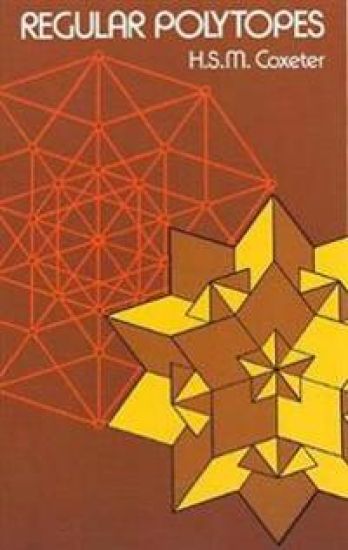
Regular Polytopes

Regular Polytopes

H.S.M. Coxeter

Dover Publications Inc.
2003
nidottu

Halvin toimitettuna 20,80 €

Foremost book available on polytopes, incorporating ancient Greek and most modern work done on them. Beginning with polygons and polyhedrons, the book moves on to multi-dimensional polytopes in a way that anyone with a basic knowledge of geometry and trigonometry can easily understand. Definitions of symbols. Eight tables plus many diagrams and examples. 1963 edition.
The Beauty of Geometry

The Beauty of Geometry

H. S. M. Coxeter

Dover Publications Inc.
2003
nidottu
These absorbing essays by a distinguished mathematician provide a compelling demonstration of the charms of mathematics. Stimulating and thought-provoking, this collection is sure to interest students, mathematicians, and any math buff with its lucid treatment of geometry and the crucial role geometry plays in a wide range of mathematical applications.
The Real Projective Plane

The Real Projective Plane

H.S.M. Coxeter

Springer-Verlag New York Inc.
1992
muu
Along with many small improvements, this revised edition contains van Yzeren's new proof of Pascal's theorem (§1.7) and, in Chapter 2, an improved treatment of order and sense. The Sylvester-Gallai theorem, instead of being introduced as a curiosity, is now used as an essential step in the theory of harmonic separation (§3.34). This makes the logi­ cal development self-contained: the footnotes involving the References (pp. 214-216) are for comparison with earlier treatments, and to give credit where it is due, not to fill gaps in the argument. H. S. M. C. November 1992 v Preface to the Second Edition Why should one study the real plane? To this question, put by those who advocate the complex plane, or geometry over a general field, I would reply that the real plane is an easy first step. Most of the prop­ erties are closely analogous, and the real field has the advantage of intuitive accessibility. Moreover, real geometry is exactly what is needed for the projective approach to non· Euclidean geometry. Instead of introducing the affine and Euclidean metrics as in Chapters 8 and 9, we could just as well take the locus of 'points at infinity' to be a conic, or replace the absolute involution by an absolute polarity.
Introduction to Geometry

Introduction to Geometry

H. S. M. Coxeter

John Wiley Sons Inc
1989
nidottu
This classic work is now available in an unabridged paperback edition. The Second Edition retains all the characterisitcs that made the first edition so popular: brilliant exposition, the flexibility permitted by relatively self-contained chapters, and broad coverage ranging from topics in the Euclidean plane, to affine geometry, projective geometry, differential geometry, and topology. The Second Edition incorporates improvements in the text and in some proofs, takes note of the solution of the 4-color map problem, and provides answers to most of the exercises.
The Fifty-Nine Icosahedra

The Fifty-Nine Icosahedra

H. S. M. Coxeter; P. DuVal; H. T. Flather; J. F. Petrie

Springer-Verlag New York Inc.
1982
nidottu
The Fifty-Nine Icosahedra was originally published in 1938 as No. 6 of "University of Toronto Studies (Mathematical Series)". Of the four authors, only Coxeter and myself are still alive, and we two are the authors of the whole text of the book, in which any signs of immaturity may perhaps be regarded leniently on noting that both of us were still in our twenties when it was written. N either of the others was a professional mathematician. Flather died about 1950, and Petrie, tragically, in a road accident in 1972. Petrie's part in the book consisted in the extremely difficult drawings which consti­ tute the left half of each of the plates (the much simpler ones on the right being mine). A brief biographical note on Petrie will be found on p. 32 of Coxeter's Regular Polytopes (3rd. ed. , Dover, New York, 1973); and it may be added that he was still a schoolboy when he discovered the regular skew polygons that are named after him, and are the occasion for the note on him in Coxeter's book. (Coxeter also was a schoolboy when some of the results for which he will be most remembered were obtained; he and Petrie were schoolboy friends and used to work together on polyhedron and polytope theory. ) Flather's part in the book consisted in making a very beautiful set of miniature models of all the fifty-nine figures. These are still in existence, and in excellent preservation.
Non-Euclidean Geometry

Non-Euclidean Geometry

H.S.M. Coxeter

University of Toronto Press
1965
pokkari
The name non-Euclidean was used by Gauss to describe a system of geometry which differs from Euclid's in its properties of parallelism. Such a system was developed independently by Bolyai in Hungary and Lobatschewsky in Russia, about 120 years ago. Another system, differing more radically from Euclid's, was suggested later by Riemann in Germany and Cayley in England. The subject was unified in 1871 by Klein, who gave the names of parabolic, hyperbolic, and elliptic to the respective systems of Euclid-Bolyai-Lobatschewsky, and Riemann-Cayley. Since then, a vast literature has accumulated. The Fifth edition adds a new chapter, which includes a description of the two families of 'mid-lines' between two given lines, an elementary derivation of the basic formulae of spherical trigonometry and hyperbolic trigonometry, a computation of the Gaussian curvature of the elliptic and hyperbolic planes, and a proof of Schlafli's remarkable formula for the differential of the volume of a tetrahedron.