Kirjojen hintavertailu – 12 903 725 kirjaa ja 27 kauppaa

Kirjailija

H. Ziegler

Kirjat ja teokset yhdessä paikassa: 12 kirjaa, julkaisuja vuosilta 2011–2025, suosituimpiin kuuluu Verhandlungen der Gesellschaft für Ökologie Wien 1975. Vertaile teosten hintoja ja tarkista saatavuus suomalaisista kirjakaupoista.

Nimi esiintyy myös muodoissa: H Ziegler

12 kirjaa

Kirjojen julkaisuvuodet: 2011–2025.

Verhandlungen der Gesellschaft für Ökologie Wien 1975

Verhandlungen der Gesellschaft für Ökologie Wien 1975

G. Spatz; Ute Drescher-Kaden; K. P. Sauer; H. Pöhlmann; H. Rehder; A. Cernusca; Rudolf Hofer; Herbert Ladurner; Angelika Gattringer; Wolfgang Wieser; Stefan Myczkowski; H. Kaiser; H. Lehn; W. Larcher; H. Sampl; W. Hinz; U. Halbach; G. Flechtner; U. Witt; Edith Kann; E. Hübl; H. Dobesch; M. Dokulil; A. Herzig; W. Kühnelt; E.-D Schulze; H. Ziegler; W. Stichler; H. Nemenz; J. Donner; G. Wendelberger; F. Böck; J. Reichholf; A. Kohler; P. Müller; A. Schäfer; Christian Körner; Frieda Huber; H. Wagner; H. Franz; P. Blaser

Springer
2012
nidottu
Die 5. "Verhandlungen der Gesellschaft fur Okologie" enthalten die Vortrage der vom 22. bis 24. September 197 5 in Wien durchgefuhrten J ahrestagung. Schwer- punktsmassig behandeln die Referate alpine und arktische Okosysteme, die okologi- schen und genetischen Voraussetzungen fur das Leben in Trockengebieten sowie limnische Okosysteme. Durch die Berucksichtigung der diese Systeme tangierenden IBP- und MAB-Forschungsprogramme liefern sie zugleich auch aktuelle Informa- tionen uber laufende Forschungsprojekte unserer Osterreichischen und schweizer Kollegen. Struktudle und energetische Untersuchungen uber einzelne Okosysteme, Biozo- nosen und Populationen stehen dabei im Vordergrund. Die vorgelegten Arbeiten verdeutlichen, dass jedes lebendige System uber die Kenntnis seiner Struktur, Funk- tion und Geschichte Informationen zu einem tieferen Verstandnis des von ihm belebten Raumes liefert. Sie zeigen, dass letztlich jeder Suche nach "Belastungsindi- katoren" und "okologischen Kriterien" die Frage nach dem Informationsgehalt von Organismen und lebenden Systemen sowie deren Reaktionen auf endo- und exogene Faktoren zugrunde liegt. Sowohl aus Veranderungen der Areal- und Okosysteme, als auch aus Wandlungen von Biozonosen und deren Reaktionen wurden Ruckschlusse auf die diese Veranderungen auslosenden Faktoren gezogen. Populationen und Bio- zonosen reagieren naturgemass nach eigenen Regeln, konnen jedoch nur existieren, wenn sie bestandig auch Informationen uber andere Komponenten aus ihrem Ver- breitungsgebiet speichern und verarbeiten. Diese adaptiven Fahigkeiten der unter- suchten Arten und Systeme sind jedoch noch weitgehend unbearbeitet. Hier klafft eine echte Lucke, die den Transfer okologischer Daten z. B. in di. c Landesplanung erschwert. Die Qualitat jeder Planung hangt weitgehend von den eingesetzten okologischen, sozialen und wirtschaftlichen Erhebungsdaten ab.

Catechetics

Catechetics

H Ziegler

Anatiposi Verlag
2023
sidottu
Reprint of the original, first published in 1873. The publishing house Anatiposi publishes historical books as reprints. Due to their age, these books may have missing pages or inferior quality. Our aim is to preserve these books and make them available to the public so that they do not get lost.
Catechetics

Catechetics

H Ziegler

Anatiposi Verlag
2023
pokkari
Reprint of the original, first published in 1873. The publishing house Anatiposi publishes historical books as reprints. Due to their age, these books may have missing pages or inferior quality. Our aim is to preserve these books and make them available to the public so that they do not get lost.
Vorlesungen über Mechanik

Vorlesungen über Mechanik

H. Ziegler

Springer Basel
2014
nidottu
Dieses Buch ist aus Vorlesungen entstanden, die ich seit drei Jahrzehnten an der Eidgenössischen Technischen Hochschule für die Studierenden des Bau­ ingenieurwesens und der Vermessung, des Maschineningenieurwesens und der Elektrotechnik gehalten habe. Es stellt eine Neufassung der Bände I und II der Mechanik dar, welche seit 1946 im gleichen Verlag (ursprünglich unter meinem und dem Namen meines verehrten Lehrers und Vorgängers, Prof. Dr. ERNST MEISSNER) erschienen ist. Ich habe den schon in der 3. Auflage der früheren Fassung begonnenen Modemisierungsprozeß hier ein Stück weitergeführt und versucht, das Buch theoretisch zu straffen und gleichzeitig in methodischer Hinsicht den heutigen Bedürfnissen anzupassen. So wurde die Kinematik, die ja unmittelbar an die Geometrie anknüpft und daher dem Studierenden nur geringe Anfangsschwie­ rigkeiten macht, an die Spitze gestellt. Mit dieser Anordnung kann der Begriff der Leistung frühzeitig definiert werden. Das bietet den Vorteil, daß sowohl die Statik wie die Kinetik allein auf ein verallgemeinertes Reaktionsprinzip sowie das Prinzip der virtuellen Leistungen gegründet und damit von zahl­ reichen überflüssigen Axiomen befreit werden können. Die beiden Prinzipien lassen sich von Anfang an in einer für beliebige Körper gültigen Gestalt formu­ lieren, und damit kann auf die nur historisch gerechtfertigte, sachlich aber an­ fechtbare Praxis verzichtet werden, die Mechanik räumlich ausgedehnter Körper aus derjenigen der Massenpunkte zu entwickeln. Aus didaktischen sowie historischen Gründen erscheint es freilich vernünftig, die Axiome der Punkt­ mechanik zu erwähnen und auch zu verwenden, auch wenn sie sich schließlich als Konsequenzen der beiden genannten Prinzipien herausstellen.
Principles of Structural Stability

Principles of Structural Stability

H. Ziegler

Springer Basel
2014
nidottu
FirstEdition DUE TO THE necessity to save weight and materialin the design ofmodern structures and machines, stability problems have become increasingly im- portant. The classicalengineering approach to this type of problem has been characterized by the tacit assumption that structures are nongyroscopic conservative systems,that is, bythegeneraladoptionofthemethodsdeveloped for this particular case. During the last decades numerous stability problems of a more complicated nature have become important, and it has therefore become necessary to correlate the various types of problems with the ap- proaches to be used in their solution. The principal object ofthis little bookisthis correlation between the systems to be investigated and the methods to be used for this purpose, In other words, our main concern is the choice of a correct approach. It is evident that this idea renders it necessary to distinguish between the various types of problems or systems. At the same time the similarities and the connections between apparently quite different problems will become obvious, and it will be evident that there islittle differencebetween, say, the buckling of a column, thecritical speed of a turbine shaft, and the stability of an airplane, a control mechanism, or an electric circuit.
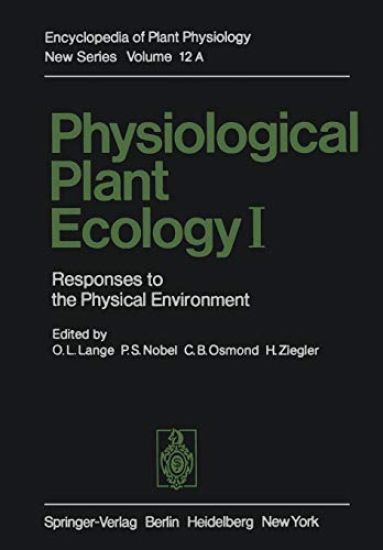
Physiological Plant Ecology IV

Physiological Plant Ecology IV

O. L. Lange; P. S. Nobel; C. B. Osmond; H. Ziegler

Springer-Verlag Berlin and Heidelberg GmbH Co. K
2011
nidottu
O. L. LANGE, P. S. NOBEL, C. B. OSMOND, and H. ZIEGLER In the last volume of the series 'Physiological Plant Ecology' we have asked contributors to address the bases of ecosystem processes in terms of key plant physiological properties. It has often been suggested that it is not profitable to attempt analysis of complex living systems in terms of the properties of component individuals or populations, i. e. , the whole is more than the sum of its parts. Nevertheless, assessments of ecological research over the last century show that other approaches are seldom more helpful. Although it is possible to describe complex systems of living organisms in holistic terms, the most useful descriptions are found in terms of the birth, growth and death of individ­ uals. This allows analysis of performance of the parts of the whole considering their synergistic and antagonistic interrelationships and is the basis for a synthe­ sis which elucidates the specific properties of a system. Thus it seemsthat the description of ecosystem processes is inevitably anchored in physiological under­ standing. If enquiry into complex living systems is to remain a scientific exercise, it must retain tangible links with physiology. Of course, as was emphasized in Vol. 12A, not all of our physiological understanding is required to explore ecosystem processes. For pragmatic purposes, the whole may be adequantely represented as a good deal less than the sum of its parts.
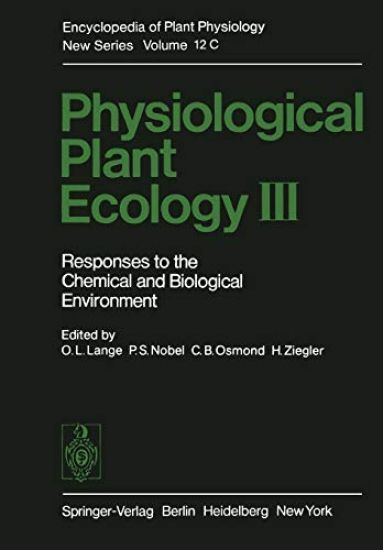
Physiological Plant Ecology III

Physiological Plant Ecology III

O. L. Lange; P. S. Nobel; C. B. Osmond; H. Ziegler

Springer-Verlag Berlin and Heidelberg GmbH Co. K
2011
nidottu
O. L. LANGE, P. S. NOBEL, C. B. OSMOND, and H. ZIEGLER Growth, development and reproductive success of individual plants depend on the interaction, within tolerance limits, of the factors in the physical, chemical and biological environment. The first two volumes of this series addressed fea­ tures of the physical environment (Vol. 12A) and the special responses of land plants as they relate to water use and carbon dioxide assimilation (Vol. 12B). In this volume we consider specific aspects of the chemical and biological envi­ ronment, and whereas the previous volumes were primarily concerned with the atmospheric interactions, our emphasis here shifts very much to the soil. This complex medium for plant growth was briefly reviewed in Chapter 17, Volume 12A. Since it is difficult to determine the precise physical and chemical interactions in the soil, it is even more difficult to determine the important biological interactions among organisms. Nevertheless there is growing aware­ ness of the significance of these interactions and their effects on physiological processes in the individual plant.