Kirjojen hintavertailu – 12 903 725 kirjaa ja 27 kauppaa

Kirjailija

Hagen M. Krämer

Kirjat ja teokset yhdessä paikassa: 3 kirjaa, julkaisuja vuosilta 2021–2023, suosituimpiin kuuluu Saving and Investment in the Twenty-First Century. Vertaile teosten hintoja ja tarkista saatavuus suomalaisista kirjakaupoista.

3 kirjaa

Kirjojen julkaisuvuodet: 2021–2023.

Capitalism, Inclusive Growth, and Social Protection

Capitalism, Inclusive Growth, and Social Protection

Hagen M. Krämer; Christian R. Proaño; Mark Setterfield

EDWARD ELGAR PUBLISHING LTD
2023
sidottu
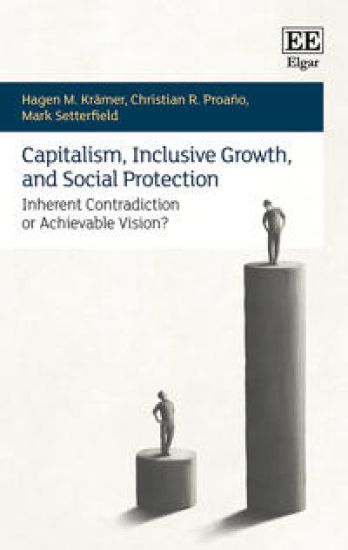
After more than four decades of real income stagnation, ever-increasing inequality and household financial distress, this book explores how the very fabric of our society is under threat. It argues that although capitalism is imperfect, it can be improved, and harnessing its forces of production to more suitable social relations of production is key to that improvement. Highlighting the concept of ‘social capitalism’ and ensuring that it is consistent with our underlying theoretical vision of how capitalism works, chapters address the need for an alternative theory of economic policy-making by combining elements of Marx, Keynes, and Schumpeter (MKS). Applying their emphasis on distributive conflicts, effective demand, and innovation, the MKS system provides an in-depth description of capitalist dynamics and how they reflect observed capitalist history. Based on this approach, Capitalism, Inclusive Growth, and Social Protection suggests that an unregulated capitalistic system is inherently unstable, generates social inequality and is ultimately unviable. This comprehensive book is an excellent resource for scholars concerned with alternatives to prevailing economics who wish to examine more intensively the current problems of capitalism. The analysis will also be of great value to policy makers and representatives of civil society.
Saving and Investment in the Twenty-First Century

Saving and Investment in the Twenty-First Century

Carl Christian von Weizsäcker; Hagen M. Krämer

Springer Nature Switzerland AG
2022
nidottu
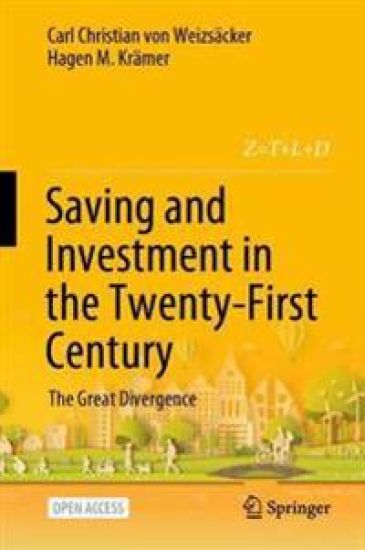
The economy of the 21st century in the OECD countries and in China, is characterized by a new phenomenon: the structural surplus of private savings in relation to private investment. This is true even in a situation of prosperity and very low interest rates. On the one hand, this excess saving is due to people's increasing inclination to save in light of rising life expectancy, driven by the desire to have sufficient assets in old age. On the other hand, the demand for capital is not increasing to the same extent, so that investment is not keeping pace with the rising desire to save. The resulting gap between the private desire for wealth and private investment can only be closed by increasing public debt. This open access book offers a new, capital-theoretical perspective on the macroeconomic relationship between desired wealth and investment, and it presents new empirical data on private wealth and its composition in the OECD plus China area. The authors arguethat a free economic and social order can only be stabilized if the wealth aspirations of individuals are met under conditions of price stability. This is not possible without substantial net public debt. A new way of thinking about the economy as a whole is required. By way of an in-depth theoretical and empirical analysis, the book demonstrates this new way of thinking and describes the current challenges facing economic policy. It will appeal to economists and students of economics who are interested in macroeconomic theory and its economic policy implications. An impressive, and convincing theoretical dive into the fundamentals behind secular stagnation, with very strong implications for actual debt policy. Public debt may be needed to improve welfare.- Olivier Blanchard, Senior Fellow at the Peterson Institute for International Economics and Professor of Economics Emeritus at Massachusetts Institute of Technology (MIT). Chief Economist at the International Monetary Fund from 2008 to 2015. Saving and Investment in the Twenty-First Century gives a wholly new perspective on macroeconomics. (...) Weiz­säcker and Krämer describe a simple, practical solution to the underemployment that has plagued Southern Europe for more than a decade.- George Akerlof, Nobel Laureate in Economics, 2001. Professor at the McCourt School of Public Policy at Georgetown University and Professor of Economics Emeritus at the University of California, Berkeley. This is a profound and original contribution that can help us to understand and act on the great issues of our times.- Nicholas Stern, Grantham Research Institute on Climate Change and the Environment at the London School of Economics. Author of the Stern Review Report on the Economics of Climate Change. Chief Economist at the World Bank from 2000 to 2003.
Saving and Investment in the Twenty-First Century

Saving and Investment in the Twenty-First Century

Carl Christian Von Weizsäcker; Hagen M. Krämer

Springer Nature Switzerland AG
2021
sidottu
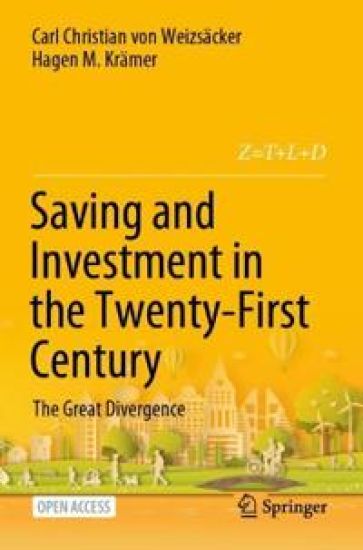
The economy of the 21st century in the OECD countries and in China, is characterized by a new phenomenon: the structural surplus of private savings in relation to private investment. This is true even in a situation of prosperity and very low interest rates. On the one hand, this excess saving is due to people's increasing inclination to save in light of rising life expectancy, driven by the desire to have sufficient assets in old age. On the other hand, the demand for capital is not increasing to the same extent, so that investment is not keeping pace with the rising desire to save. The resulting gap between the private desire for wealth and private investment can only be closed by increasing public debt. This open access book offers a new, capital-theoretical perspective on the macroeconomic relationship between desired wealth and investment, and it presents new empirical data on private wealth and its composition in the OECD plus China area. The authors arguethat a free economic and social order can only be stabilized if the wealth aspirations of individuals are met under conditions of price stability. This is not possible without substantial net public debt. A new way of thinking about the economy as a whole is required. By way of an in-depth theoretical and empirical analysis, the book demonstrates this new way of thinking and describes the current challenges facing economic policy. It will appeal to economists and students of economics who are interested in macroeconomic theory and its economic policy implications. An impressive, and convincing theoretical dive into the fundamentals behind secular stagnation, with very strong implications for actual debt policy. Public debt may be needed to improve welfare.- Olivier Blanchard, Senior Fellow at the Peterson Institute for International Economics and Professor of Economics Emeritus at Massachusetts Institute of Technology (MIT). Chief Economist at the International Monetary Fund from 2008 to 2015. Saving and Investment in the Twenty-First Century gives a wholly new perspective on macroeconomics. (...) Weiz­säcker and Krämer describe a simple, practical solution to the underemployment that has plagued Southern Europe for more than a decade.- George Akerlof, Nobel Laureate in Economics, 2001. Professor at the McCourt School of Public Policy at Georgetown University and Professor of Economics Emeritus at the University of California, Berkeley. This is a profound and original contribution that can help us to understand and act on the great issues of our times.- Nicholas Stern, Grantham Research Institute on Climate Change and the Environment at the London School of Economics. Author of the Stern Review Report on the Economics of Climate Change. Chief Economist at the World Bank from 2000 to 2003.