Kirjailija
Hannah Arendt
Kirjat ja teokset yhdessä paikassa: 135 kirjaa, julkaisuja vuosilta 1968–2027, suosituimpiin kuuluu Vita activa. Vertaile teosten hintoja ja tarkista saatavuus suomalaisista kirjakaupoista.
135 kirjaa
Kirjojen julkaisuvuodet: 1968–2027.
>>Es handelt sich um eine Einführung in das, was Politik eigentlich ist und mit welchen Grundbedingungen menschlichen Daseins Politik zu tun hat.>Dem Leser eröffnen diese Texte die Begegnung mit einem ursprünglichen Philosophieren über Politik, dessen gedanklicher und sprachlicher Suggestion man sich auch dann kaum entziehen kann, wenn man die Frage :Was ist Politik?9 theoretisch in anderer Weise in den Blick zu fassen gewohnt ist.
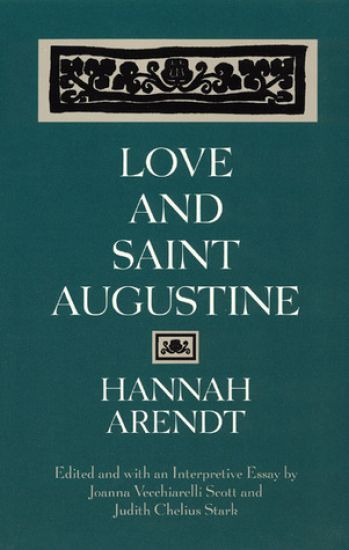
Love and Saint Augustine
Hannah Arendt
University of Chicago Press
1998
nidottu
Halvin toimitettuna 31,20 €
Hannah Arendt began her scholarly career with an exploration of Saint Augustine's concept of caritas, or neighborly love, written under the direction of Karl Jaspers and the influence of Martin Heidegger. After her German academic life came to a halt in 1933, Arendt carried her dissertation into exile in France, and years later took the same battered and stained copy to New York. During the late 1950s and early 1960s, as she was completing or reworking her most influential studies of political life, Arendt was simultaneously annotating and revising her dissertation on Augustine, amplifying its argument with terms and concepts she was using in her political works of the same period. The disseration became a bridge over which Arendt traveled back and forth between 1929 Heidelberg and 1960s New York, carrying with her Augustine's question about the possibility of social life in an age of rapid political and moral change. In Love and Saint Augustine, Joanna Vecchiarelli Scott and Judith Chelius Stark make this important early work accessible for the first time. Here is a completely corrected and revised English translation that incorporates Arendt's own substantial revisions and provides additional notes based on letters, contracts, and other documents as well as the recollections of Arendt's friends and colleagues during her later years.
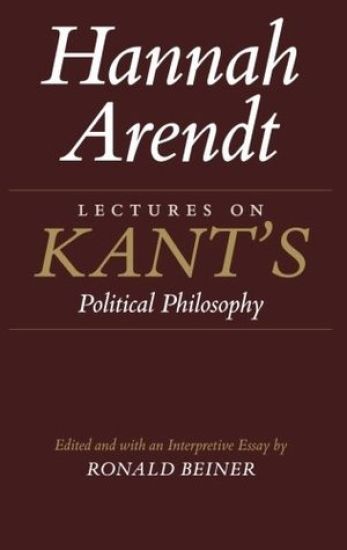
Lectures on Kant's Political Philosophy
Hannah Arendt
University of Chicago Press
1989
nidottu
Halvin toimitettuna 29,40 €
Hannah Arendt's last philosophical work was an intended three-part project entitled The Life of the Mind. Unfortunately, Arendt lived to complete only the first two parts, Thinking and Willing. Of the third, Judging, only the title page, with epigraphs from Cato and Goethe, was found after her death. As the titles suggest, Arendt conceived of her work as roughly parallel to the three Critiques of Immanuel Kant. In fact, while she began work on The Life of the Mind, Arendt lectured on "Kant's Political Philosophy," using the Critique of Judgment as her main text. The present volume brings Arendt's notes for these lectures together with other of her texts on the topic of judging and provides important clues to the likely direction of Arendt's thinking in this area.
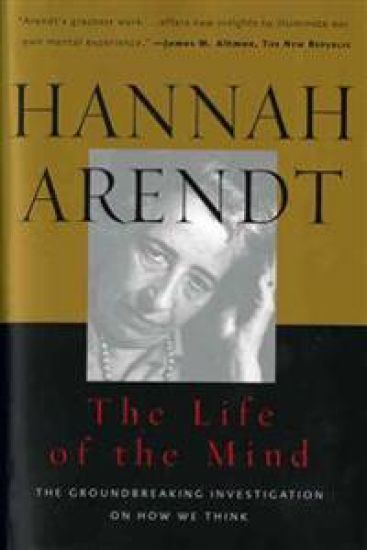
Life of the Mind: One/Thinking, Two/Willing
Hannah Arendt; Mary McCarthy
Mariner Books Classics
1981
nidottu
Halvin toimitettuna 23,00 €
Discusses the nature of thought and volition, examines past philosophical theories, and clarifies the relation between will and freedom
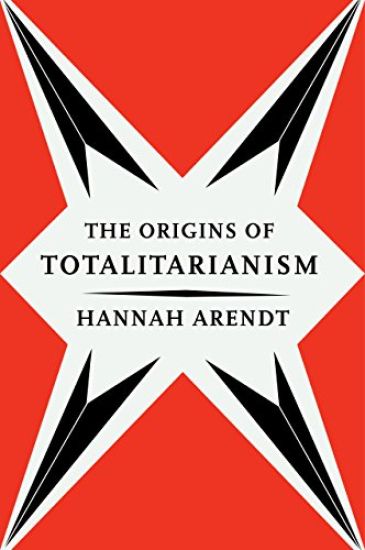
Hannah Arendt's definitive work on totalitarianism--an essential component of any study of twentieth-century political history--now with a new introduction by Anne ApplebaumHannah Arendt's definitive work, The Origins of Totalitarianism, is an essential component of any study of twentieth-century political history. It begins with the rise of anti-Semitism in central and western Europe in the 1800s and continues with an examination of European colonial imperialism from 1884 to the outbreak of World War I. This edition includes an introduction by Anne Applebaum - a leading voice on authoritarianism and Russian history - who fears that "once again, we are living in a world that Arendt would recognize." Hannah Arendt explores the institutions and operations of totalitarian movements, focusing on the two genuine forms of totalitarian government in our time, Nazi Germany and Stalinist Russia, which she adroitly recog-nizes were two sides of the same coin, rather than opposing philosophies of Right and Left. From this vantage point, she discusses the evolution of classes into masses, the role of propaganda in dealing with the nontotali-tarian world, the use of terror, and the nature of isolation and loneliness as preconditions for total domination.
Crises of the Republic: Lying in Politics; Civil Disobedience; On Violence; Thoughts on Politics and Revolution
Hannah Arendt
Mariner Books Classics
1972
nidottu
Halvin toimitettuna 24,00 €
A collection of studies in which Arendt, from the standpoint of a political philosopher, views the crises of the 1960s and early 1970s as challenges to the american form of government. Index.
Unter dem Eindruck des Vietnamkrieges und der Studentenunruhen der 60er Jahre setzt sich Hannah Arendt mit den politischen Schlüsselbegriffen von Macht und Gewalt auseinander. (Stiftung Lesen).
Political theorist, philosopher, and feminist thinker Hannah Arendt's On Violence is an analysis of the nature, causes, and significance of violence in the second half of the twentieth century. The public revulsion against violence and nonviolent philosophies continues to diminish in the twenty-first century. In this classic and still all too resonant work, Hannah Arendt puts her theories about violence into historical perspective, examining the relationships between war and politics, violence and power. Questioning the nature of violent behavior, she reveals the causes of its many manifestations, and ulitmately argues against Mao Zedong's dictum "power grows out of the barrel of a gun," proposing instead that "power and violence are opposites; where one rules absolutely, the other is absent."“Incisive, deeply probing, written with clarity and grace, it provides an ideal framework for understanding the turbulence of our times.”—The Nation
The first volume of Arendt’s celebrated three-part study of the philosophical origins of the totalitarian mind. This volume focuses on the rise of antisemitism in Europe in the late nineteenth and early twentieth centuries. Index.
Explores the roots of totalitarianism and its culmination in Nazi Germany and Stalinist Russia
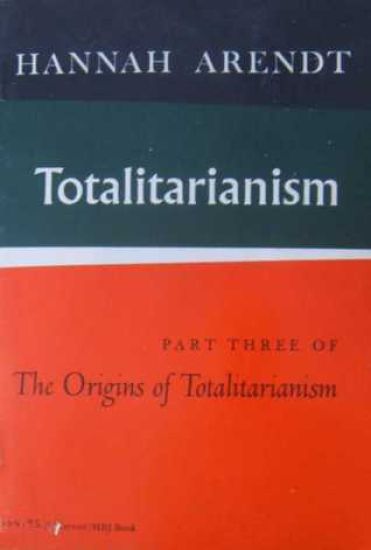
Totalitarianism: Part Three of the Origins of Totalitarianism
Hannah Arendt
Mariner Books Classics
1968
nidottu
In the final volume, Arendt focuses on the two genuine forms of the totalitarian state in history-the dictatorships of Bolshevism after 1930 and of National Socialism after 1938. Index.
Hannah Arendt, den tysk-jødisk politiske tenkeren på midten av forrige århundre og tidløs intellektuelle sine tanker om forholdet mellom makt og vold er fortsatt aktuelle, til tross for at to essay er skrevet med den amerikanske borgerrettsbevegelsen, Vietnamkrigen og studentopprøret som bakgrunn og et med Hitler og Stalins terrorregimer som bakgrunn. Arendt søkte å utvikle en ny forståelse av politikk som ikke var bygget på vold, men på makt. Mens makt oppstår når mennesker handler sammen, kan vold brukes av enkeltindivider for å nå sine mål. Vold kan være rasjonelt, men aldri være legitimt. Volden kan tilintetgjøre makten, og i verste fall er det som står igjen et terrorvelde som tar sikte på å ødelegge alle mellommenneskelige relasjoner, både i den offentlige og i den private sfæren. I vår tid er verden full av hendelser som kan analyseres i ly av Hanna Arendts tanker om forholdet mellom makt og vold. Hannah Arendts (1906-1975) liv spenner over et avgjørende kapittel i den vestlige verdens historie, en tid da våre ideer om mennesket og menneskets verdi, skyld og ansvar, omformuleres. I sine mest kjente arbeider forsøker Arendt å forstå totalitarismen og vise nazismens og kommunismens felles røtter. Hennes tenkning er nært knyttet til eget liv og de erfaringer hun gjorde om ondskap, men også om kjærlighet, flukt, fremmedskap og lengsel.