Kirjojen hintavertailu – 12 903 725 kirjaa ja 27 kauppaa

Kirjailija

Hans Christoph Wolf

Kirjat ja teokset yhdessä paikassa: 7 kirjaa, julkaisuja vuosilta 2003–2012, suosituimpiin kuuluu Molecular Physics and Elements of Quantum Chemistry. Vertaile teosten hintoja ja tarkista saatavuus suomalaisista kirjakaupoista.

7 kirjaa

Kirjojen julkaisuvuodet: 2003–2012.

Atom- und Quantenphysik

Atom- und Quantenphysik

Hermann Haken; Hans Christoph Wolf

Springer-Verlag Berlin and Heidelberg GmbH Co. K
2012
nidottu
Atom- und Quantenphysik führt sorgfältig und leicht verständlich in die Ergebnisse und Methoden der empirischen Atomphysik ein, wobei auch das Rüstzeug der Quantentheorie vermittelt und besonders die Wechselwirkung zwischen Experiment und Theorie herausgearbeitet wird. Die vorliegende achte Auflage enthält neben umfangreichen Aktualisierungen neue Abschnitte zur quantenmechanischen Behandlung des Atoms im Magnetfeld und im elektrischen Feld. Weiter finden sich in dem Kapitel "Fortschritte der Quantenphysik: Tieferes Verständnis und neue Anwendungen" genaue Erläuterungen zur Verschränkung von Wellenfunktionen, dem Einstein-Podolsky-Rosen Paradoxon, den Bellschen Ungleichungen, dem Paradoxon der Schrödingerschen Katze und dem Konzept der Dekohärenz. Das letzte Kapitel führt in die Grundlagen der Quantentheorie der chemischen Bindung ein, welche im zweiten Band der Autoren "Molekülphysik und Quantenchemie" ihre Fortsetzung findet. 177 Übungen mit vollständigen Lösungen runden das Buch ab und dienen der Vertiefung.

Molecular Physics and Elements of Quantum Chemistry

Molecular Physics and Elements of Quantum Chemistry

Hermann Haken; Hans Christoph Wolf

Springer-Verlag Berlin and Heidelberg GmbH Co. K
2010
nidottu
Since the publication of the first edition of this book, there have been many im­ portant new developments in the field of molecular physics. The new methods and results which are most significant for students are treated extensively in this second edition. Among these are in particular single-molecule spectroscopy and the field of molecular electronics, which is in a stage of rapid development, including the areas of electroluminescence and organic light-emitting diodes. In addition, we have ex­ tended and corrected the earlier material in a number of places. We have also included exercises in this new edition; they will allow students to deepen their understanding and offer a basis for further individual study. The complete solutions to the exercises can be found on the Internet under www. springeronline. com/3-540-40792-S. We are grateful to Mr. C. -D. Bachem and Dr. Th. Schneider of the Springer­ Verlag for their continuous and very agreeable cooperation during the preparation of the book. We thank our colleague Prof. W. D. Brewer for his competent translation. Stuttgart, February 2004 H. Haken . H. C. Wolf Preface to the First Edition This textbook is intended for use by students of physics, physical chemistry, and theoretical chemistry. The reader is presumed to have a basic knowledge of atomic and quantum physics at the level provided, for example, by the first few chapters in our book The Physics of Atoms and Quanta.
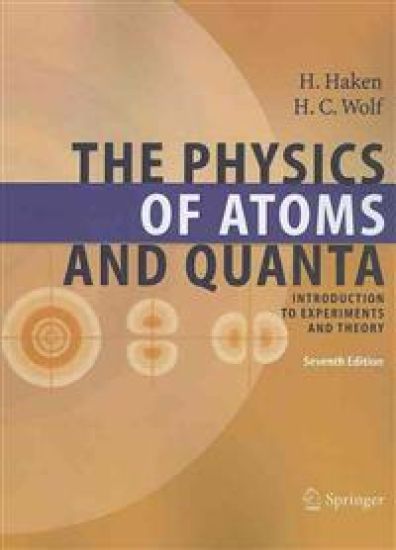
The Physics of Atoms and Quanta

The Physics of Atoms and Quanta

Hermann Haken; Hans Christoph Wolf

Springer-Verlag Berlin and Heidelberg GmbH Co. K
2010
nidottu
The highly positive affirmation and wide reception that this book continues to receive from professors and students ahke is the occasion for this 7th edition. Once again we have included a number of valuable suggestions for improvements, which we address as appropriate. In addition, we refer to a number of developments in atomic physics. Of these new developments in regard to exotic atoms, we mention antihydrogen in par­ ticular, because fundamental experiments in matter and antimatter can be expected in the future. Furthermore, we have inserted a chapter on the behaviour of atoms in strong elec­ trical fields. Experiments with corresponding lasers could only recently be realized. We thank our Jenaer colleague, R. Sauerbrey, for his contribution of this chapter. We have also included a new chapter on the behaviour of the hydrogen atom in strong magnetic fields. The results are of profound interest for two very different fields of physics: on the one hand, according to classical physics, one expects chaotic behaviour from Rydberg atoms in magnetic fields that can be created in the laborato­ ry; thus, an association can be drawn to aspects of chaos theory and the problems of quantum chaos. On the other hand, the very strong fields necessary for low quantum numbers are realized in the cosmos, in particular with white dwarfs and neutron stars.
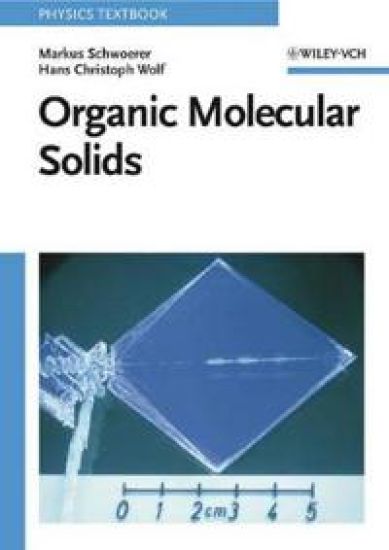
Organic Molecular Solids

Organic Molecular Solids

Markus Schwoerer; Hans Christoph Wolf

Wiley-VCH Verlag GmbH
2007
nidottu
This is the first comprehensive textbook on the physical aspects of organic solids. All phenomena which are necessary in order to understand modern technical applications are being dealt with in a way which makes the concepts of the topics accessible for students. The chapters - from the basics, production and characterization of organic solids and layers to organic semiconductors, superconductors and opto-electronical applications - have been arranged in a logical and well thought-out order.
The Physics of Atoms and Quanta

The Physics of Atoms and Quanta

Hermann Haken; Hans Christoph Wolf

Springer-Verlag Berlin and Heidelberg GmbH Co. K
2005
sidottu

Halvin toimitettuna 151,30 €

The highly positive affirmation and wide reception that this book continues to receive from professors and students ahke is the occasion for this 7th edition. Once again we have included a number of valuable suggestions for improvements, which we address as appropriate. In addition, we refer to a number of developments in atomic physics. Of these new developments in regard to exotic atoms, we mention antihydrogen in par­ ticular, because fundamental experiments in matter and antimatter can be expected in the future. Furthermore, we have inserted a chapter on the behaviour of atoms in strong elec­ trical fields. Experiments with corresponding lasers could only recently be realized. We thank our Jenaer colleague, R. Sauerbrey, for his contribution of this chapter. We have also included a new chapter on the behaviour of the hydrogen atom in strong magnetic fields. The results are of profound interest for two very different fields of physics: on the one hand, according to classical physics, one expects chaotic behaviour from Rydberg atoms in magnetic fields that can be created in the laborato­ ry; thus, an association can be drawn to aspects of chaos theory and the problems of quantum chaos. On the other hand, the very strong fields necessary for low quantum numbers are realized in the cosmos, in particular with white dwarfs and neutron stars.
Molecular Physics and Elements of Quantum Chemistry

Molecular Physics and Elements of Quantum Chemistry

Hermann Haken; Hans Christoph Wolf

Springer-Verlag Berlin and Heidelberg GmbH Co. K
2004
sidottu
Since the publication of the first edition of this book, there have been many im­ portant new developments in the field of molecular physics. The new methods and results which are most significant for students are treated extensively in this second edition. Among these are in particular single-molecule spectroscopy and the field of molecular electronics, which is in a stage of rapid development, including the areas of electroluminescence and organic light-emitting diodes. In addition, we have ex­ tended and corrected the earlier material in a number of places. We have also included exercises in this new edition; they will allow students to deepen their understanding and offer a basis for further individual study. The complete solutions to the exercises can be found on the Internet under www. springeronline. com/3-540-40792-S. We are grateful to Mr. C. -D. Bachem and Dr. Th. Schneider of the Springer­ Verlag for their continuous and very agreeable cooperation during the preparation of the book. We thank our colleague Prof. W. D. Brewer for his competent translation. Stuttgart, February 2004 H. Haken . H. C. Wolf Preface to the First Edition This textbook is intended for use by students of physics, physical chemistry, and theoretical chemistry. The reader is presumed to have a basic knowledge of atomic and quantum physics at the level provided, for example, by the first few chapters in our book The Physics of Atoms and Quanta.
Atom- und Quantenphysik

Atom- und Quantenphysik

Hermann Haken; Hans Christoph Wolf

Springer-Verlag Berlin and Heidelberg GmbH Co. K
2003
sidottu
Atom- und Quantenphysik führt sorgfältig und leicht verständlich in die Ergebnisse und Methoden der empirischen Atomphysik ein, wobei auch das Rüstzeug der Quantentheorie vermittelt und besonders die Wechselwirkung zwischen Experiment und Theorie herausgearbeitet wird. Die vorliegende achte Auflage enthält neben umfangreichen Aktualisierungen neue Abschnitte zur quantenmechanischen Behandlung des Atoms im Magnetfeld und im elektrischen Feld. Weiter finden sich in dem Kapitel "Fortschritte der Quantenphysik: Tieferes Verständnis und neue Anwendungen" genaue Erläuterungen zur Verschränkung von Wellenfunktionen, dem Einstein-Podolsky-Rosen Paradoxon, den Bellschen Ungleichungen, dem Paradoxon der Schrödingerschen Katze und dem Konzept der Dekohärenz. Das letzte Kapitel führt in die Grundlagen der Quantentheorie der chemischen Bindung ein, welche im zweiten Band der Autoren "Molekülphysik und Quantenchemie" ihre Fortsetzung findet. 177 Übungen mit vollständigen Lösungen runden das Buch ab und dienen der Vertiefung.