Kirjojen hintavertailu – 12 903 724 kirjaa ja 27 kauppaa
Kirjailija
Hans Hahn
Kirjat ja teokset yhdessä paikassa: 18 kirjaa, julkaisuja vuosilta 1980–2026, suosituimpiin kuuluu Betriebswirtschaftslehre mit Rechnungswesen Band 2 Schulbuch. Für die Fachhochschulreife - Ausgabe Nordrhein-Westfalen. Vertaile teosten hintoja ja tarkista saatavuus suomalaisista kirjakaupoista.
This book is a record of a seminar on mathematical logic Kurt Gödel and Hans Hahn held in Vienna in 1931-32. The seminar proceedings, given in English translation, are a unique witness of the state of research in logic and foundations of mathematics right after Gödel had published his celebrated incompleteness theorems. The seminars explain Gödel's results in logic in detail, in contrast to his publications of the time that often were quite laconic and extremely short. This book also contains Gödel's trial lecture on intuitionistic logic held in Vienna in 1933. The manuscript, recently found among the Gödel papers kept in Princeton, is preserved in Gödel's forgotten German shorthand and published here in an English translation. The book also adds an important aspect to the intellectual history of Vienna, as both Gödel and Hahn were members of the Vienna Circle group of philosophers and scientists.
Like Descartes and Pascal, Hans Hahn (1879–1934) was both an eminent mathematician and a highly influential philosopher. He founded the Vienna Circle and was the teacher of both Kurt Gödel and Karl Popper. His seminal contributions to functional analysis and general topology had a huge impact on the development of modern analysis. Hahn’s passionate interest in the foundations of mathematics, vividly described in Sir Karl Popper’s foreword (which became his last essay), had a decisive influence upon Gödel. Like Freud, Musil and Schönberg, Hahn became a pivotal figure in the feverish intellectual climate of Vienna between the two wars. Volume 1: The first volume of Hahn’s Collected Works contains his path-breaking contributions to functional analysis, the theory of curves, and ordered groups. These papers are commented on by Harro Heuser, Hans Sagan, and Laszlo Fuchs. Volume 2: The second volume deals with functional analysis, real analysis and hydrodynamics. The commentaries are written by Wilhelm Frank, Davis Preiss, and Alfred Kluwick. Volume 3: In the third volume, Hahn’s writings on harmonic analysis, measure and integration, complex analysis and philosophy are collected and commented on by Jean-Pierre Kahane, Heinz Bauer, Ludger Kaup, and Christian Thiel. This volume also contains excerpts of Hahn’s letters and accounts by his students and colleagues.
Like Descartes and Pascal, Hans Hahn (1879–1934) was both an eminent mathematician and a highly influential philosopher. He founded the Vienna Circle and was the teacher of both Kurt Gödel and Karl Popper. His seminal contributions to functional analysis and general topology had a huge impact on the development of modern analysis. Hahn’s passionate interest in the foundations of mathematics, vividly described in Sir Karl Popper’s foreword (which became his last essay), had a decisive influence upon Gödel. Like Freud, Musil and Schönberg, Hahn became a pivotal figure in the feverish intellectual climate of Vienna between the two wars. Volume 1: The first volume of Hahn’s Collected Works contains his path-breaking contributions to functional analysis, the theory of curves, and ordered groups. These papers are commented on by Harro Heuser, Hans Sagan, and Laszlo Fuchs. Volume 2: The second volume deals with functional analysis, real analysis and hydrodynamics. The commentaries are written by Wilhelm Frank, Davis Preiss, and Alfred Kluwick. Volume 3: In the third volume, Hahn’s writings on harmonic analysis, measure and integration, complex analysis and philosophy are collected and commented on by Jean-Pierre Kahane, Heinz Bauer, Ludger Kaup, and Christian Thiel. This volume also contains excerpts of Hahn’s letters and accounts by his students and colleagues.
Like Descartes and Pascal, Hans Hahn (1879–1934) was both an eminent mathematician and a highly influential philosopher. He founded the Vienna Circle and was the teacher of both Kurt Gödel and Karl Popper. His seminal contributions to functional analysis and general topology had a huge impact on the development of modern analysis. Hahn’s passionate interest in the foundations of mathematics, vividly described in Sir Karl Popper’s foreword (which became his last essay), had a decisive influence upon Gödel. Like Freud, Musil and Schönberg, Hahn became a pivotal figure in the feverish intellectual climate of Vienna between the two wars. Volume 1: The first volume of Hahn’s Collected Works contains his path-breaking contributions to functional analysis, the theory of curves, and ordered groups. These papers are commented on by Harro Heuser, Hans Sagan, and Laszlo Fuchs. Volume 2: The second volume deals with functional analysis, real analysis and hydrodynamics. The commentaries are written by Wilhelm Frank, Davis Preiss, and Alfred Kluwick. Volume 3: In the third volume, Hahn’s writings on harmonic analysis, measure and integration, complex analysis and philosophy are collected and commented on by Jean-Pierre Kahane, Heinz Bauer, Ludger Kaup, and Christian Thiel. This volume also contains excerpts of Hahn’s letters and accounts by his students and colleagues.
- Aktualisierung der Daten, Zahlen, Tabellen und Schaubilder- Überarbeitung insbesondere des Kapitels Personalwirtschaft- mit CD-ROM: FIBU CTO und Lernsituationen
- deckt alle Themenbereiche von Kosten- und Leistungsrechnung bis Controlling ab - Erarbeitung der Themen erfolgt anhand eines Modellunternehmens (Medi@AG)
Autour du Manifeste de Vienne se trouvent reunis des textes fondateurs ecrits autour de 1929. Leurs auteurs: Carnap, Hahn, Neurath, Schlick l'ame du Cercle de Vienne, et Waismann plus proche de Wittgenstein, temoignent d'un courant philosophique constituant aujourd'hui la tradition analytique de source continentale a la fois empiriste et logique. Forme de maniere informelle a Vienne, au coeur de l'Europe, le Cercle reunissait des savants de differentes branches qui voulaient se donner une philosophie susceptible d'unifier leurs vues. Echo aux reves d'unite de la science, cette philosophie en exprime aussi le renversement complet. Veritable Discours de la methode, mais d'esprit anti-cartesien, elle entend reconstruire la science de maniere a evincer la speculation metaphysique, le but etant qu'aucun enonce ne soit laisse a l'exterieur de cette grande architecture de symboles s'il etait pourvu de sens. La declaration de guerre contre la metaphysique est un geste de militance a une epoque riche en differents manifestes . Incomprehensible en dehors du contexte socio-politique viennois de ces annees, elle porte aussi un programme de reconstruction rationnelle qui, au dela du langage de la science, devait toucher tous les secteurs de la vie. Plus complexe qu'il n'y parait, ce programme contient, en reference a Wittgenstein, son prestigieux representant a cote d'Einstein et Russell, une mise en garde contre differentes formes d'irrationalismes, qui est d'actualite.
Like Descartes and Pascal, Hans Hahn (1879–1934) was both an eminent mathematician and a highly influential philosopher. He founded the Vienna Circle and was the teacher of both Kurt Gödel and Karl Popper. His seminal contributions to functional analysis and general topology had a huge impact on the development of modern analysis. Hahn’s passionate interest in the foundations of mathematics, vividly described in Sir Karl Popper’s foreword (which became his last essay), had a decisive influence upon Gödel. Like Freud, Musil and Schönberg, Hahn became a pivotal figure in the feverish intellectual climate of Vienna between the two wars. Volume 1: The first volume of Hahn’s Collected Works contains his path-breaking contributions to functional analysis, the theory of curves, and ordered groups. These papers are commented on by Harro Heuser, Hans Sagan, and Laszlo Fuchs. Volume 2: The second volume deals with functional analysis, real analysis and hydrodynamics. The commentaries are written by Wilhelm Frank, Davis Preiss, and Alfred Kluwick. Volume 3: In the third volume, Hahn’s writings on harmonic analysis, measure and integration, complex analysis and philosophy are collected and commented on by Jean-Pierre Kahane, Heinz Bauer, Ludger Kaup, and Christian Thiel. This volume also contains excerpts of Hahn’s letters and accounts by his students and colleagues.
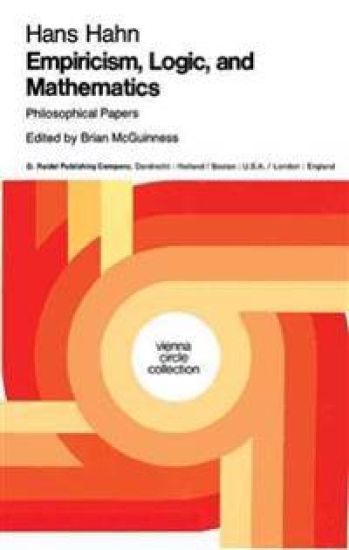
The role Hans Hahn played in the Vienna Circle has not always been sufficiently appreciated. It was important in several ways. In the ftrst place, Hahn belonged to the trio of the original planners of the Circle. As students at the University of Vienna and throughout the fIrst decade of this century, he and his friends, Philipp Frank and Otto Neurath, met more or less regularly to discuss philosophical questions. When Hahn accepted his fIrSt professorial position, at the University of Czernowitz in the north east of the Austrian empire, and the paths of the three friends parted, they decided to continue such informal discussions at some future time - perhaps in a somewhat larger group and with the cooperation of a philosopher from the university. Various events delayed the execution of the project. Drafted into the Austrian army during the first world war" Hahn was wounded on the Italian front. Toward the end of the war he accepted an offer from the University of Bonn extended in recognition of his remarkable 1 mathematical achievements. He remained in Bonn until the spring of 1921 when he returm:d to Vienna and a chair of mathe matics at his alma mater. There, in 1922, the Mach-Boltzmann professorship for the philosophy of the inductive sciences became vacant by the death of Adolf Stohr; and Hahn saw a chance to realize his and his friends' old plan.
The role Hans Hahn played in the Vienna Circle has not always been sufficiently appreciated. It was important in several ways. In the ftrst place, Hahn belonged to the trio of the original planners of the Circle. As students at the University of Vienna and throughout the fIrst decade of this century, he and his friends, Philipp Frank and Otto Neurath, met more or less regularly to discuss philosophical questions. When Hahn accepted his fIrSt professorial position, at the University of Czernowitz in the north east of the Austrian empire, and the paths of the three friends parted, they decided to continue such informal discussions at some future time - perhaps in a somewhat larger group and with the cooperation of a philosopher from the university. Various events delayed the execution of the project. Drafted into the Austrian army during the first world war" Hahn was wounded on the Italian front. Toward the end of the war he accepted an offer from the University of Bonn extended in recognition of his remarkable 1 mathematical achievements. He remained in Bonn until the spring of 1921 when he returm:d to Vienna and a chair of mathe matics at his alma mater. There, in 1922, the Mach-Boltzmann professorship for the philosophy of the inductive sciences became vacant by the death of Adolf Stohr; and Hahn saw a chance to realize his and his friends' old plan.