Kirjojen hintavertailu – 12 859 827 kirjaa ja 27 kauppaa

Kirjailija

Hans Joachim Eichler

Kirjat ja teokset yhdessä paikassa: 4 kirjaa, julkaisuja vuosilta 2013–2018, suosituimpiin kuuluu Lasers. Vertaile teosten hintoja ja tarkista saatavuus suomalaisista kirjakaupoista.

4 kirjaa

Kirjojen julkaisuvuodet: 2013–2018.

Lasers

Lasers

Hans Joachim Eichler; Jürgen Eichler; Oliver Lux

Springer
2018
sidottu
This book provides a comprehensive overview of laser sources and their applications in various fields of science, industry, and technology. After an introduction to the basics of laser physics, different laser types and materials for lasers are summarized in the context of a historical survey, outlining the evolution of the laser over the past five decades. This includes, amongst other aspects, gas lasers, excimer lasers, the wide range of solid-state and semiconductor lasers, and femtosecond and other pulsed lasers where particular attention is paid to high-power sources. Subsequent chapters address related topics such as laser modulation and nonlinear frequency conversion. In closing, the enormous importance of the laser is demonstrated by highlighting its current applications in everyday life and its potential for future developments. Typical applications in advanced material processing, medicine and biophotonics as well as plasma and X-ray generation for nanoscale lithography are discussed. The book provides broad and topical coverage of laser photonics and opto-electronics, focusing on significant findings and recent advances rather than in-depth theoretical studies. Thus, it is intended not only for university students and engineers, but also for scientists and professionals applying lasers in biomedicine, material processing and everyday consumer products. Further, it represents essential reading for engineers using or developing high-power lasers for scientific or industrial applications.

Das neue Physikalische Grundpraktikum

Das neue Physikalische Grundpraktikum

Hans Joachim Eichler; Heinz-Detlef Kronfeldt; Jürgen Sahm

Springer Fachmedien Wiesbaden
2016
nidottu
Das vorliegende Werk bietet in seiner vollständig überarbeiteten dritten Auflage eine hervorragende Begleitung für Physik-Praktika im Bachelorstudium. In 12 Kapiteln mit insgesamt 52 Themenkreisen werden mehr als 200 Einzelaufgaben jeweils mit Zielsetzung, Literaturangaben, physikalischen Grundlagen, Gerätezubehör sowie Hinweisen zu Messung und Auswertung ausführlich beschrieben. Rundum ein innovatives Buch für alle Studierenden mit Haupt- oder Nebenfach Physik. Die Neuauflage enthält neue Experimente zu Mikrowellen, Polarisation, Flüssigkristallen, Röntgenstrahlung, Gamma-Spektroskopie u.a. Zudem wurden die Messverfahren weitgehend auf moderne digitale Messtechnik umgestellt.
Laser

Laser

Hans Joachim Eichler; Jürgen Eichler

Springer Fachmedien Wiesbaden
2015
sidottu
Diese grundlegende Einführung in die Physik und Technik der Laser informiert über - Funktion, Bauformen und Emissionseigenschaften der Laser,- Lasertypen, optische Komponenten und Strahlführung,- Anwendungen in Materialbearbeitung, Medizin und Messtechnik. Die 8. Auflage dieses etablierten Lehrbuchs berücksichtigt neueste Entwicklungen: Hochleistungsdioden- und Festkörperlaser für ultraviolette, sichtbare und infrarote Strahlung, Faserlaser zur Erzeugung ultrakurzer Lichtimpulse und Röntgenstrahlung aus Freie-Elektronen-Lasern, sowie Anwendungen in der Laserchirurgie, medizinischen Diagnostik und Biophotonik.
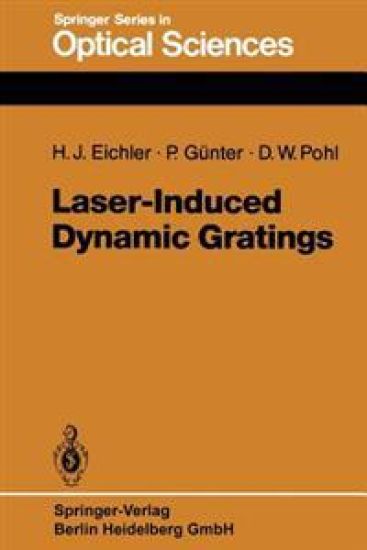
Laser-Induced Dynamic Gratings

Laser-Induced Dynamic Gratings

Hans Joachim Eichler; Peter Günter; Dieter W. Pohl

Springer-Verlag Berlin and Heidelberg GmbH Co. K
2013
nidottu
The invention ofthe laser 25years ago resulted in powerfullight sources which led to the observation of unexpected and striking phenomena. New fields of science such as holography and nonlinear optics developed constituting the basis of this volume. The classical principle of linear superposition of light wavesdoes not hold anymore. Two laser beams crossing in a suitable material may produce a set of new beams with different directions and frequencies. The interaction of light waves can be understood by considering the optical grating structures which develop in the overlap region. The optical properties of matter become spatially modulated in the interference region of two light waves. Permanent holographic gratings have been produced in this way by photographic processes for many years. In contrast, dynamic or transient gratings disappear after the inducing light source, usually a laser, has been switched off. The grating amplitude is controlled by the light intensity. Dynamic gratings have been induced in a large number ofsolids, liquids, and gases, and are detected by diffraction, 'forced light scattering' of a third probing beam, or by self-diffraction of the light waves inducing the grating. The combined interference and diffraction effect corresponds to four-wave mixing (FWM) in the language of nonlinear optics. The process is called degenerate ifthe frequenciesofthe three incident wavesand the scattered wave are equal. Degenerate four-wave mixing (DFWM) is a simple method to achieve phase conjugation, i.e. to generate a wave which propagates time reversed with respect to an incident wave.