Kirjailija
Hans Keman
Kirjat ja teokset yhdessä paikassa: 13 kirjaa, julkaisuja vuosilta 1993–2023, suosituimpiin kuuluu Handbook of Democratic Government. Vertaile teosten hintoja ja tarkista saatavuus suomalaisista kirjakaupoista.
13 kirjaa
Kirjojen julkaisuvuodet: 1993–2023.
This insightful text rigorously examines and accounts for contemporary developments – and crucially a reversal of “democraticness” – in democratic polities and related political processes comparing 38 democracies across the world. The focus is on contemporary developments and recent volatile levels of democraticness. Democracies in Peril? introduces theoretical backgrounds of what makes democracy tick and scrutinises empirical trends and development in “democraticness” in an accessible manner. It explores what “democracy” as a political regime implies and how the liberal democratic model developed, as well as examining the present state of affairs in democracies, the challenges democracies encounter and the perils of democracy as a legitimate system of governance in the 21st century. The book provides a “systemic” approach to adjudicate the effects of this assumed reversal in democratisation in terms of popular preferences, party behaviour, institutional architecture and policy performance. The effects of public policy formation and the role of the state on actual democratic performance are also analysed. Finally, case studies on the Covid pandemic and the development of social welfare demonstrate the complex relationship between government capacities – under pressure – and the quality of democracy, approaching the question: How do 38 democratic states cope with societal problems, populist tendencies and a fast-changing world without degrading their institutional quality and legitimacy? This text will be of key interest to students, scholars, journalists and interested readers of comparative politics, democratisation, public administration, political economy, constitutional law and the social sciences in general.
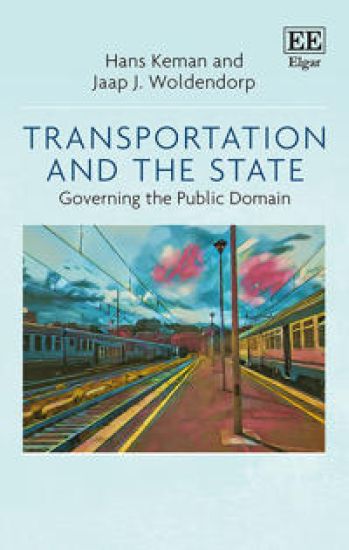
Transportation and the State
Hans Keman; Jaap J. Woldendorp
Edward Elgar Publishing Ltd
2020
sidottu
Transportation and the State explores the role of the emerging national state in the 19th century as an organiser of territory and a governor of infrastructure. It offers a comparative historical analysis of eight industrialising nation-states and discusses their role in the democratisation and economic development of the industrialising world since the post-Napoleonic era. Hans Keman and Jaap J. Woldendorp provide a comprehensive analysis of how nation-states have regulated the economy and society from the 19th century to the present day, with particular focus on the development and operation of railway systems. They demonstrate how states define and direct infrastructure and railway systems as part of the public domain. By exploring the impact of the railways on the evolution of the national state, Keman and Woldendorp reveal the complex interactions between the state, society and the economy, and how these are situated within their historical context. Taking a diachronic empirical approach, they challenge common misinterpretations around the role of the state and argue for a revision and reformulation of its current format and capacities. Drawing together the academic fields of political science, economics and economic history in an innovative way, this book will be of particular interest to scholars and students looking to expand their understanding of the ways these disciplines interlink. It will also be a helpful read for policy-makers working on improving transport infrastructure in different nations.
The Social Democratic party family is a central part of political life in the West. This book focuses on this party family as well as a unique political force in the industrialised world. It provides a critical comparative survey of when, where, how and why Social Democracy developed within established capitalist democracies. The book explains the electoral fortunes of Social Democratic parties, the influence of the party system dynamics and co-operation between parties in government. It examines the ideological tensions within Social Democratic parties between socialists and reformists and its ramifications for pursuing a ‘better and kinder’ world. This study also discusses the recent state of affairs and its mission in the 21st century. The book features a comparative analysis of 21 cases from Australia, Austria, Belgium, Canada, Denmark, Finland, France, Germany, Greece, Ireland, Italy, Japan, Netherlands, New Zealand, Norway, Portugal, Spain, Sweden, Switzerland, the UK and the United States. It will be of key interest to students and scholars of public policy, comparative politics, party politics and democracy studies.
The Handbook of Democratic Government is the first compact and comprehensive data collection for 20 countries which simultaneously provides comparative and complete information on the composition of governments. Parties, ministries, portfolios, ministers and parliamentary support are listed, as well as duration, type of government and reasons for termination. The data are organised in such a manner that every researcher can use them as a basic data set, ready to be transformed according to the particular needs dictated by the research undertaken. Various levels of analysis are possible, both cross-nationally and across time, ranging from individual ministers and separate ministries to specific parties, governments or countries. Given its format, the data set is also a very useful background to the special annual issue of the European Journal of Political Research: Political Data Yearbook. It will save researchers in the field of comparative politics valuable time as it can be utilised in connection with, or in addition to other data sources.
Organizing Democratic Choice
Ian Budge; Michael McDonald; Paul Pennings; Hans Keman
Oxford University Press
2012
sidottu
This bold venture into democratic theory offers a new and reinvigorating thesis for how democracy delivers on its promise of public control over public policy. In theory, popular control could be achieved through a process entirely driven by supply-side politics, with omniscient and strategic political parties converging on the median voter's policy preference at every turn. However, this would imply that there would be no distinguishable political parties (or even any reason for parties to exist) and no choice for a public to make. The more realistic view taken here portrays democracy as an ongoing series of give and take between political parties' policy supply and a mass public's policy demand. Political parties organize democratic choices as divergent policy alternatives, none of which is likely to satisfy the public's policy preferences at any one turn. While the one-off, short-run consequence of a single election often results in differences between the policies that parliaments and governments pursue and the preferences their publics hold, the authors construct theoretical arguments, employ computer simulations, and follow up with empirical analysis to show how, why, and under what conditions democratic representation reveals itself over time. Democracy, viewed as a process rather than a single electoral event, can and usually does forge strong and congruent linkages between a public and its government. This original thesis offers a challenge to democratic pessimists who would have everyone believe that neither political parties nor mass publics are up to the tasks that democracy assigns them. Comparative Politics is a series for students, teachers, and researchers of political science that deals with contemporary government and politics. Global in scope, books in the series are characterised by a stress on comparative analysis and strong methodological rigour. The series is published in association with the European Consortium for Political Research. For more information visit: www.ecprnet.eu The Comparative Politics series is edited by Professor David M. Farrell, School of Politics and International Relations, University College Dublin, Kenneth Carty, Professor of Political Science, University of British Columbia, and Professor Dirk Berg-Schlosser, Institute of Political Science, Philipps University, Marburg.
Party Government in 48 Democracies (1945–1998)
J.J. Woldendorp; Hans Keman; I. Budge
Springer
2010
nidottu
Since the 1980s, political scientists have developed a renewed interest in the study of political institutions, based on the assumption that "institutions matter" -that is, that formal governmental institutions and constitutional-legal rules (as well as informal institutions like parties and interest groups) are crucial determinants of the shape of politics and policy outcomes. In this respect, the "new institutionalism" resembles the "old institutionalism" of pre-behaviorist days, but the crucial difference between the two is that the new institutionalists are committed to systematic empirical testing of their hypotheses, at least in principle. In practice, however, especially in compara tive analyses, this goal has often been frustrated by the lack of reliable data for a large number of countries. Researchers have therefore usually been limited to testing their hypotheses with modest data sets collected for their own particular purposes. Of all of the political institutions, the executive branch of the government is by far the most important; it can be regarded as the irreducible core of government and the principal embodiment of political authority with specific powers that are not lodged elsewhere in the political system. Almost all countries in the world, and certainly all modem democracies, have an executive body called "government", "cabinet", or "administration" (as in the term "the Clinton administration") that has the main responsibility for running the country's public affairs.
Doing Research in Political Science
Paul Pennings; Hans Keman; Jan Kleinnijenhuis
SAGE Publications Inc
2005
sidottu
This is an immensely helpful book for students starting their own research… an excellent introduction to the comparative method giving an authoritative overview over the research process - Klaus Armingeon, University of Bern Doing Research in Political Science is the book for mastering the comparative method in all the social sciences - Jan-Erik Lane, University of Geneva This book has established itself as a concise and well-readable text on comparative methods and statistics in political science I…strongly recommend it. - Dirk Berg-Schlosser, Philipps-University Marburg This thoroughly revised edition of the popular textbook offers an accessible but comprehensive introduction to comparative research methods and statistics for students of political science. Clearly organized around three parts, the text introduces the main theories and methodologies used in the discipline. Part 1 frames the comparative approach within the methodological framework of the political and social sciences. Part 2 introduces basic descriptive and inferential statistical methods as well as more advanced multivariate methods used in quantitative political analysis. Part 3 applies the methods and techniques of Parts 1 & 2 to research questions drawn from contemporary themes and issues in political science. Incorporating practice exercises, ideas for further reading and summary questions throughout, Doing Research in Political Science provides an invaluable step-by-step guide for students and researchers in political science, comparative politics and empirical political analysis.
Doing Research in Political Science
Paul Pennings; Hans Keman; Jan Kleinnijenhuis
SAGE Publications Inc
2005
nidottu
This is an immensely helpful book for students starting their own research… an excellent introduction to the comparative method giving an authoritative overview over the research process - Klaus Armingeon, University of Bern Doing Research in Political Science is the book for mastering the comparative method in all the social sciences - Jan-Erik Lane, University of Geneva This book has established itself as a concise and well-readable text on comparative methods and statistics in political science I…strongly recommend it. - Dirk Berg-Schlosser, Philipps-University Marburg This thoroughly revised edition of the popular textbook offers an accessible but comprehensive introduction to comparative research methods and statistics for students of political science. Clearly organized around three parts, the text introduces the main theories and methodologies used in the discipline. Part 1 frames the comparative approach within the methodological framework of the political and social sciences. Part 2 introduces basic descriptive and inferential statistical methods as well as more advanced multivariate methods used in quantitative political analysis. Part 3 applies the methods and techniques of Parts 1 & 2 to research questions drawn from contemporary themes and issues in political science. Incorporating practice exercises, ideas for further reading and summary questions throughout, Doing Research in Political Science provides an invaluable step-by-step guide for students and researchers in political science, comparative politics and empirical political analysis.
Party Government in 48 Democracies (1945–1998)
J.J. Woldendorp; Hans Keman; I. Budge
Springer
2000
sidottu
Since the 1980s, political scientists have developed a renewed interest in the study of political institutions, based on the assumption that "institutions matter" -that is, that formal governmental institutions and constitutional-legal rules (as well as informal institutions like parties and interest groups) are crucial determinants of the shape of politics and policy outcomes. In this respect, the "new institutionalism" resembles the "old institutionalism" of pre-behaviorist days, but the crucial difference between the two is that the new institutionalists are committed to systematic empirical testing of their hypotheses, at least in principle. In practice, however, especially in compara tive analyses, this goal has often been frustrated by the lack of reliable data for a large number of countries. Researchers have therefore usually been limited to testing their hypotheses with modest data sets collected for their own particular purposes. Of all of the political institutions, the executive branch of the government is by far the most important; it can be regarded as the irreducible core of government and the principal embodiment of political authority with specific powers that are not lodged elsewhere in the political system. Almost all countries in the world, and certainly all modem democracies, have an executive body called "government", "cabinet", or "administration" (as in the term "the Clinton administration") that has the main responsibility for running the country's public affairs.
The Handbook of Democratic Government is the first compact and comprehensive data collection for 20 countries which simultaneously provides comparative and complete information on the composition of governments. Parties, ministries, portfolios, ministers and parliamentary support are listed, as well as duration, type of government and reasons for termination. The data are organised in such a manner that every researcher can use them as a basic data set, ready to be transformed according to the particular needs dictated by the research undertaken. Various levels of analysis are possible, both cross-nationally and across time, ranging from individual ministers and separate ministries to specific parties, governments or countries. Given its format, the data set is also a very useful background to the special annual issue of the European Journal of Political Research: Political Data Yearbook. It will save researchers in the field of comparative politics valuable time as it can be utilised in connection with, or in addition to other data sources.
Parties and Democracy studies the actual behaviour of some four hundred governments in twenty post-war democracies. The conclusion that parties do function in accordance with modern democratic theory will serve to put moral justifications of democracy and descriptions of the system on a firmer footing.