Kirjojen hintavertailu – 12 859 818 kirjaa ja 27 kauppaa
Kirjailija
Hans Petter Langtangen
Kirjat ja teokset yhdessä paikassa: 19 kirjaa, julkaisuja vuosilta 2007–2020, suosituimpiin kuuluu Scaling of Differential Equations. Vertaile teosten hintoja ja tarkista saatavuus suomalaisista kirjakaupoista.
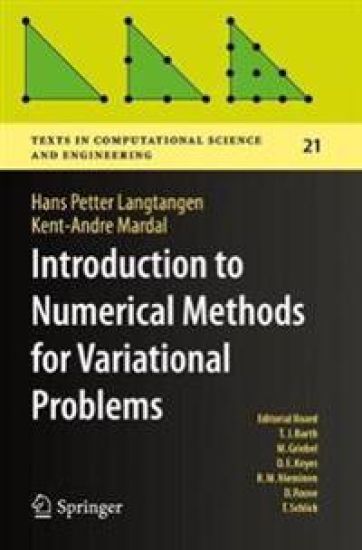
This textbook teaches finite element methods from a computational point of view. It focuses on how to develop flexible computer programs with Python, a programming language in which a combination of symbolic and numerical tools is used to achieve an explicit and practical derivation of finite element algorithms. The finite element library FEniCS is used throughout the book, but the content is provided in sufficient detail to ensure that students with less mathematical background or mixed programming-language experience will equally benefit. All program examples are available on the Internet.
Mathematics; Computer mathematics; Numerical analysis; Computer software; Numerical analysis This work was published by Saint Philip Street Press pursuant to a Creative Commons license permitting commercial use. All rights not granted by the work's license are retained by the author or authors.
Mathematics; Computer mathematics; Numerical analysis; Computer software; Numerical analysis This work was published by Saint Philip Street Press pursuant to a Creative Commons license permitting commercial use. All rights not granted by the work's license are retained by the author or authors.
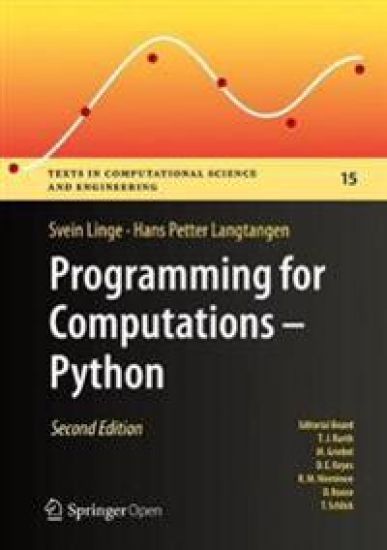
This book is published open access under a CC BY 4.0 license. This book presents computer programming as a key method for solving mathematical problems. This second edition of the well-received book has been extensively revised: All code is now written in Python version 3.6 (no longer version 2.7). In addition, the two first chapters of the previous edition have been extended and split up into five new chapters, thus expanding the introduction to programming from 50 to 150 pages. Throughout the book, the explanations provided are now more detailed, previous examples have been modified, and new sections, examples and exercises have been added. Also, a number of small errors have been corrected. The book was inspired by the Springer book TCSE 6: A Primer on Scientific Programming with Python (by Langtangen), but the style employed is more accessible and concise, in keeping with the needs of engineering students. The book outlines the shortest possible path from no previous experience with programming to a set of skills that allows students to write simple programs for solving common mathematical problems with numerical methods in the context of engineering and science courses. The emphasis is on generic algorithms, clean program design, the use of functions, and automatic tests for verification.
This textbook teaches finite element methods from a computational point of view. It focuses on how to develop flexible computer programs with Python, a programming language in which a combination of symbolic and numerical tools is used to achieve an explicit and practical derivation of finite element algorithms. The finite element library FEniCS is used throughout the book, but the content is provided in sufficient detail to ensure that students with less mathematical background or mixed programming-language experience will equally benefit. All program examples are available on the Internet.
This book is open access under a CC BY 4.0 license. This easy-to-read book introduces the basics of solving partial differential equations by means of finite difference methods. Unlike many of the traditional academic works on the topic, this book was written for practitioners. Accordingly, it especially addresses: the construction of finite difference schemes, formulation and implementation of algorithms, verification of implementations, analyses of physical behavior as implied by the numerical solutions, and how to apply the methods and software to solve problems in the fields of physics and biology.
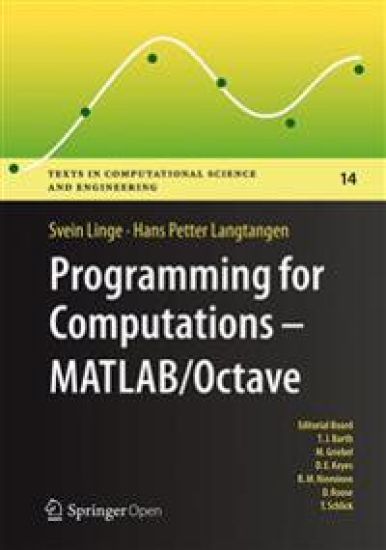
This book presents computer programming as a key method for solving mathematical problems. There are two versions of the book, one for MATLAB and one for Python. The book was inspired by the Springer book TCSE 6: A Primer on Scientific Programming with Python (by Langtangen), but the style is more accessible and concise, in keeping with the needs of engineering students. The book outlines the shortest possible path from no previous experience with programming to a set of skills that allows the students to write simple programs for solving common mathematical problems with numerical methods in engineering and science courses. The emphasis is on generic algorithms, clean design of programs, use of functions, and automatic tests for verification.
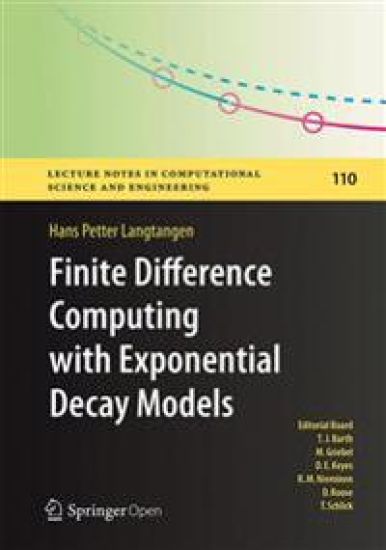
This text provides a very simple, initial introduction to the complete scientific computing pipeline: models, discretization, algorithms, programming, verification, and visualization. The pedagogical strategy is to use one case study – an ordinary differential equation describing exponential decay processes – to illustrate fundamental concepts in mathematics and computer science. The book is easy to read and only requires a command of one-variable calculus and some very basic knowledge about computer programming. Contrary to similar texts on numerical methods and programming, this text has a much stronger focus on implementation and teaches testing and software engineering in particular.
This book presents computer programming as a key method for solving mathematical problems. There are two versions of the book, one for MATLAB and one for Python. The book was inspired by the Springer book TCSE 6: A Primer on Scientific Programming with Python (by Langtangen), but the style is more accessible and concise, in keeping with the needs of engineering students. The book outlines the shortest possible path from no previous experience with programming to a set of skills that allows the students to write simple programs for solving common mathematical problems with numerical methods in engineering and science courses. The emphasis is on generic algorithms, clean design of programs, use of functions, and automatic tests for verification.
This book is open access under a CC BY 4.0 license. This easy-to-read book introduces the basics of solving partial differential equations by means of finite difference methods. Unlike many of the traditional academic works on the topic, this book was written for practitioners. Accordingly, it especially addresses: the construction of finite difference schemes, formulation and implementation of algorithms, verification of implementations, analyses of physical behavior as implied by the numerical solutions, and how to apply the methods and software to solve problems in the fields of physics and biology.
This book offers a concise and gentle introduction to finite element programming in Python based on the popular FEniCS software library. Using a series of examples, including the Poisson equation, the equations of linear elasticity, the incompressible Navier–Stokes equations, and systems of nonlinear advection–diffusion–reaction equations, it guides readers through the essential steps to quickly solving a PDE in FEniCS, such as how to define a finite variational problem, how to set boundary conditions, how to solve linear and nonlinear systems, and how to visualize solutions and structure finite element Python programs. This book is open access under a CC BY license.
The book serves as a first introduction to computer programming of scientific applications, using the high-level Python language. The exposition is example and problem-oriented, where the applications are taken from mathematics, numerical calculus, statistics, physics, biology and finance. The book teaches "Matlab-style" and procedural programming as well as object-oriented programming. High school mathematics is a required background and it is advantageous to study classical and numerical one-variable calculus in parallel with reading this book. Besides learning how to program computers, the reader will also learn how to solve mathematical problems, arising in various branches of science and engineering, with the aid of numerical methods and programming. By blending programming, mathematics and scientific applications, the book lays a solid foundation for practicing computational science. From the reviews: Langtangen … does an excellent job of introducing programming as a set of skills in problem solving. He guides the reader into thinking properly about producing program logic and data structures for modeling real-world problems using objects and functions and embracing the object-oriented paradigm. … Summing Up: Highly recommended. F. H. Wild III, Choice, Vol. 47 (8), April 2010Those of us who have learned scientific programming in Python ‘on the streets’ could be a little jealous of students who have the opportunity to take a course out of Langtangen’s Primer.” John D. Cook, The Mathematical Association of America, September 2011This book goes through Python in particular, and programming in general, via tasks that scientists will likely perform. It contains valuable information for students new to scientific computing and would be the perfect bridge between an introduction to programming and an advanced course on numerical methods or computational science. Alex Small,IEEE, CiSE Vol. 14 (2), March /April 2012 “This fourth edition is a wonderful, inclusive textbook that covers pretty much everything one needs to know to go from zero to fairly sophisticated scientific programming in Python…” Joan Horvath, Computing Reviews, March 2015
This book presents computer programming as a key method for solving mathematical problems. There are two versions of the book, one for MATLAB and one for Python. The book was inspired by the Springer book TCSE 6: A Primer on Scientific Programming with Python (by Langtangen), but the style is more accessible and concise, in keeping with the needs of engineering students. The book outlines the shortest possible path from no previous experience with programming to a set of skills that allows the students to write simple programs for solving common mathematical problems with numerical methods in engineering and science courses. The emphasis is on generic algorithms, clean design of programs, use of functions, and automatic tests for verification.
The book serves both as a reference for various scaled models with corresponding dimensionless numbers, and as a resource for learning the art of scaling. A special feature of the book is the emphasis on how to create software for scaled models, based on existing software for unscaled models. Scaling (or non-dimensionalization) is a mathematical technique that greatly simplifies the setting of input parameters in numerical simulations. Moreover, scaling enhances the understanding of how different physical processes interact in a differential equation model. Compared to the existing literature, where the topic of scaling is frequently encountered, but very often in only a brief and shallow setting, the present book gives much more thorough explanations of how to reason about finding the right scales. This process is highly problem dependent, and therefore the book features a lot of worked examples, from very simple ODEs to systems of PDEs, especially from fluid mechanics. The text is easily accessible and example-driven. The first part on ODEs fits even a lower undergraduate level, while the most advanced multiphysics fluid mechanics examples target the graduate level. The scientific literature is full of scaled models, but in most of the cases, the scales are just stated without thorough mathematical reasoning. This book explains how the scales are found mathematically. This book will be a valuable read for anyone doing numerical simulations based on ordinary or partial differential equations.
This text provides a very simple, initial introduction to the complete scientific computing pipeline: models, discretization, algorithms, programming, verification, and visualization. The pedagogical strategy is to use one case study – an ordinary differential equation describing exponential decay processes – to illustrate fundamental concepts in mathematics and computer science. The book is easy to read and only requires a command of one-variable calculus and some very basic knowledge about computer programming. Contrary to similar texts on numerical methods and programming, this text has a much stronger focus on implementation and teaches testing and software engineering in particular.
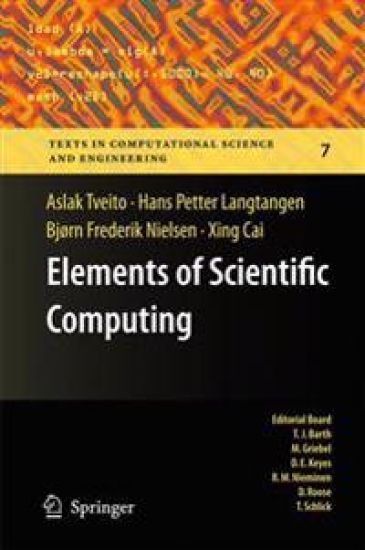
Science used to be experiments and theory, now it is experiments, theory and computations. The computational approach to understanding nature and technology is currently flowering in many fields such as physics, geophysics, astrophysics, chemistry, biology, and most engineering disciplines. This book is a gentle introduction to such computational methods where the techniques are explained through examples. It is our goal to teach principles and ideas that carry over from field to field. You will learn basic methods and how to implement them. In order to gain the most from this text, you will need prior knowledge of calculus, basic linear algebra and elementary programming.
Numerous readers of the second edition have noti?ed me about misprints and possible improvements of the text and the associated computer codes. The resulting modi?cations have been incorporated in this new edition and its accompanying software. The major change between the second and third editions, however, is caused by the new implementation of Numerical Python, now called numpy. The new numpy package encourages a slightly di?erent syntax compared to the old Numeric implementation, which was used in the previous editions. Since Numerical Python functionality appears in a lot of places in the book, there are hence a huge number of updates to the new suggested numpy syntax, especially in Chapters 4, 9, and 10. The second edition was based on Python version 2.3, while the third edition contains updates for version 2.5. Recent Python features, such as generator expressions (Chapter 8.9.4), Ctypes for interfacing shared libraries in C (Chapter 5.2.2), the with statement (Chapter 3.1.4), and the subprocess module for running external processes (Chapter 3.1.3) have been exempli?ed to make the reader aware of new tools. Chapter 4.4.4 is new and gives a taste of symbolic mathematics in Python.