Kirjojen hintavertailu – 12 859 828 kirjaa ja 27 kauppaa
Kirjailija
Hans-Stefan Siller
Kirjat ja teokset yhdessä paikassa: 6 kirjaa, julkaisuja vuosilta 2016–2026, suosituimpiin kuuluu Didaktik der Analysis. Vertaile teosten hintoja ja tarkista saatavuus suomalaisista kirjakaupoista.
Dieses Buch zeigt, wie verschiedene digitale Medien als Lern- und Lehrhilfsmittel in den Mathematikunterricht integriert werden können: Es stellt theoretische Überlegungen und Konzeptionen dar und zeigt an vielen unterrichtspraktischen Beispielen, wie Taschenrechner, Laptop und Smartphone mit der entsprechenden Software und dem Internet im Unterricht eingesetzt werden können. Das dargestellte Programm-Spektrum reicht von Computeralgebrasystemen über dynamische Geometriesysteme, Tabellenkalkulationen und 3D-Druck bis hin zu interaktiven Lernumgebungen, auch mit Virtueller Realität und Augmented Reality. Der Einsatz der Medien orientiert sich dabei stets am zentralen Ziel, die Entwicklung vielfältiger Kompetenzen bei Schülerinnen und Schülern nachhaltig zu unterstützen. Das Buch wendet sich an Studierende des Lehramts Mathematik, an Referendarinnen und Referendare sowie praktizierende Lehrkräfte. Es konzentriert sich auf zentrale Inhalte der Sekundarstufe I – also Zahlen, Algebra, Funktionen, Geometrie sowie Daten und Zufall. Um Leserinnen und Leser zur eigenständigen Auseinandersetzung mit digitalen Medien anzuregen, sind am Ende jedes Kapitels Aufgaben zur individuellen Bearbeitung angefügt. Materialien zu den Inhalten, vor allem interaktive Elemente, sind auf einer eigenen Internetseite zusammengestellt. Das vorliegende Buch ist eine vollständige Neubearbeitung des Buches „Computer im Mathematikunterricht“ von Hans-Georg Weigand und Thomas Weth aus dem Jahr 2002.
This open access book presents a structural model and an associated test instrument designed to provide a detailed analysis of professional competences for teaching mathematical modelling. The conceptualisation is based on the COACTIV model, which describes aspects, areas and facets of professional competences of teachers. The manual provides an overview of the essential teaching skills in application-related contexts and offers the tools needed to capture these aspects. It discusses the objectives and application areas of the instrument, as well as the development of the test. In addition, it describes the implementation and evaluates the quality and results of the structural equation analysis of the model. Teaching mathematical modelling is a cognitively challenging activity for (prospective) teachers. Thus, teacher education requires a detailed analysis of professional competence for teaching mathematical modelling. Measuring this competence requires theoretical models thataccurately describe requirements placed upon teachers, as well as appropriate evaluation tools that adequately capture skills and abilities in this field. This book presents an instrument that measures the professional competences in a sample of 349 prospective teachers.
This open access book presents a structural model and an associated test instrument designed to provide a detailed analysis of professional competences for teaching mathematical modelling. The conceptualisation is based on the COACTIV model, which describes aspects, areas and facets of professional competences of teachers. The manual provides an overview of the essential teaching skills in application-related contexts and offers the tools needed to capture these aspects. It discusses the objectives and application areas of the instrument, as well as the development of the test. In addition, it describes the implementation and evaluates the quality and results of the structural equation analysis of the model. Teaching mathematical modelling is a cognitively challenging activity for (prospective) teachers. Thus, teacher education requires a detailed analysis of professional competence for teaching mathematical modelling. Measuring this competence requires theoretical models thataccurately describe requirements placed upon teachers, as well as appropriate evaluation tools that adequately capture skills and abilities in this field. This book presents an instrument that measures the professional competences in a sample of 349 prospective teachers.
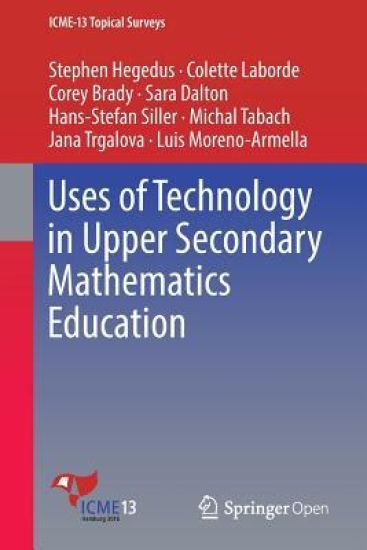
This survey addresses the use of technology in upper secondary mathematics education from four points of view: theoretical analysis of epistemological and cognitive aspects of activity in new technology mediated learning environments, the changes brought by technology in the interactions between environment, students and teachers, the interrelations between mathematical activities and technology, skills and competencies that must be developed in teacher education. Research shows that the use of some technologies may deeply change the solving processes and contribute to impact the learning processes. The questions are which technologies to choose for which purposes, and how to integrate them, so as to maximize all students’ agency. In particular the role of the teacher in classrooms and the content of teacher education programs are critical for taking full advantage of technology in teaching practice.
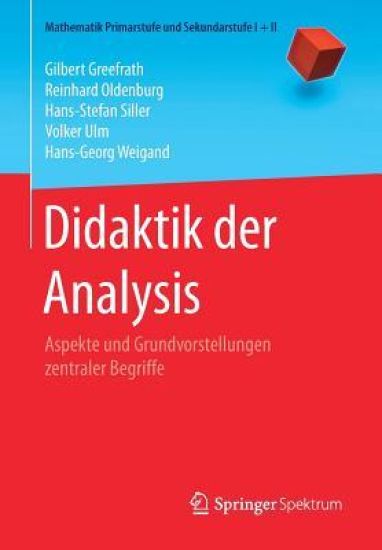
Im Mathematikunterricht der Sekundarstufe II kommt der Analysis eine zentrale Rolle zu. Dieses Buch bietet eine umfassende Darstellung der Didaktik der Analysis unter Berücksichtigung der aktuellen didaktischen Diskussion, theoretischer Konzepte, praktischer Unterrichtserfahrungen und der Bildungsstandards der Kultusministerkonferenz. Es unterstützt Studierende, Referendarinnen und Referendare, aber auch Lehrkräfte dabei, das Gebiet angemessen – kompetenzorientiert - unterrichten zu können. Dazu gibt es Orientierung über die allgemeinbildende Bedeutung der Analysis und beleuchtet die zentralen Begriffe Funktion, Folge, Grenzwert, Ableitung und Integral. Für diese, für den Analysisunterricht, zentralen Begriffe werden wichtige Aspekte und Grundvorstellungen herausgearbeitet sowie typische unterrichtliche Zugänge vorgestellt. Die Chancen digitaler Mathematikwerkzeuge für das Lernen und ihre Bedeutung im Analysisunterricht werden besprochen. Übungsaufgaben geben Impulse für selbstständiges Anwenden und Vertiefen der Inhalte. ?