Kirjojen hintavertailu – 12 859 829 kirjaa ja 27 kauppaa

Kirjailija

Hans Ulrich Gumbrecht

Kirjat ja teokset yhdessä paikassa: 32 kirjaa, julkaisuja vuosilta 1985–2026, suosituimpiin kuuluu OsnabrÃ"cker Universitätsreden. Vertaile teosten hintoja ja tarkista saatavuus suomalaisista kirjakaupoista.

32 kirjaa

Kirjojen julkaisuvuodet: 1985–2026.

What Is Life?

What Is Life?

Hans Ulrich Gumbrecht; Robert Pogue Harrison; Robert B. Laughlin; Michael R. Hendrickson

Stanford University Press
2011
sidottu
Erwin Schrödinger (1887–1961) is best known as a co-recipient of the 1933 Nobel Prize in Physics for his development of a mathematical description of quantum mechanics. Today, many experts also consider him the father of bioengineering, and philosophers grant him an important role in the development of an ecological philosophy of nature. Here, four leading scientists and humanists reveal the ongoing contributions of Schrödinger's thought and unfold its controversial potential. They remind us that, in addition to being a great scientist, Schrödinger was also a great thinker whose intellectual provocations far exceed his historical impact. Their insights will be valued by biologists, philosophers, physicists—and a wide range of the scientifically curious alike.

In Praise of Athletic Beauty

In Praise of Athletic Beauty

Hans Ulrich Gumbrecht

The Belknap Press
2006
sidottu
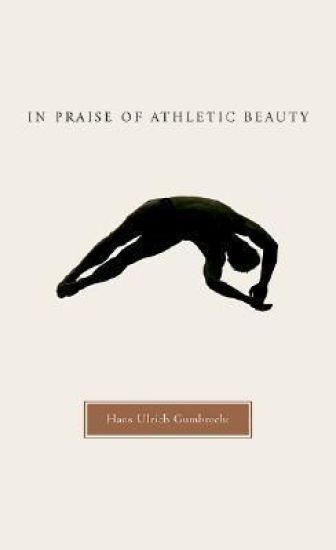
“A thought-provoking—and academically rigorous—defense of the grace and aesthetic worth of sports.” —Sports IllustratedBy the hundreds of millions we show up, stand in line, turn on, and tune in to watch, mesmerized, as athletes perform. And yet this experience, so widely craved and intensely felt, we commonly dismiss as “only a game.” A book that looks beyond the usual explanations of why sports fascinates, In Praise of Athletic Beauty also strives for a language that can frame—even enhance—the pleasure we take in watching athletic events. The vicarious thrill, anxiety release, competitive spirit: in place of these traditional answers to the mystery of sports’ allure, Hans Ulrich Gumbrecht proposes a more powerful and provocative alternative. The fascination with watching sports, he argues, is probably the most popular and potent contemporary form of aesthetic experience—in the classic, very literal sense of this concept. In exploring this idea, Gumbrecht develops a lucid reflection on the pleasures of sports spectatorship and the nature of athletic beauty. Where we might readily pronounce certain athletic moves and plays “beautiful,” this book gives us the means to explore, understand, and enjoy even more acutely the aesthetic experience that our words-in-passing barely suggest. With a new perspective on the appreciation of—and, indeed, a new tone of praising—sports, Gumbrecht also offers a new way of narrating the history of athletics and a fresh vocabulary for analyzing various sports. Exploring athletic beauty, this book makes us understand the widespread passion sport inspires as an untamed form of aesthetic fascination.
Production of Presence

Production of Presence

Hans Ulrich Gumbrecht

Stanford University Press
2003
sidottu
Production of Presence is a comprehensive version of the thinking of Hans Ulrich Gumbrecht, one of the most consistently original literary scholars writing today. It offers a personalized account of some of the central theoretical movements in literary studies and in the humanities over the past thirty years, together with an equally personal view of a possible future. Based on this assessment of the past and the future of literary studies and the humanities, the book develops the provocative thesis that, through their exclusive dedication to interpretation, i.e. to the reconstruction and attribution of meaning, the humanities have become incapable of addressing a dimension in all cultural phenomena that is as important as the dimension of meaning. Interpretation alone cannot do justice to the dimension of "presence," a dimension in which cultural phenomena and cultural events become tangible and have an impact on our senses and our bodies. Production of Presence is a passionate plea for a rethinking and a reshaping of the intellectual practice within the humanities.
Production of Presence

Production of Presence

Hans Ulrich Gumbrecht

Stanford University Press
2003
pokkari
Production of Presence is a comprehensive version of the thinking of Hans Ulrich Gumbrecht, one of the most consistently original literary scholars writing today. It offers a personalized account of some of the central theoretical movements in literary studies and in the humanities over the past thirty years, together with an equally personal view of a possible future. Based on this assessment of the past and the future of literary studies and the humanities, the book develops the provocative thesis that, through their exclusive dedication to interpretation, i.e. to the reconstruction and attribution of meaning, the humanities have become incapable of addressing a dimension in all cultural phenomena that is as important as the dimension of meaning. Interpretation alone cannot do justice to the dimension of "presence," a dimension in which cultural phenomena and cultural events become tangible and have an impact on our senses and our bodies. Production of Presence is a passionate plea for a rethinking and a reshaping of the intellectual practice within the humanities.
The Powers of Philology

The Powers of Philology

Hans Ulrich Gumbrecht

University of Illinois Press
2003
sidottu
Philology–-the discovery, editing, and presentation of historical texts–-was once a firmly established discipline that formed the core study for students across a wide range of linguistic and literary fields. Although philology departments are steadily disappearing from contemporary educational establishments, in this book Hans Ulrich Gumbrecht demonstrates that the problems, standards, and methods of philology remain as vital as ever. For two and a half millennia philologists have viewed themselves as the modest heirs and curators of their textual past's most glorious periods, collecting and editing text fragments, historicizing them and adding commentary, and ultimately teaching them to contemporary readers. Gumbrecht argues for a return to this tradition as an alternative to an often free-floating textual interpretation and to the more recent redefinition of literary studies as "cultural studies," which risks a loss of intellectual focus. Such a return to philological core exercises, however, can become more than yet another movement of academic nostalgia only if it takes into account the hidden desire that has inspired philology since its Hellenistic beginnings: the desire to make the past present again by embodying it.
In 1926

In 1926

Hans Ulrich Gumbrecht

Harvard University Press
1998
nidottu
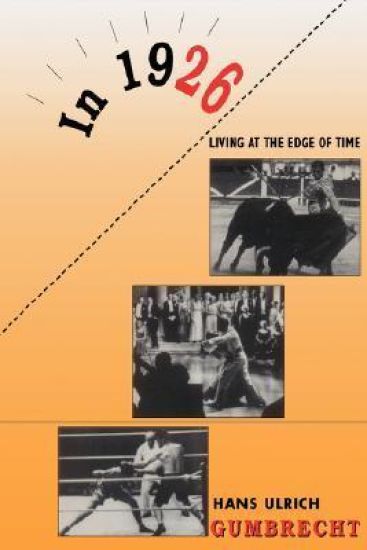
Travel back to the year 1926 and into the rush of experiences that made people feel they were living on the edge of time. Touch a world where speed seemed the very essence of life. It is a year for which we have no expectations. It was not 1066 or 1588 or 1945, yet it was the year A. A. Milne published Winnie-the-Pooh and Alfred Hitchcock released his first successful film, The Lodger. A set of modern masters was at work--Jorge Luis Borges, Babe Ruth, Leni Riefenstahl, Ernest Hemingway, Josephine Baker, Greta Garbo, Franz Kafka, Gertrude Stein, Martin Heidegger--while factory workers, secretaries, engineers, architects, and Argentine cattle-ranchers were performing their daily tasks. Hans Ulrich Gumbrecht opens up the space-time continuum by exploring the realities of the day such as bars, boxing, movie palaces, elevators, automobiles, airplanes, hair gel, bullfighting, film stardom, dance crazes, and the surprise reappearance of King Tut after a three-thousand-year absence. From the vantage points of Berlin, Buenos Aires, and New York, Gumbrecht ranges widely through the worlds of Spain, Italy, France, and Latin America. The reader is allowed multiple itineraries, following various routes from one topic to another and ultimately becoming immersed in the activities, entertainments, and thought patterns of the citizens of 1926. We learn what it is to be an "ugly American" in Paris by experiencing the first mass influx of American tourists into Europe. We visit assembly lines which turned men into machines. We relive a celebrated boxing match and see how Jack Dempsey was beaten yet walked away with the hearts of the fans. We hear the voice of Adolf Hitler condemning tight pants on young men. Gumbrecht conveys these fragments of history as a living network of new sensibilities, evoking in us the excitement of another era.
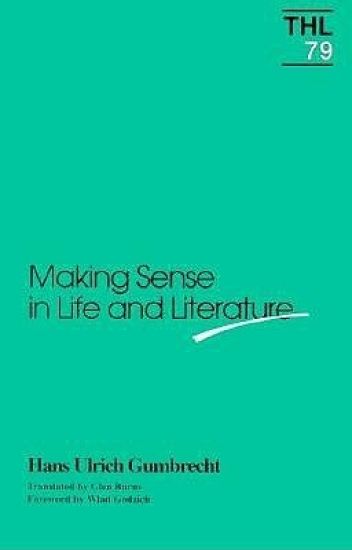
Making Sense in Life and Literature

Making Sense in Life and Literature

Hans Ulrich Gumbrecht

University of Minnesota Press
1992
nidottu
“The translation of these essays by Gumbrecht on literary theory and history marks the appearance in English of one of Europe’s most learned, productive, and inventive scholars. Their range is extraordinary. They show that Gumbrecht is not only a sophisticated theorist and historian of literature, but a master practitioner of cultural studies.” --Hayden White, University of California, Santa Cruz
Handbuch politisch-sozialer Grundbegriffe in Frankreich 1680-1820, Heft 3, Philosophe, Philosophie. Terreur, Terroriste, Terrorisme
Aus dem Inhalt Philosophe, Philosophie - Einleitung: "Philosophe" Grundbegriff der Aufklarung - Abestzung einer Interaktionsrolle von gesellschaftlichen Konventionen: Der "philosophe" als Stoiker und Misantrhop (etwa 1680 1730) - Konstitution des Subjekts der Aufklarung: Die Rolle des "philosophe" als Konvergenzpunkt von Reflexion und gesellschaftlichem Handeln (etwa 1730 1751) - Eroberung des Publikums: Der publizistische Kampf zwischen "philosophes" und "anti-philosophes" in der aufgeklarten Offentlichkeit (etwa 1751 1776) - Selbstapotheose der Jahrhunderts und vorrevolutionare Radikalisierung: Die "philosophie" als modische Lebensform und ihre Auffacherung (1776 1788) - Beschworung und Distanzierung der Vergangenheit: "Philosophie" und "philosophes" im revolutionaren Selbstverstandnis (1789 1799) Terreur, Terroriste, Terrorisme: - Aspekte des sozialen Wissens um "Angst uind Schrecken" im Ancien Regime - Entwicklung und Verbreitung des Terreur-Begriffs von 1779 bis zum 9. Thermidor des Jahres II - "Terreur" zur Kennzeichnung der Regierungspraxis vor dem 9. Thermidor - "Terreur" als Epochenbegriff - Der Terreur-Begriff in der innenpolitischen Auseinandersetzung nach Thermidor - "Terreur" als aussenpolitisches Mittel - Der Terreur-Begriff in der Wertung der Jakobinerdiktatur nach Thermidor"