Kirjojen hintavertailu – 12 903 725 kirjaa ja 27 kauppaa

Kirjailija

Harbin Miles Ruth

Kirjat ja teokset yhdessä paikassa: 8 kirjaa, julkaisuja vuosilta 2011–2019, suosituimpiin kuuluu Visible Thinking in the K–8 Mathematics Classroom. Vertaile teosten hintoja ja tarkista saatavuus suomalaisista kirjakaupoista.

8 kirjaa

Kirjojen julkaisuvuodet: 2011–2019.

Visible Thinking in the K–8 Mathematics Classroom

Visible Thinking in the K–8 Mathematics Classroom

Hull Ted H.; Balka Don S.; Harbin Miles Ruth

SAGE Publications Inc
2011
nidottu
Do you ever wish your students could read each other's thoughts? Now they can—and so can you! Veteran mathematics educators Ted Hull, Don Balka, and Ruth Miles explain why making students' thought processes visible is the key to effective mathematics instruction. Their newest book contains numerous grade-specific sample problems and instructional strategies for teaching essential concepts such as number sense, fractions, and estimation. Among the many benefits of visible thinking are: - Interactive student-to-student learning - Increased class participation - Development of metacognitive thinking and problem-solving skills. Helpful features include vignettes, relevant word problems, classroom scenarios, sample problems, lesson adaptations, and easy-to-follow examples of each strategy in action. The authors also explain how students can demonstrate their thinking using calculators and online tools. The final chapter outlines steps maths leaders can take to implement visible thinking and maximize mathematics comprehension for all students.
The Mathematics Lesson-Planning Handbook, Grades 3-5

The Mathematics Lesson-Planning Handbook, Grades 3-5

Harbin Miles Ruth; Beth McCord Kobett; Williams Lois A.

Corwin Press Inc
2019
kierre
YOU are the architect in the mathematics classroom. This daily reference offers practical guidance for when and how to pull together mathematics routines, resources, and effective teaching techniques into a coherent and manageable set of lesson plans. This resource will Lead teachers through a process of lesson planning based on various learning objectivesSet the stage for lesson planning using relatable vignettesOffer sample lesson plans for Grades 3–5Create opportunities to reflect on each component of a mathematics lessonSuggest next steps for building a unit from the lessonsProvide teachers the space and tools to create their own lesson plans going forward
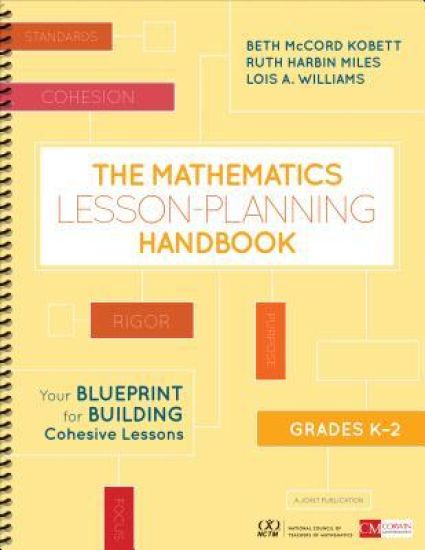
The Mathematics Lesson-Planning Handbook, Grades K-2

The Mathematics Lesson-Planning Handbook, Grades K-2

Beth McCord Kobett; Harbin Miles Ruth; Williams Lois A.

Corwin Press Inc
2018
kierre
Your blueprint to planning K-2 math lessons for maximum impact and understanding Not sure of tomorrow’s lesson plan? Your blueprint for designing K-2 math lessons for maximum student learning is here. This indispensable handbook guides you decision-by-decision through the planning of lessons that are purposeful, rigorous, and coherent. Clarify learning intentions and connect goals to success criteria. Distinguishing between conceptual understanding, procedural fluency, and transfer. Select the formats and tasks that facilitate questioning and encourage productive struggle. Includes a lesson-planning template and examples from Kindergarten, first, and second grade classrooms. Empower yourself to plan lessons strategically, teach with intention and confidence, and build an exceptional foundation in math for your students.
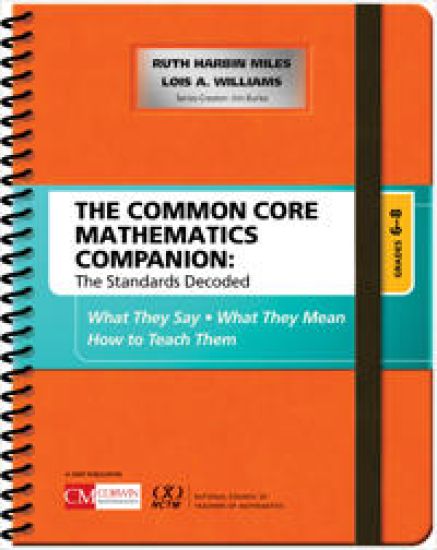
The Common Core Mathematics Companion: The Standards Decoded, Grades 6-8

The Common Core Mathematics Companion: The Standards Decoded, Grades 6-8

Harbin Miles Ruth; Williams Lois A.

Corwin Press Inc
2016
kierre
"The Common Core Mathematics Companion 6-8 offers a practical guide for implementing the CCSS Math Standards. Teachers will appreciate the misconception alerts and ideas for differentiation." — Jay McTighe, Author and Consultant When it comes to math, standards-aligned is achievement-aligned… In the short time since The Common Core Mathematics Companions, Grades K-2 and 3-5 burst on the scene, they have been lauded as the best resources for making critical math ideas easy to teach. With this brand-new 6-8 volume, middle school math success is at your fingertips. Page by page, the authors lay out the pieces to a cutting-edge curriculum, helping you to: Get the inside scoop on which standards connect, what key vocabulary means, and time-saving tables showing where to focus instruction for each grade Write curriculum for: ratios and proportional relationships, the number system, expressions and equations, functions, geometry, and statistics & probabilityUse the What to Teach pages to deliver powerful standards-based lessons Learn effective techniques to create an environment where all students can experience math break-throughsIncorporate the Standards for Mathematical Practice to improve students’ ability to problem solve, construct viable arguments, use tools strategically, attend to precision, and more The Common Core Mathematics Companion, Grades 6–8 has what every middle school needs to provide students with the foundation for the concepts and skills they will be expected to know in grade 9–12. Ruth Harbin Miles is a mathematics coach, with special expertise in developing teachers’ content knowledge and strategies for engaging students to achieve high mathematics standards. A serving member on the Board of Directors for the National Council of Teachers of Mathematics and the National Council of Supervisors of Mathematics, Ruth is a co-author with Linda Gojak of The Common Core Mathematics Companions, K–2 and 3–5 (Corwin). Lois Williams, Ed. D., who taught mathematics in grades K–8 for 20 years, is currently an adjunct professor at Mary Baldwin College and an International Fellow with the Charles A. Dana Center, training teachers in the College and Career Readiness Standards She has been honored with a Fulbright Teacher Exchange and the Virginia Middle School Mathematics Teacher of the Year award.
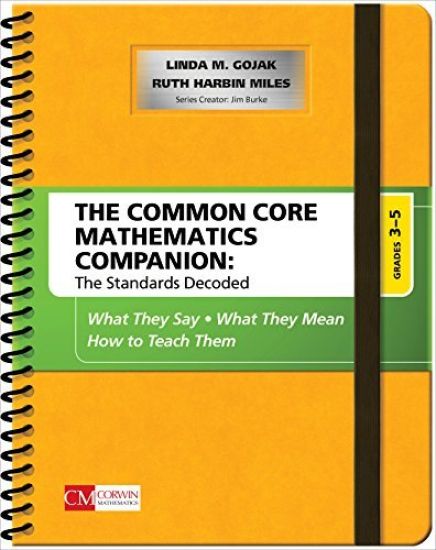
The Common Core Mathematics Companion: The Standards Decoded, Grades 3-5

The Common Core Mathematics Companion: The Standards Decoded, Grades 3-5

Gojak Linda M.; Harbin Miles Ruth

Corwin Press Inc
2015
kierre
Your user’s guide to the mathematics standards In the 12 short months since the ELA versions of The Common Core Companions, Grades K-2 and 3-5, burst on the scene, they’ve already assisted tens of thousands of teachers with the day-to-day "what you do." Teachers’ one big criticism: what about mathematics? Luckily NCTM past-president Linda Gojak and mathematics coach Ruth Harbin Miles stepped up to the task. The result? That version of the mathematics standards you wish you had. Page by page, The Common Core Mathematics Companions clearly lay out: The mathematics embedded in each standard for a deeper understanding of the contentExamples of what effective teaching and learning look like in the classroom Connected standards within each domain so teachers can better appreciate how they relatePriorities within clusters so teachers know where to focus their timeThe three components of rigor: conceptual understanding, procedural skills, and applicationsVocabulary and suggested materials for each grade-level band with explicit connections to the standardsCommon student misconceptions around key mathematical ideas with ways to address them Don’t spend another minute poring over the mathematics standards. Gojak and Miles have already done the heavy-lifting for you. Focus instead on how to teach them, using The Common Core Mathematics Companion as your one-stop guide for teaching, planning, assessing, collaborating, and designing powerful mathematics curriculum.
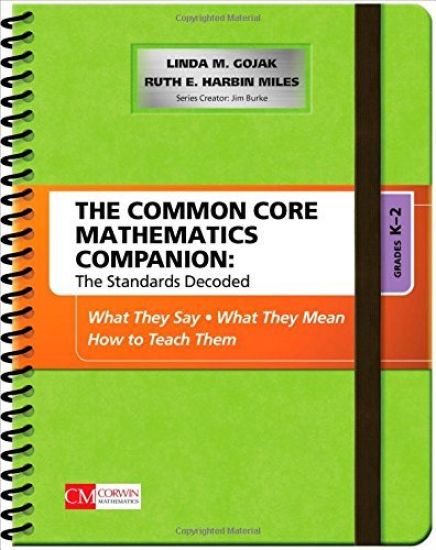
The Common Core Mathematics Companion: The Standards Decoded, Grades K-2

The Common Core Mathematics Companion: The Standards Decoded, Grades K-2

Gojak Linda M.; Harbin Miles Ruth

Corwin Press Inc
2015
kierre
Your user’s guide to the mathematics standards In the 12 short months since the ELA versions of The Common Core Companions, Grades K-2 and 3-5, burst on the scene, they’ve already assisted tens of thousands of teachers with the day-to-day "what you do." Teachers’ one big criticism: what about mathematics? Luckily NCTM past-president Linda Gojak and mathematics coach Ruth Harbin Miles stepped up to the task. The result? That version of the mathematics standards you wish you had. Page by page, The Common Core Mathematics Companions clearly lay out: The mathematics embedded in each standard for a deeper understanding of the content Examples of what effective teaching and learning look like in the classroom Connected standards within each domain so teachers can better appreciate how they relate Priorities within clusters so teachers know where to focus their time The three components of rigor: conceptual understanding, procedural skills, and applications Vocabulary and suggested materials for each grade-level band with explicit connections to the standards Common student misconceptions around key mathematical ideas with ways to address them Don’t spend another minute poring over the mathematics standards. Gojak and Miles have already done the heavy-lifting for you. Focus instead on how to teach them, using The Common Core Mathematics Companion as your one-stop guide for teaching, planning, assessing, collaborating, and designing powerful mathematics curriculum.
Realizing Rigor in the Mathematics Classroom

Realizing Rigor in the Mathematics Classroom

Hull Ted H.; Harbin Miles Ruth; Balka Don S.

Corwin Press Inc
2014
nidottu
Rigor: The Common Core has made it policy—and this first-of-its-kind guide takes math teachers and leaders through the process of making it reality. Using the Proficiency Matrix as a framework, the authors offer proven strategies and practical tools for successful implementation of the CCSS mathematical practices—with rigor as a central objective. Readers learn how to Define rigor in the context of each mathematical practice Identify and overcome potential issues, including differentiating instruction and using data Relate specific roles and goals for all stakeholders Use assessment tools to guide work and monitor progress Using the Proficiency Matrix framework along with practical assessment tools, math teachers and leaders will define and achieve rigor in the context of the CCSS mathematical practices.
The Common Core Mathematics Standards

The Common Core Mathematics Standards

Hull Ted H.; Harbin Miles Ruth; Balka Don S.

Corwin Press Inc
2012
nidottu
The Common Core State Standards for Mathematical Practice describe the mathematical ôhabits of mindö that teachers, at all levels, should develop in their students, and without which the content standards cannot be successfully implemented. Attention to the Mathematical Practices connected with content must be enacted in teaching, which will require professional development. Though the CCSS Mathematical Content Standards differ in detail from other content standards, their form is familiar to teachers: a list of things to know. The Mathematical Practices are not so easily condensed into a lesson or unit, not so easily tested and, generally, not so familiar. Content standards are specified grade by grade and build on each other rather than repeating year after year. The Mathematical Practices are different. Though they can be enacted in an appropriate way at any level, they evolve and mature over years rather than days, along with childrenÆs cognitive development and the nature and sophistication of the Mathematical Content. It can be expected that the developers of the CCSS, and the states that collaborated in calling for the development of the CCSS, will work with the developers of assessments to ensure that the Mathematical Practices are taken seriously in testing. Hull, Miles, and Balka wrote this book as professional development resource to help school and math leaders grapple with the changes that must be addressed and move their teachers toward implementation of CCSS-required practices.