Kirjojen hintavertailu – 12 859 819 kirjaa ja 27 kauppaa
Kirjailija
Hari M Srivastava
Kirjat ja teokset yhdessä paikassa: 7 kirjaa, julkaisuja vuosilta 1992–2025, suosituimpiin kuuluu Local Fractional Integral Transforms and Their Applications. Vertaile teosten hintoja ja tarkista saatavuus suomalaisista kirjakaupoista.
The subject of fractional calculus (that is, calculus of integrals and derivatives of any arbitrary real or complex order) has gained considerable popularity and importance during the past four decades, due mainly to its demonstrated applications in numerous seemingly diverse and widespread fields of science and engineering. It does indeed provide several potentially useful tools for solving differential, integral and differintegral equations, and various other problems involving special functions of mathematical physics as well as their extensions and generalizations in one and more variables. Many books and monographs (and conference proceedings) deal with the subject of fractional calculus and its applications. However, to the best of our knowledge, there does not exist an exclusive work that co-ordinates the disciplines of fractional calculus and special functions in a potentially useful manner. This book is an attempt in that direction and would serve a dual purpose: in providing key formulas and identities involving special functions and also in opening up some novel avenues of applications of fractional calculus.
Local Fractional Integral Transforms and Their Applications provides information on how local fractional calculus has been successfully applied to describe the numerous widespread real-world phenomena in the fields of physical sciences and engineering sciences that involve non-differentiable behaviors. The methods of integral transforms via local fractional calculus have been used to solve various local fractional ordinary and local fractional partial differential equations and also to figure out the presence of the fractal phenomenon. The book presents the basics of the local fractional derivative operators and investigates some new results in the area of local integral transforms.
This book presents an introduction to the key topics in Real Analysis and makes the subject easily understood by the learners. The book is primarily useful for students of mathematics and engineering studying the subject of Real Analysis. It includes many examples and exercises at the end of chapters. This book is very authentic for students, instructors, as well as those doing research in areas demanding a basic knowledge of Real Analysis. It describes several useful topics in Real Analysis such as sets and functions, completeness, ordered field, neighborhoods, limit points of a set, open sets, closed sets, countable and uncountable sets, sequences of real numbers, limit, continuity and differentiability of real functions, uniform continuity, point-wise and uniform convergence of sequences and series of real functions, Riemann integration, improper integrals and metric spaces.
In recent years there has been an increasing interest in problems involving closed form evaluations of (and representations of the Riemann Zeta function at positive integer arguments as) various families of series associated with the Riemann Zeta function ((s), the Hurwitz Zeta function ((s,a), and their such extensions and generalizations as (for example) Lerch's transcendent (or the Hurwitz-Lerch Zeta function) iI>(z, s, a). Some of these developments have apparently stemmed from an over two-century-old theorem of Christian Goldbach (1690-1764), which was stated in a letter dated 1729 from Goldbach to Daniel Bernoulli (1700-1782), from recent rediscoveries of a fairly rapidly convergent series representation for ((3), which is actually contained in a 1772 paper by Leonhard Euler (1707-1783), and from another known series representation for ((3), which was used by Roger Apery (1916-1994) in 1978 in his celebrated proof of the irrationality of ((3). This book is motivated essentially by the fact that the theories and applications of the various methods and techniques used in dealing with many different families of series associated with the Riemann Zeta function and its aforementioned relatives are to be found so far only"in widely scattered journal articles. Thus our systematic (and unified) presentation of these results on the evaluation and representation of the Zeta and related functions is expected to fill a conspicuous gap in the existing books dealing exclusively with these Zeta functions.
One service mathematics has rendered the 'Et moi ...* si favait su comment en revenir, je human race. It has put common sense back n'y serais point a1l6.' lules Verne where it belongs, on the topmost shelf next to the dusty eanister labelled 'discarded nonsense' . Erie T. Bell The series is divergent; therefore we may be able to do something with it O. Heaviside Mathematics is a tool for thought. A highly necessary tool in a world where both feedback and nonlineari- ties abound. Similarly, all kinds of parts of mathematics serve as tools for other parts and for other sci- ences. Applying a simple rewriting rule to the quote on the right above one finds such statements as: 'One ser- vice topology has rendered mathematical physics ...'; 'One service logic has rendered computer science ...'; 'One service category theory has rendered mathematics ...'. All arguably true. And all statements obtainable this way form part of the raison d'etre of this series. This series, Mathematics and Its Applications, started in 1977. Now that over one hundred volumes have appeared it seems opportune to reexamine its scope. At the time I wrote "Growing specia1ization and diversification have brought a host of monographs and textbooks on increasingly specialized topics. However, the 'tree' of knowledge of mathematics and It also happens, quite often in related fields does not grow only by putting forth new branches.
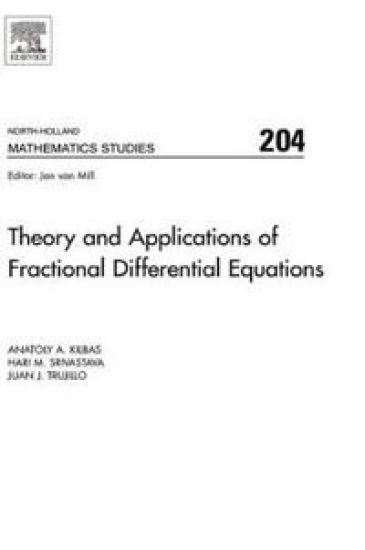
This monograph provides the most recent and up-to-date developments on fractional differential and fractional integro-differential equations involving many different potentially useful operators of fractional calculus. The subject of fractional calculus and its applications (that is, calculus of integrals and derivatives of any arbitrary real or complex order) has gained considerable popularity and importance during the past three decades or so, due mainly to its demonstrated applications in numerous seemingly diverse and widespread fields of science and engineering. Some of the areas of present-day applications of fractional models include Fluid Flow, Solute Transport or Dynamical Processes in Self-Similar and Porous Structures, Diffusive Transport akin to Diffusion, Material Viscoelastic Theory, Electromagnetic Theory, Dynamics of Earthquakes, Control Theory of Dynamical Systems, Optics and Signal Processing, Bio-Sciences, Economics, Geology, Astrophysics, Probability and Statistics, Chemical Physics, and so on. In the above-mentioned areas, there are phenomena with estrange kinetics which have a microscopic complex behaviour, and their macroscopic dynamics can not be characterized by classical derivative models. The fractional modelling is an emergent tool which use fractional differential equations including derivatives of fractional order, that is, we can speak about a derivative of order 1/3, or square root of 2, and so on. Some of such fractional models can have solutions which are non-differentiable but continuous functions, such as Weierstrass type functions. Such kinds of properties are, obviously, impossible for the ordinary models. What are the useful properties of these fractional operators which help in the modelling of so many anomalous processes? From the point of view of the authors and from known experimental results, most of the processes associated with complex systems have non-local dynamics involving long-memory in time, and the fractional integral and fractional derivative operators do have some of those characteristics. This book is written primarily for the graduate students and researchers in many different disciplines in the mathematical, physical, engineering and so many others sciences, who are interested not only in learning about the various mathematical tools and techniques used in the theory and widespread applications of fractional differential equations, but also in further investigations which emerge naturally from (or which are motivated substantially by) the physical situations modelled mathematically in the book. This monograph consists of a total of eight chapters and a very extensive bibliography. The main objective of it is to complement the contents of the other books dedicated to the study and the applications of fractional differential equations. The aim of the book is to present, in a systematic manner, results including the existence and uniqueness of solutions for the Cauchy type problems involving nonlinear ordinary fractional differential equations, explicit solutions of linear differential equations and of the corresponding initial-value problems through different methods, closed-form solutions of ordinary and partial differential equations, and a theory of the so-called sequential linear fractional differential equations including a generalization of the classical Frobenius method, and also to include an interesting set of applications of the developed theory. Key features:- It is mainly application oriented.- It contains a complete theory of Fractional Differential Equations.- It can be used as a postgraduate-level textbook in many different disciplines within science and engineering.- It contains an up-to-date bibliography.- It provides problems and directions for further investigations.- Fractional Modelling is an emergent tool with demonstrated applications in numerous seemingly diverse and widespread fields of science and engineering.- It contains many examples.- and so on!
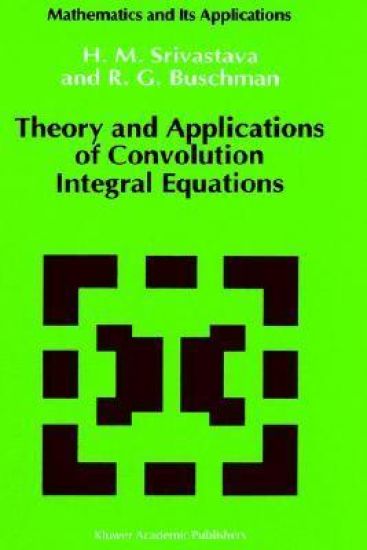
A state-of-the-art account of the theory and applications of integral equations of convolution type, and of certain classes of integro-differential and non-linear integral equations. A discussion of some open questions and of various important directions for further research is also presented.